
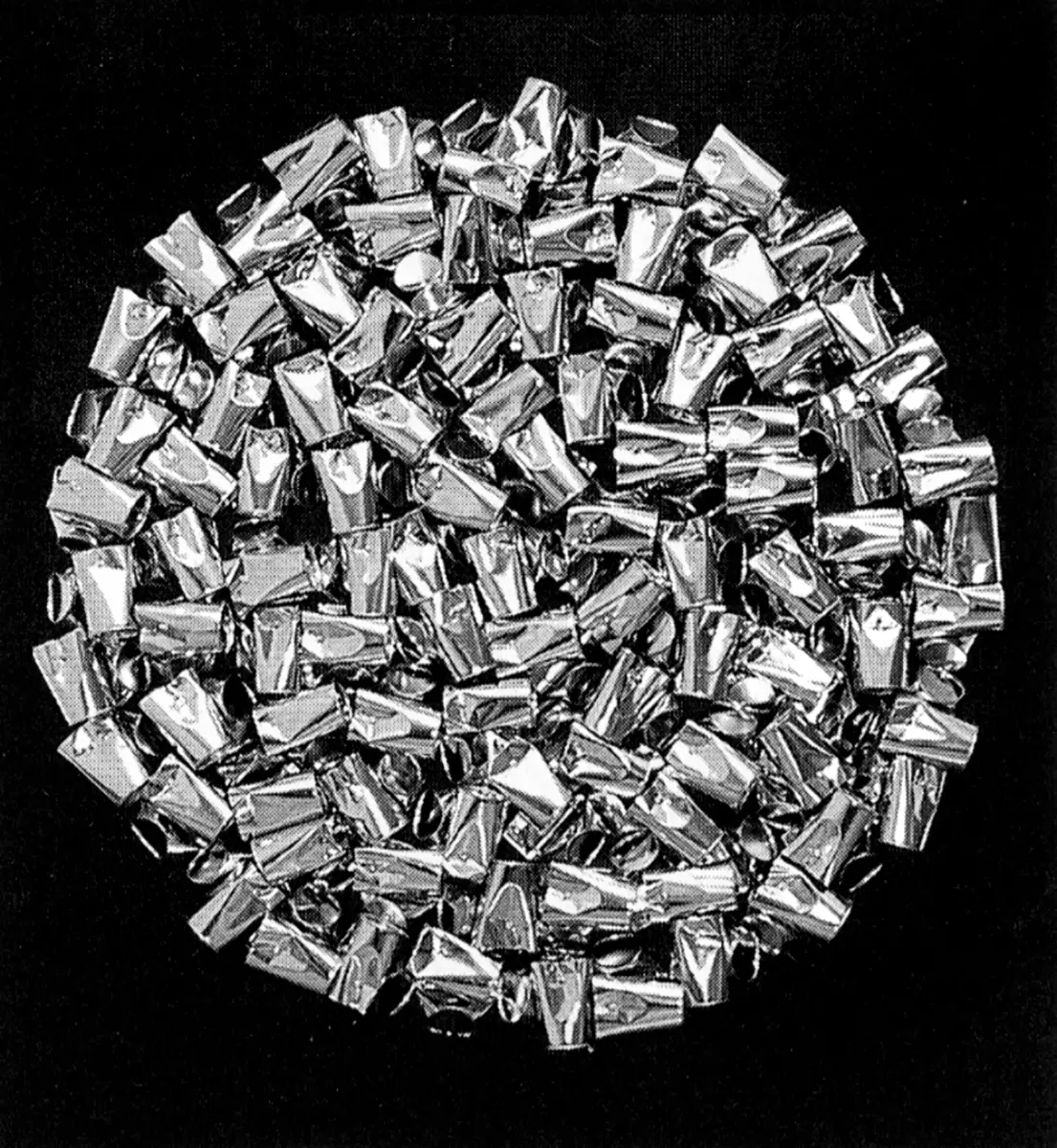
How many tin cans were there in this show? This might be a pertinent question for some people because things have value in relation to what they are or what we do with them. And what we do with them also concerns the creativity of the artist, who is free to use whatever comes to hand to express himself.
Alfredo Eguiguren loves matter: he seeks it out, plays with it, fights with it, scolds it, claims it, delights in it.. and of course, transforms it into art. Matter is for him a “big word” with a philosophical connotation. It is the substance of all that exists. Thus a piece of wood, a rubber hose, pieces of textile material, and wire mesh aluminum discs are all used to give form to his artistic proposals.
But his process is not to use things to invent his works, but the reverse: he conceives the work and on the basis of his idea, he seeks out the materials he needs, just as the poet searches for words. However, something he may find by chance may modify his idea and have an influence on the work in process.
In the case of this exhibition, for example, it is clear that he sought out a space and thought about a work for that space. Because the entire show was a large work whose fragments had their own life and autonomy.
And the cans, with which Eguiguren had begun to work in New York, where he lives, were now used to create a plastic discourse, which he called the Chromatic Dimensions of Matter.
And indeed, it is color the application of which recalls Pollock’s use of dripping, which really determined the forms in this show.
This was the function of the display of color the delicate balance of which is more the result of the creator’s intuition than the academic knowledge of the artist.
But there was also the use of black the absence of color and the absence of painting. Like a wise dissonant voice in the whole, or an attempt to take advantage of the effects of light on the almost metallic orography of the pictures. In any event, each stain and each color void, as well as each relief, had its own purpose. There is nothing gratuitous in Eguiguren’s work.
With regard to assemblage, which is the technique used by the artist as a means of adding pictorial and pre-fabricated elements to the support, the process not only exploits the third dimension but contributes with its own range of multiple meanings, beyond the level of pure visual enjoyment.
The result, in terms of art, is a response to an aesthetic. And this time, it was an aesthetic related to a geometry-based, without exception, on the figure of the circle, the symbol of the infinite in some cultures.
Finally, if I may insist again on the materials, we cannot really speak in Eguiguren’s case of just the “material”, which is only a process, but rather an attitude of understanding with regard to the matter itself.
RODRIGO VILLACÍS MOLINA