Two recent publications and a forthcoming book explore significant aspects of the work of the Cuban artist AIfredo Sosabravo. Pieces from his recent production, including paintings, works on paper, and glass sculptures, will be presented at the La Acacia Gallery in Havana in October 2000 in order to commemorate the artist’s seventieth birthday including paintings, works on paper, and glass sculptures.
Recently, the Letras Cubanas publishing house of the Cuban Book Institute published a volume entitled Sosabravo, focusing on the work of this artist whose versatility, rigor, and achievements have earned him an outstanding position in the world of contemporary art. A catalog was also published on the occasion of his exhibition entitled Afredo Sosabravo, National Plastic Arts Prize, which was presented at the Wifredo Lam Center of Contemporary Art in February 1999.
In addition, another book is also being prepared that addresses various aspects of the artist’s productive life and work. It is due to appear in the second half of 2000.
Those who are not very familiar with the career of this Cuban artist might wonder why so many publications on his work are appearing around the same time. This is due in part to the fact that the artist was awarded the National Prize for the Plastic Arts in the Republic of Cuba in 1997, but above all, to his mature and fully developed work and his personality as reflected in a number of disciplines in which Sosabravo has explored undeniable meanings. There are not many artists who have expressed themselves, over a period of more than four decades, and with such quality, in painting, drawing, print-making, and ceramic art as Sosabravo, who continues to be active and make a significant contribution.
For example, in October and November of this year, he will be presenting a one-man show at the La Acacia Gallery in Havana, which in addition to paintings and drawings, will include glass sculptures done with the celebrated Italian glass manufacturer Ars Murano. Such a combination of works is not unusual in the case of this artist, whose curriculum includes exhibitions that have reflected his enormous versatility. Mention can be made here of two exhibitions at the Havana Gallery: one of oils and ceramic pieces in 1967 and another in 1978, consisting of ceramic works, lithographs, drawings, and collages. In 1990, there was a major retrospective entitled Nature, Man, Machine at the National Museum of Fine Arts.
The title of this show, which was the largest devoted to the work of Alfredo Sosabravo to date, reflects the range of his themes which, along with his versatility, clearly illustrate his own inclinations and preferences, as well as his solid mastery of various techniques acquired outside the conventional academic training he never received. Apart from the courses he followed at the School attached to the Academy of Fine Arts in San Alejandro, Sosabravo is essentially a self-taught artist.
Those who visit his show at the La Acacia Gallery will find the results of his craft, perfected over time and fine-tuned through self-criticism, although the exhibition will in no way attempt to be a retrospective. On the contrary, it is a summary of his new work, although firmly based on experiences resulting from his decision in 1992 to return to painting, after two decades of work with ceramic art and the exploration of drawing, print-making, and collage. Sosabravo, who began his career in painting, discovered in the volumes provided by ceramic work a vein which he exploited thoroughly, and which he transformed into a particularly meaningful and influential art form. Since then, he has returned to his first field of exploration, but now benefiting from the experience acquired in other disciplines, which he will not however definitively abandon. This experience has allowed him to avoid any redundancies: after a few paintings that marked his return to the medium, he once again abandoned the more or less textual references of those very successful oil works from 1967, when he placed real stitches on the surface of the works and attached fragments of fabric or paper to emphasize the connection with art brut. The compositions were planimetric and did not deny their relationship with the freshness of pop art: they retained the irony of his allusions to life and behavior although the artist gradually abandoned this kind of original innocence in preference to more acerbic observations.
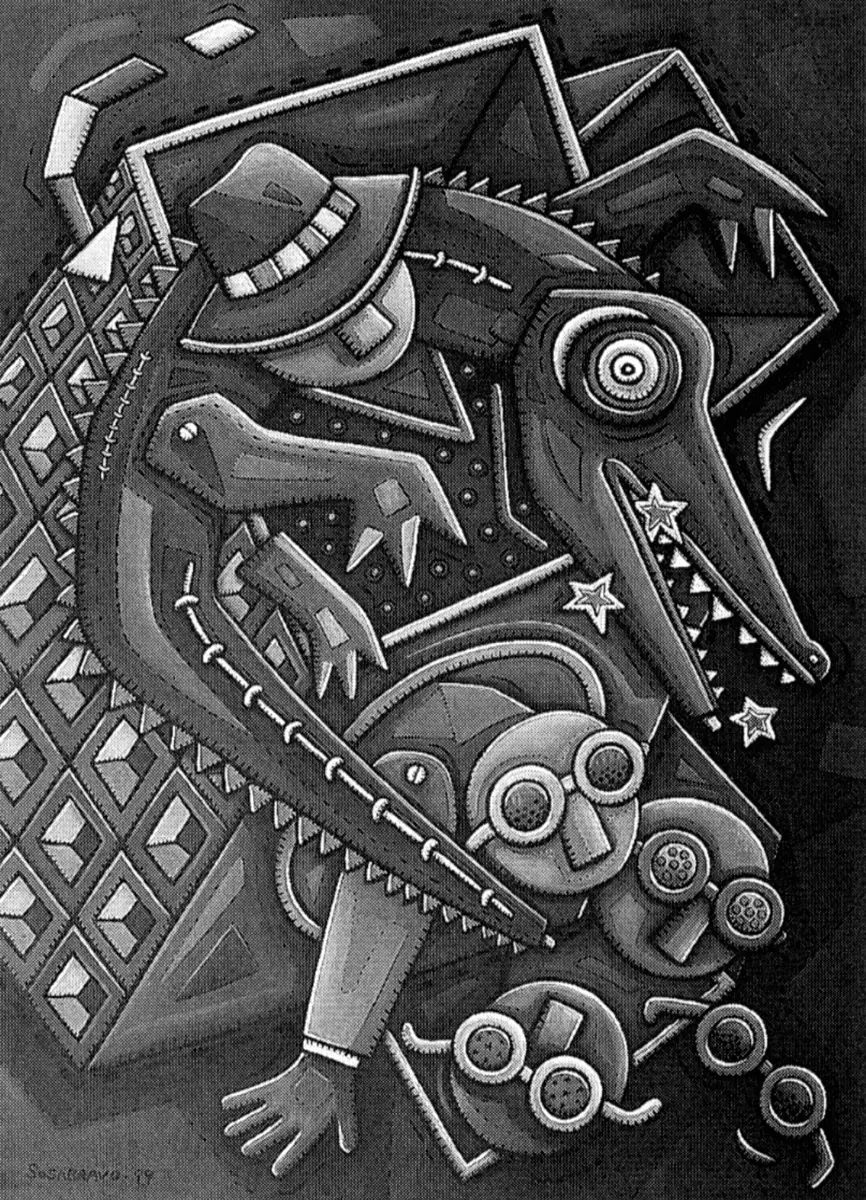
In his current work, Sosabravo composes his work from a perspective that oscillates between the primitive and the intellectual, and in which he gradually acquires a sense of volume. He therefore creates within the context of a space that is contained in itself, with constant elements from other creative phases of his work, such as the use of texts and themes from popular art. But the atmosphere has changed, particularly in his use of aggressive elements (scissors, knives, and other sharp utensils). Suspicious-looking birds and persons appear in the corners, spying on the movement unfolding around them, like critical observers. The oniric and metaphysical elements, in this context of surrealist connotations, materialize through the combination of different features that are the catalysts of Sosabravo’s artistic experience. His current language creates a climate of mysterious omens, inhabited by beings who seem to be a kind of multiple and negative alter ego of the artist. Art, we should remember has a lot of ambiguity, as we can see from these attempts to capture an ever-elusive truth.
Sosabravo’s collaboration with international workshops has enabled this restless artist to achieve variations within the same discourse, as can be seen from the collagraphies printed by the Recoba Studio (Ayuntamiento de Santa Cruz de Tenerife), in November 1994, and which resulted in the creation of unusual textures. Similar subtlety was achieved in the lithographies, or rather mixed media works, which were printed by the Kyron Studio in Mexico City during a brief period of work in 1993. The workshop atmosphere clearly stimulates the artisanal skills of Sosabravo, complementing his intellectual capacities and the combination of disciplines that he himself has cultivated. The result is an all-embracing, rich, and festive imagery, like a fair in a constant state of ebullience.
Alfredo Sosabravo continues to be the same, although he is changing. He is not held back by any contradiction: the first truth is rooted in his status as an artist sui generis, and the second perhaps is the result of so many turbulent events - such as the natural disasters caused by the indiscriminate growth of industry. We dream about birds that become a public threat, according to Hitchcock; we have witnessed the collapse of the socialist camp in Europe and the rise of neo-liberal policies based on a “save yourself if you can” philosophy; we are witnesses to the bitter aesthetics and disenchantment with contemporary life that Almodovar has explored in his films. And reports continue to arrive of international clashes and senseless violence (ranging from individual assaults to mass-scale disasters).
Given the already historical range of interests of this artist, we should not be surprised that in his recent painting, the figures and characters have acquired a bodily presence as a result of his collaboration with the glass-maker Elio Raffaeli of Ars Murano. This is the result of a broadened perspective that includes the traditional handling of this material, the accumulation of experience, and the concerns of the artist, who has discovered new means of expression that remain unaffected by so much of the aberration associated with the postmodern condition. The transparency of the material and the specific discourse that volume (like ceramic production earlier in his career) offers him enable Sosabravo to develop a repertoire that is ideally suited to his characteristics as an artist. While chance, demand, or established relations have resulted in his association with a specific discipline, we should not have any doubts that he is at an important stage in his work, in an adventure which already opening up new avenues of exploration for the future and which will complement those he has followed to date. Interdisciplinary links and the transfer of themes and motifs from painting to the volumes of glass will guarantee the continuing success and continuity of this work, which began under such auspicious circumstances.
ALEJANDRO G. ALONSO