Argentine sculptor Carolina Sardi explores the phenomena that influence, expose, or reinforce issues of gender transculturation, and identity. Using a simple and direct vocabulary of linear symbols made of metal, she weaves a complex web of sociological, biological, mythological, and historical truths that reveal themselves as a unique and personal language of signs that addresses issues pertinent to women in society throughout history. Each object performs as a glyph, transformed for modern interpretation. For this installation in the Museum of Art in Fort Lauderdale, the space is as important as the shapes, and the concept is as important as the image. The large stark white wall becomes the background for a sequence of black metal signs, like a book page waiting to be read, or a billboard luring a viewer to its message. The signs draw you in, inviting a close interpretation of each element, but the wall demands you move away in order to comprehend the entire sequence and decipher its meaning. What may appear simple at first is far from elementary in concept and is based on numerous symbolic references complicated by multiple levels of interpretation.
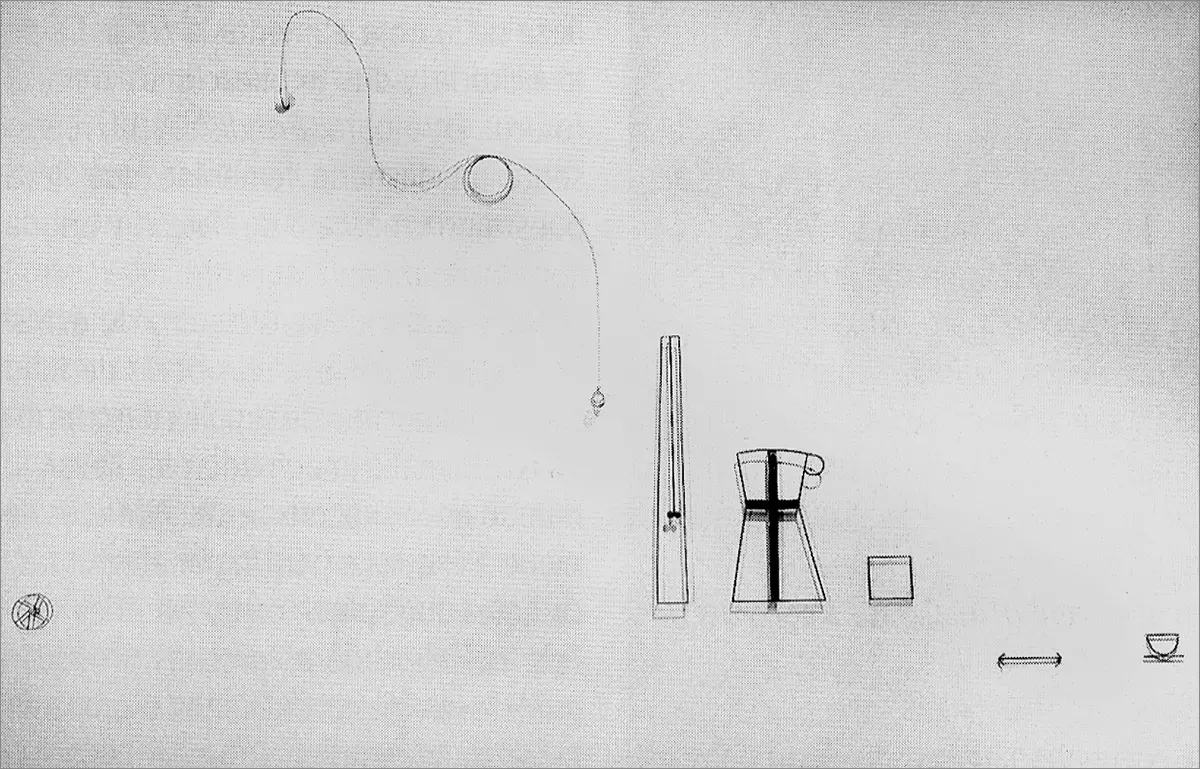
Sardi’s sources derive from personal experiences growing up in Argentina and from her own feminine mind. Often complex ideas are expressed in a minimal aesthetic based on abstract forms, lines, selective arrangements, and the positive and negative spaces that create an interaction and interrelationship artistically and conceptually. Each symbol or component performs as a word, and each grouping is a sentence. The complete “story” or “myth” is exposed only after decoding the symbols on an individual and collective basis.
For example, what may at first appear as a childlike language of shapes resembling coffee cups, houses, geometric forms, arrows, crosses, and circles takes on new meaning when arranged as letters in a sentence or repeated in numerous variations. Each symbol has the ability to stand alone and invite personal interpretation and response or signify one idea. When grouped together they reveal new meanings and levels of interpretation. For Sardi, the wall was an invitation to feminine and personal discourse, as well as the opportunity to explore a repertoire of signs as evidence of her own experience.
The long wall of the museum is organized into four parts, each section like the page of a book, although order is not significant to its reading. Beginning with three hanging metal cages that set the tone for the message of Freedom/Captivity that pervades the installation and needs no explanation, the metal objects involve numerous insights and symbolic statements regarding women. The most provocative arrangement of steel contours and outlines addresses how women are described in history and mythology, the expectations of society regarding women’s roles, and the biological functions that distinguish the feminine body.
The mythology derived from the ivory tower idea is presented as a lovely flower its four petals floating upwards. Called The Secret this pretty design is also recognizable as the formation of four vagina-like shapes celebrating women’s biological identity, as does the simple triangle/circle figure that is an elementary notation of a mother and child, the mother wearing a scarf-like woman from southern Europe who are often trapped in their domestic roles. From coffee pots and cups to a silhouette comprised of a ruler and a hanger that comments on image, to a series of frames that may be interpreted as confining or liberating, each object is presented as a glyph or a unique element of a universal story. This is not only Caroline Sardi’s story, it is every woman’s story.
CAROL DAMIAN