
This exhibition by David Palacios at the Sala Mendoza was part of a broader inquiry into the methods of articulating artistic discourse in the contemporary world. To this end, it proposed an inverse journey from the work to its component elements, from totality to the fragment. This process began in 1988 with a show titled Reserved Waster Material held in the artist’s own house. On that occasion, he presented a series of objects and drawings from unfinished projects, in which he used the methods of museological labeling and cataloging. This strategy acquired a more public dimension in Pirelli Spare Parts (1999), consisting of printed material for the IVth Pirelli Salon of Young Creators, which reproduced some of the fragments of the installations on show. As in the previous proposal, the artist used identification and codification mechanisms, but this time based on the visual rhetoric of commercial publications.
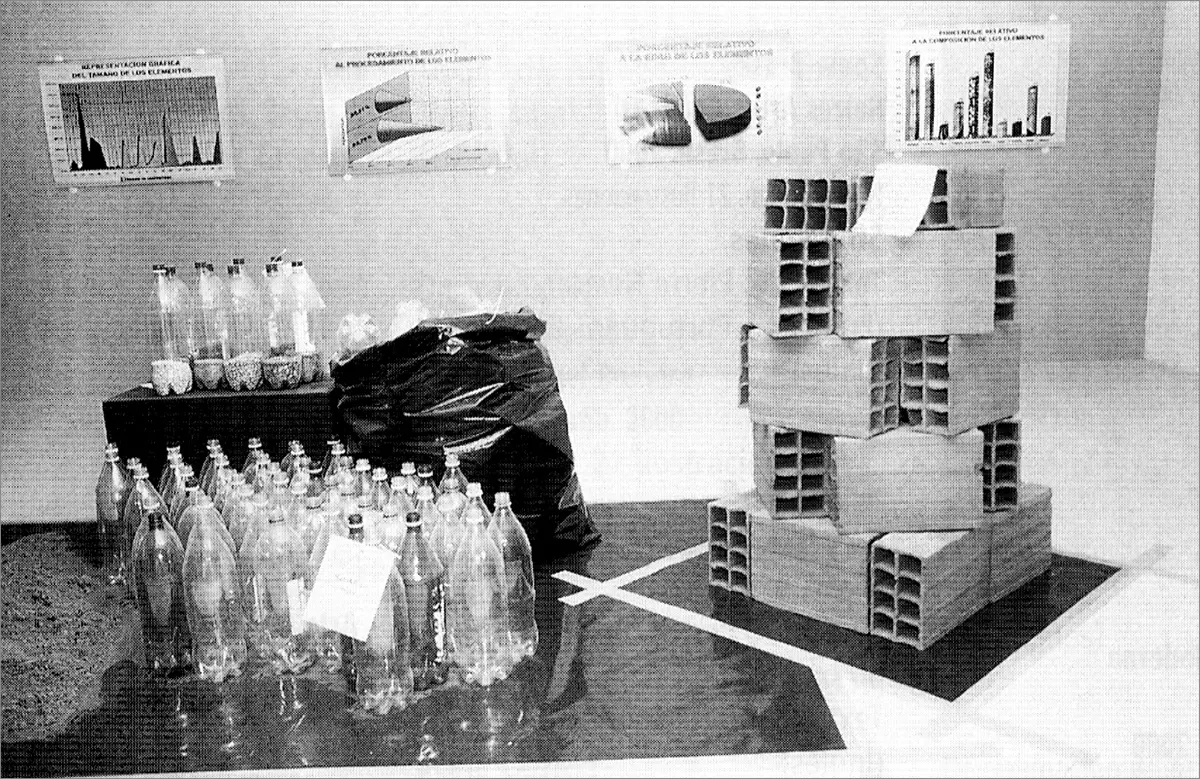
Percentage Art takes this “classification neurosis” to the extremes of a statistical analysis which quantifies even the most banal aspects of the work, such as the weight, color, origin of materials, or size. The proposal consisted of 8 printed didactic graphs, a series of duly labeled objects, and a video. However, all these elements pointed towards a non-existent work entitled Naturaleza muerta/ The End., the potential character of which was suggested or evoked in the parts on show. Only the manual catalog accompanying the exhibition left any record of the total configuration of the piece.
Palacios’ work does not try to infiltrate strange objects into the field of art but attempts to strip them of any metaphorical reference. Thus each thing—a brick, a fork, or an umbrella—is listed and transformed into data. Subject to the strictest statistical expression, the work is reduced to the sum of its physical properties. This is a process, which begins with the “deauratization” of creative work and concludes with the “re-naturalization” of the objects. Without any “aura” and without any symbolic pretensions, art is as naked as the legendary king.
Paradoxically, this effort to “see things as they are”, rather than in terms of their artistic meaning, is based on the use of a system of representation that also falsifies the nature of the “real.” Although univocal, the formalized language of the statistical graphs is an abstraction that also fails to give an explicit account of the attributes of the things. Percentage Art thus presents us with an unsolvable but ingenious equation that can also be approached with humor.
In conclusion, this project by David Palacios takes us back to the rules governing the functioning of the institutional field of art as a space of beliefs. The skill of this artist is not limited to the careful handling of his materials or forms but also includes the way he incorporates elements from the museographic and curatorial discourse into the creative process. In his work with these elements—panels, glass cases, labels, and graphs—he attempts to reveal the meanings that remain hidden or have been silenced, behind the expositional rhetoric.
FÉLIX SUAZO