
This exhibition of work by Edgard de Souza at the Jack Shainman Gallery could easily have been forgotten or gone unnoticed by any of the passersby in Chelsea who were looking for the strong sensation and pleasure produced by a new discovery, the sudden, unusual, and overwhelming emotion that we continue to demand of contemporary art.
But there was something irrational that made the spectator return to the gallery and see the show again. And in this second visit, the show could be seen for the first time. The person returning revisits the place like a criminal, reliving the event through the traces left behind. The impossible traces of the most everyday act. The magnified remains of repeated ejaculation, the blurred images of the same nude. The elaborate sculptures of Edgard de Souzad (São Paulo, 1962) are generated in the “body of pleasure”, as Antonio Godino Cabes has called that physical space where the body disappears or becomes diluted in order to emphasize the traces of pleasure that Souza insists on showing in their most ephemeral and elusive existence by freezing the movements and gestures of desire.
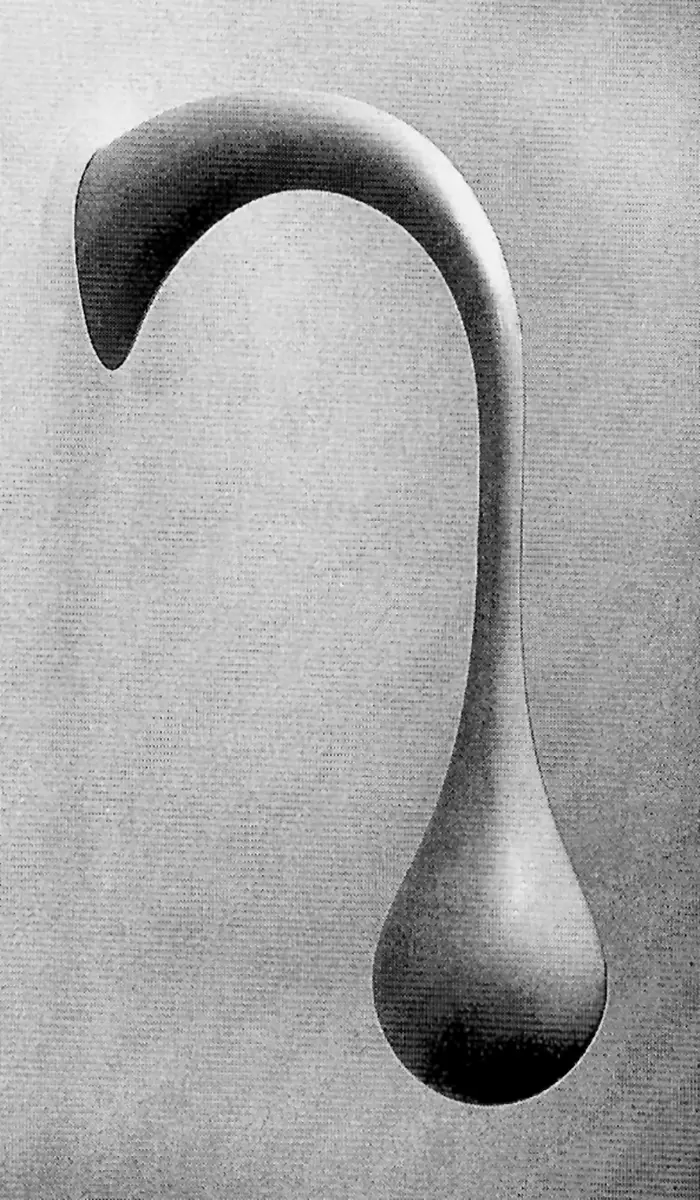
At the artist’s first one-man show in New York, five sculptures made of polished wood and covered in pearled lacquer shared the space with two modular pure white lacquered compositions, as well as four unfocused photographs of a naked body facing itself. As a counterpoint, there was a single black sculpture in which the same body was enclosed with its double in a gesture of crossed references: Alice getting into the mirror, Narcissus in the fatal act of contemplating himself, and Chronos devouring himself.
We have to return to this well-known territory created by the physical and fantastic traces of the erotic body, the body of the crime, in order to understand it and to feel like an accomplice. The sperm is captured and frozen at the moment of ejaculation and obsessively magnified by the guilty eye or the greedy lens of the detective. Pearled sculptures are scattered around the space of the gallery at random, like the drops of ejaculated semen —but also speculatively, like the photographic enlargements of an insignificant detail in detective films. These are guilty traces and irrefutable pieces of evidence. Sculptures bent on capturing in photographic terms the impossible moment of the semen as it falls. Instants make up the insignificant consequence of a transcendental event. This transcendental event is developed in the impossible fiction of the photographs. The naked body is in the exact perfection of its double, playing with it, fighting against it. Narcissus, victorious at last, enjoys himself through the deceitful process of the photographic image. And perhaps like one step in this ingenuous fiction of successful self-eroticism, the white sculptures, like generative cells in the first reproduction lesson, two cells introducing themselves into one another, opposite a composition of cells on the point of managing to form something like a body. And at the end, a shadow, a black sculpture of two curved bodies forming an arch with their shoulders, their heads swallowed up by the other body, by the double, a body devouring itself, disappearing through its own reflection, announcing perhaps a void, perhaps the threat of future non-existence.
Impossibility, transcendence, fantasies, fears, and myths emerge from the strictly formalistic work of this young sculptor who works on the fine edge separating formal perfection and sensual evocation of—a certain wager, perhaps, of the coexistence of the two worlds.
LIDIA BLANCO