
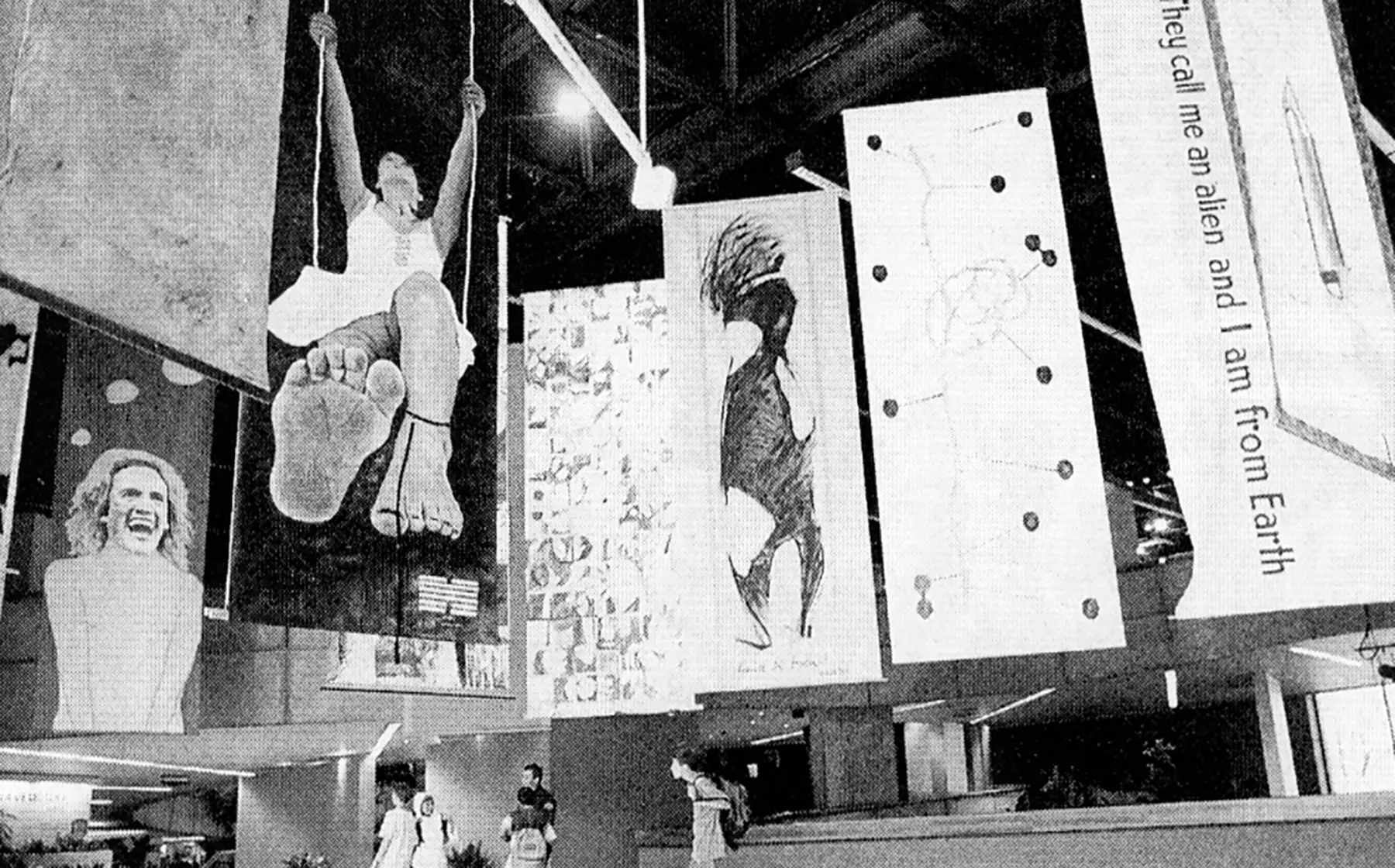
At the end of March, the fourth edition of the International Salon of Banners E52000 was inaugurated in Tijuana, Baja California. From this edition on, the event will be held every two years, instead of everyone, as has been the case to date. Tijuana, a border city, offers an unusual and receptive style of life, whose artistic events also include the internationally known INSITE. Both this event and the salon of banners have made Tijuana one of the important poles of attraction for creators, especially from Los Angeles and Sao Diego. The director and curator of E52000, Martha Palau, chose the headquarters of the Tijuana Cultural Center (CECUT) to house the event. Its installations were able to present the banners—measuring 5 meters high and 1.80 meters wide —without any problem.
This year 35 banners were presented by artists from Argentina, Brazil, Colombia, Costa Rica, Cuba, Chile, Dominican Republic, Ecuador, Germany, Mexico, Paraguay, the United States, and Venezuela. The first prize was worth 100,000 Mexican pesos, and the second prize was 50,000 Mexican pesos (10,000 US dollars and 5,000 US dollars respectively). Two mentions were also awarded by the jury, which this year was made up of Gerardo Mosquera, from Cuba, Silvia Pandolfi, from Mexico, and Álvaro Medina, from Colombia.
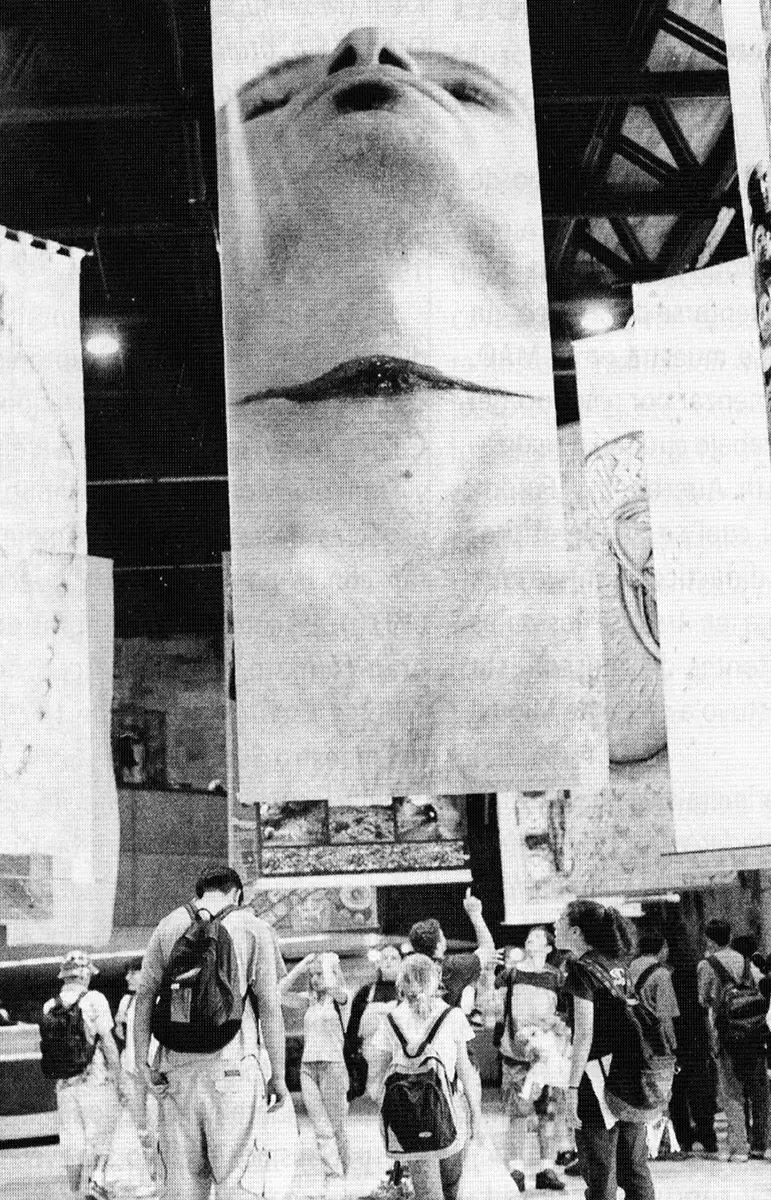
The first prize went to the visual artist and activist Daniel Joseph Martínez, who lives in Los Angeles, and who presented a work entitled Self Portrait: Attempt No. 3 to clone mental disorder, an impressive piece based on electrostatic printing, which showed a foreshortened photograph of a man (the artist himself), with an open wound in his neck.
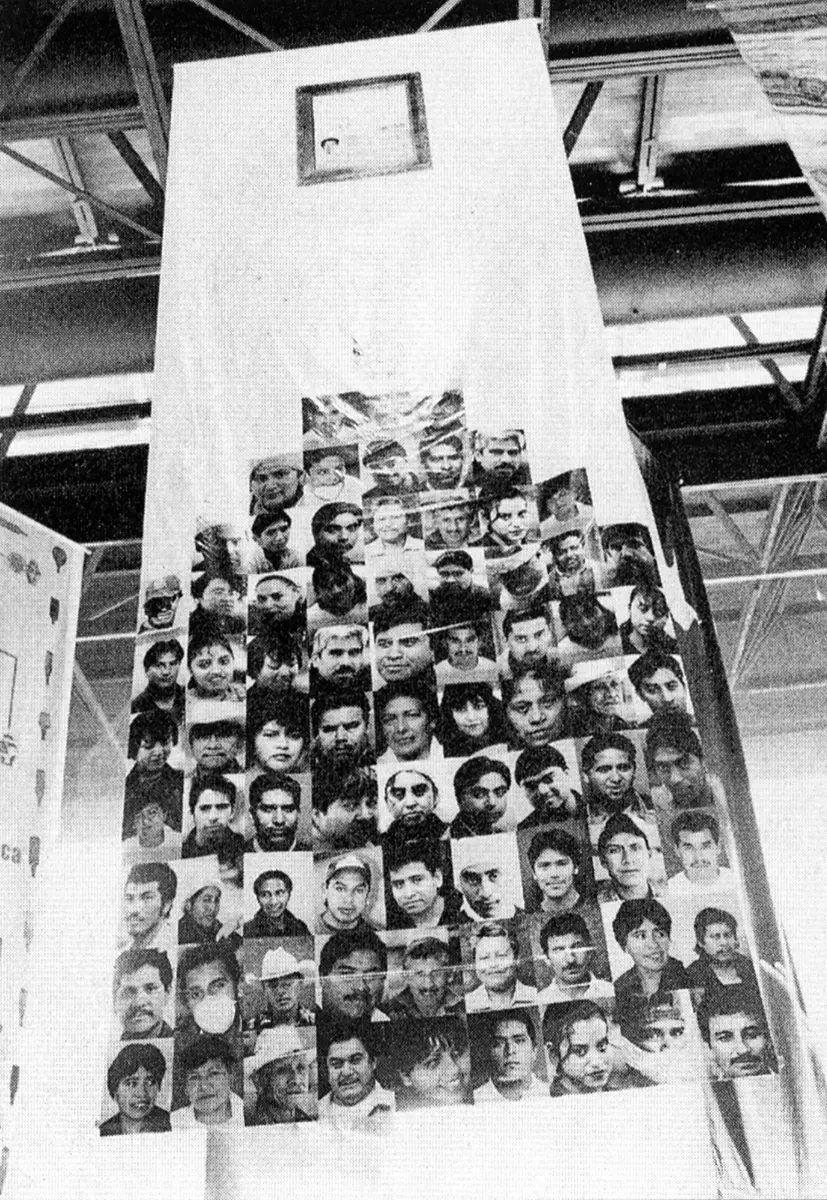
Placed in the middle of the room, its impressive imagery appeared to preside over a group of works that lost some of their own power as a result. This is part of the risk involved in any invitational event and although the entries were of a good standard, with works ex profeso being prepared in all cases, it is inevitable that the visual protagonism of certain works will prevail, as a result of their subject matter, their visual intensity or simply the place in which they have been assigned in the exhibition. The work of Daniel J. Martínez reflected —to its advantage and the enjoyment of the spectator— all these ingredients, as the public came face to face, almost before any other work, with this astonishing banner.
Alfonso Lorenzana, an artist resident in Tijuana, won the second prize with a piece entitled Uncertain Signs of a Frontier. Loreozana included in his banner prototype images from his city, such as the metal barrier separating Mexico from the United States; the wall with the names of some of the thousands of people who have lost their lives trying to get to the other side, and which revealed the traces of anonymous tragedies with a simple sign saying “not identified”; the famous burrocebra (striped donkey) with which tourists and locals like to be photographed as well as other images, the visual impact of which leaves no doubt about the undeniable visual complexity of everyday life in Tijuana.
The mentions went to Guillermo Conte (Argentina) and Sergio Muñoz Sarmiento (United States), who presented a delicate work made up of words written with a pencil, with only one letter of some of them being emphasized to create an unusually large size typographical effect.
Paula Santiago (Mexico) participated with ¿Camino Real? Guadalajara-Tijuana (Mixed media, residue from burnt narcotics, blood, hair, glass, felt, aluminum cotton sheet, lace, silk, and paper). This was one of the most expressive pieces apart from those which were awarded prizes or mentions. It consisted of an enormous vaginalogive with small bags containing the residue from burnt narcotics which Paula Santiago collected from the burnings carried cut in Guadalajara, an event which she documented photographically.
The elements making up this piece are characteristic of the other works of this artist—although it is perhaps important here to note the marked presence of the bodily traces of Paula, not only the blood and hair but the marks of her hands on the lower part of the banner and of the rest of her body on the cotton sheet at the top of the work. Unfortunately, despite the great internal cohesion of the piece and its revealing internal process and finish, it lost some of its impact in the visual context in which it was set and which overwhelmed it. Something similar happened with a work by Jan Hendrix in 1996, when the artist presented a delicate piece that was mounted in such a way that the spectator found himself in physical terms placed below the work and at a certain distance from it, making it difficult to appreciate the details and richness.
Of the pieces that attracted attention by their content, there was a work by Germán Martínez Cañas (Colombia), entitled Made into of Tears, consisting of impressions made by rubber latex stamps. These little “drops” printed all over the work gave it a pink coloration. Although done with red ink, these thousands of stamps each next to the other from the background to the surface, suggested the idea of moving waves.
Patricia Van Dalen (Venezuela) presented Blue Sun, a piece made up of little pictures dominated by the color blue. The work suggested that Van Dalen wanted to break an image up into its fragments and offer it to the spectator, who would then reconstruct it as he wanted. With her long experience in the creation of large-format pieces, this exhibit was surprising for an artist who was the sole representative of Venezuela. The piece did however make a splendid use of color and chromatic rhythms.
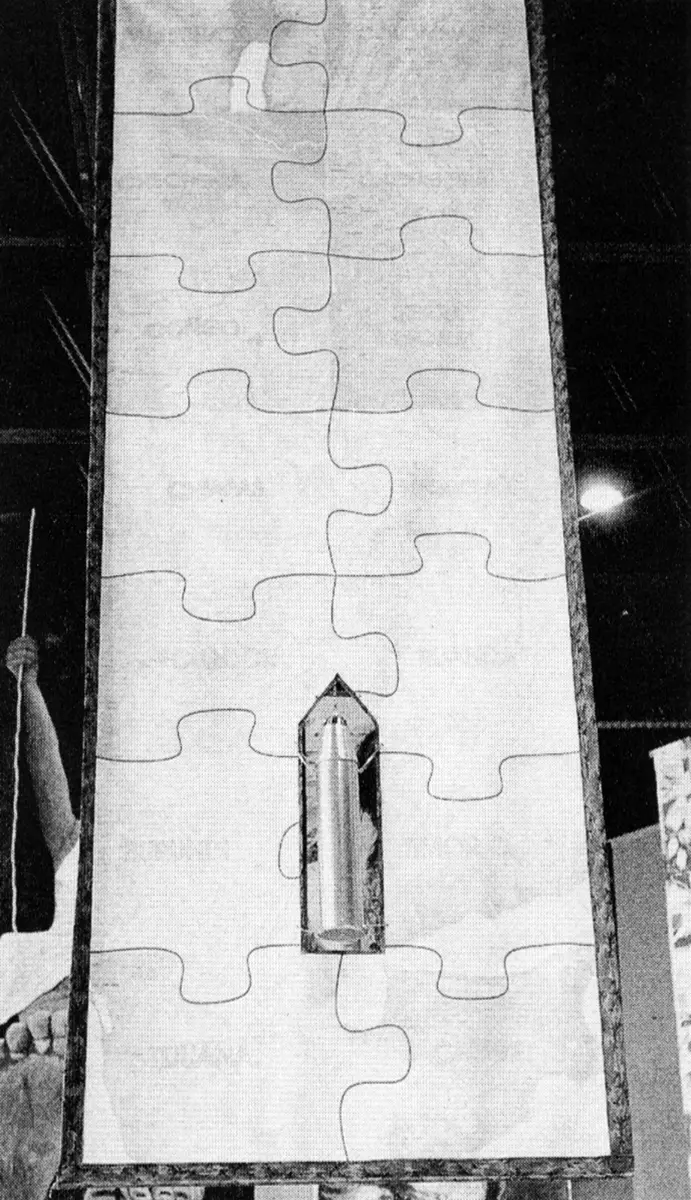
Marcos Ramirez “ERRE” (Mexico) sent a piece entitled White Dove Needed, one of the most eye-catching pieces at the show. On one side there was a kind of puzzle in which each piece referred to a state or a country in conflict (Chiapas, Bosnia, Congo, Chechnya, Rwanda, etc.). On the lower part, there was a missile hanging from thin chains, and pointing upwards in menacing fashion. On the obverse side, the missile was transformed into the cage of a bird: the title of the work appeared in disordered letters. Depending on where the work was set, it could be seen as a call for peace or evidence of war. It is not obvious which side represents the United States and which side refers to Mexico.
Jean Von Borstel (Mexico) presented a piece entitled The Traces of the Migra, on the well-known theme of the highways along which a sign warns car drivers that families of persons often try to cross from one side of the border to the other. On the other side, we can see violent tire marks (left by the migra patrols or by car drivers who did not pay any attention to the signs), along with red stains.
This work, like that of ERRE, reminded us of a work presented in 1996 by Helen Escobedo: a photographic collage with an unusual sense of transubstantiation in the most bodily sense of the word, and the purpose of which was also to highlight this bloody undeclared war between Mexico and the United States, as well as the presence of the enormous numbers of human beings who go to other countries to lock for what they do not have in their own. In the process, they make the frontier areas into the scene of thousands of everyday battles, many of which end in tragedy. This situation, coupled with the natural dynamics of these cities, is the raw material for visual artists and well as a clear reason for their critical attitude and understandable need to denounce the way things are through their art.
Other works in the show included a piece by Lourdes Grobet (Mexico), entitled Unisex Prometheus. Against a background that looked like a cybernetic landscape with roads and connected computer platforms, we can see a man/woman with breasts and a penis, standing on a metal structure inside of which a fire is blazing. Although the man/woman was drawn somewhat rigidly, the figure did offer a disturbing manner of presenting a figure standing on an object who only in the work of Grobe is able to bear the heat on its bare feet, like the souls in purgatory depicted in ecclesiastical representations, suffering the ravages of fire, which never destroys them completely and which is never extinguished.
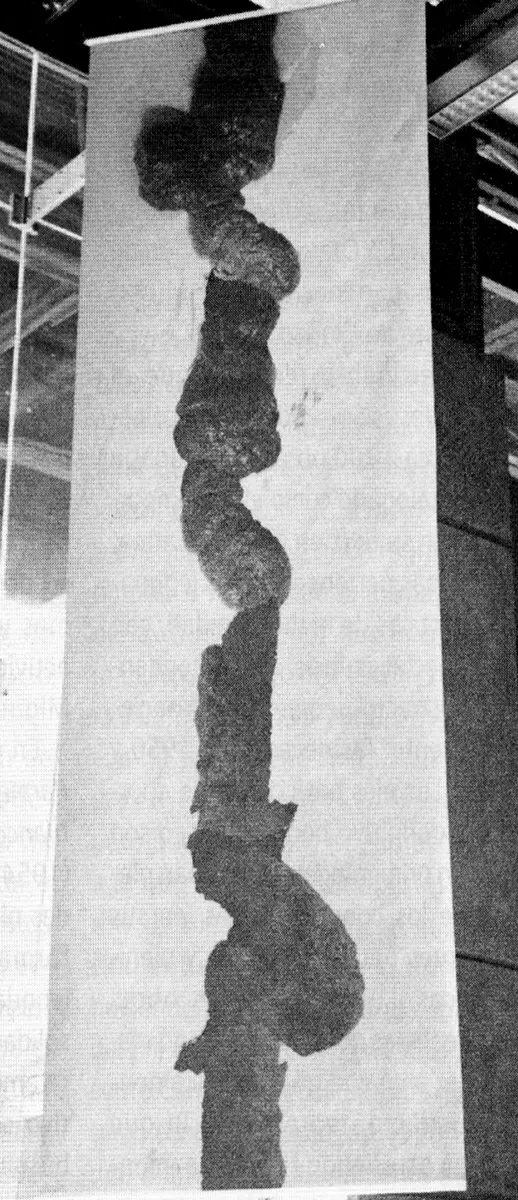
From Ecuador, Jenny Jaramillo participated with a column of excrement (her own), which she photographed after she had placed the pieces in a chain-like formation, like a train or a large column, the visual rhythm of which was determined to a large extent by the capricious forms naturally taken by human feces.
The Balancing Woman was the title of a work by Tania Candiani (Mexico). Made with acrylic, pita fiber, rope, and thread, it shows a woman on a swing. From the front, we can see her enormous feet close to the ground and to the spectator, as if we were looking through a magnifying glass that takes us selectively towards her feet, making them appear excessively large and her body very small. From behind, the view is as if we are on the floor, with the swing passing over us: we see the buttocks of the woman as she goes by and her body, now with her back to us, apparently moving forward like a pendulum.
One of the most interesting proposals was by Alejandro Zacarías (Mexico), who presented a flexometer or metallic metric tape with the exact measurements of the banners. This almost virtual piece, with its simple transparent space, attracted visitors who found themselves before a work which, although it was determined with millimetric exactitude, only contained the concept of something to be used for the other works presented in the same room. This work was “the others”, whether a window or a sense of distance; what we see through it is what Zacarías intended.
Banners, like carnival figures, have two faces, sometimes complementary, sometimes contrasting. Because of their unusual characteristics, they can be seen in very different ways; unlike a photograph, a picture, or a print, they do not have a wall behind them. They are like persons who have a front and a chest, but most important of all, they also have a gaze and a neck. We ourselves are seen, from their unusual height, like little creatures risking our necks to understand them, like latter-day Gullivers, before they run off to the land where everything is the same size as they do.
SANTIAGO ESPINOSA DE LOS MONTEROS