
The evocation of an action by omission was perhaps the premise that inspired the most recent works by Gustavo Romero (Buenos Aires, 1958). By means of approximations that were decidedly fragmentary and visually mysterious, this artist, who has devoted himself to experimentation with electronic media, now turns his attention to the very topical concept of action art reminiscent of the 1960s. His previous solo show allowed the spectator through the combination of partial fragments, to gain an idea of the complexity of the artist’s overall proposal and poetics. Romano’s production has clearly distinguished itself in the modest context of video art, multimedia, and cyber art in Argentina. Since the early 1990s, he has exhibited various works in which the presence of technology is clearly evident, not only as a support but as a theme. Romano uses technology as a means of thinking, exploring the chasms of representation, and, without doubt, as a way of analyzing the role of technology itself in the contemporary world.
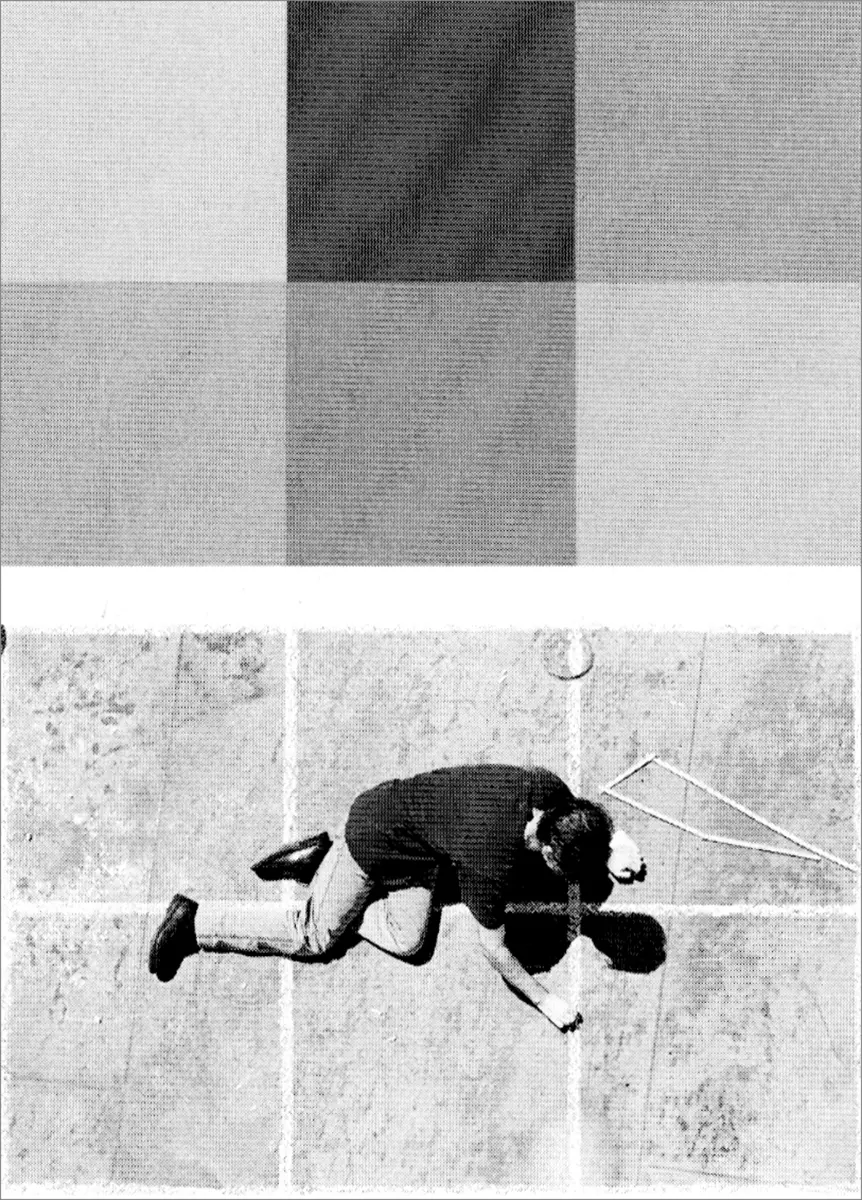
His show at the Ruth Benzacar Gallery consisted of three works. In two of them, the pixel (the smallest measure of information in digital imagery) provided the basis of his reflection. In the installation entitled Pixels, he presented the double recording of an action that took place on a boat on the Buenos Aires Riachuelo River. The image, consisting of 12 photographs measuring 100 x 100 cm, shows the artist himself drawing a grid on the floor. The satellite pictures have the same scale as the grid on the floor: someone divides the floor into squares, someone divides into squares this image is of a man who is drawing squares. A Borgesian structure contains the experiment, structuring it from within, so that it becomes visible only when the spectator shifts his attention away from the concept of the pixel, the concept of smallness, toward the system as a whole. In other words, by disregarding the action to capture its essence.
The second piece, entitled Action for a Dream, included the installation of a video channel inside a telescope. On looking through the viewing hole, we can see a blurred grid: the original image has been enlarged so that we can see only the pixels, the squares. The information in this case is the same thing as a lack of information: the pixel does not fulfill its role as an organizer of the image, and actually has the opposite effect. If we move the device on its axis, we can see that there is something there, and we come face to face with the hopeless impossibility of full vision. It is so close that it can no longer be seen.
The third and final work, entitled Lighting Piece, reworks an action proposal by Yoko Ono (Light a match and watch it until it goes out), transformed into a paradox. The video image, a three-hour long 1oop, shows a burning match that never burns out and symbolizes, in a way, the utopia of the halting of time through a technological process. The original referent of the idea of —Ono’s instructions— succumbs to the omnipotence of a technological action, which transcends the limits of physical laws. Is Romano’s work an attempt to demolish this romantic and idealistic dimension of action art? Not at all: Romano’s pieces subvert the arrogance of technology through the delicate inconsistency of a dreamlike condition.
EVA GRINSTEIN