
This recent exhibition by Iñigo Manglano Ovalle took an unexpected direction, which was nevertheless consistent with several of the artist’s previous projects. In this new project, entitled Climate, Manglano adopts for the first time a semi-narrative strategy in which he introduces certain characters as part of an installation with multiple video channels.
The gallery presented three projections shown on double-view screens, surrounded by simple metallic bar structures. Each presented various scenes with characters in more or less static positions and activities. Set within a rather Orwellian and futuristic atmosphere, the figures were shown in different activities: a meteorologist listening to a program on climatic change in Korean, a figure carefully loading and unloading a gun, and a fragile woman in a waiting room.
The movements and the tenuous, basically unchanging gestures of the figures heightened the sensation for the spectator of witnessing a kind of indefinite suspension of the same scene within a story unfolding before his eyes.
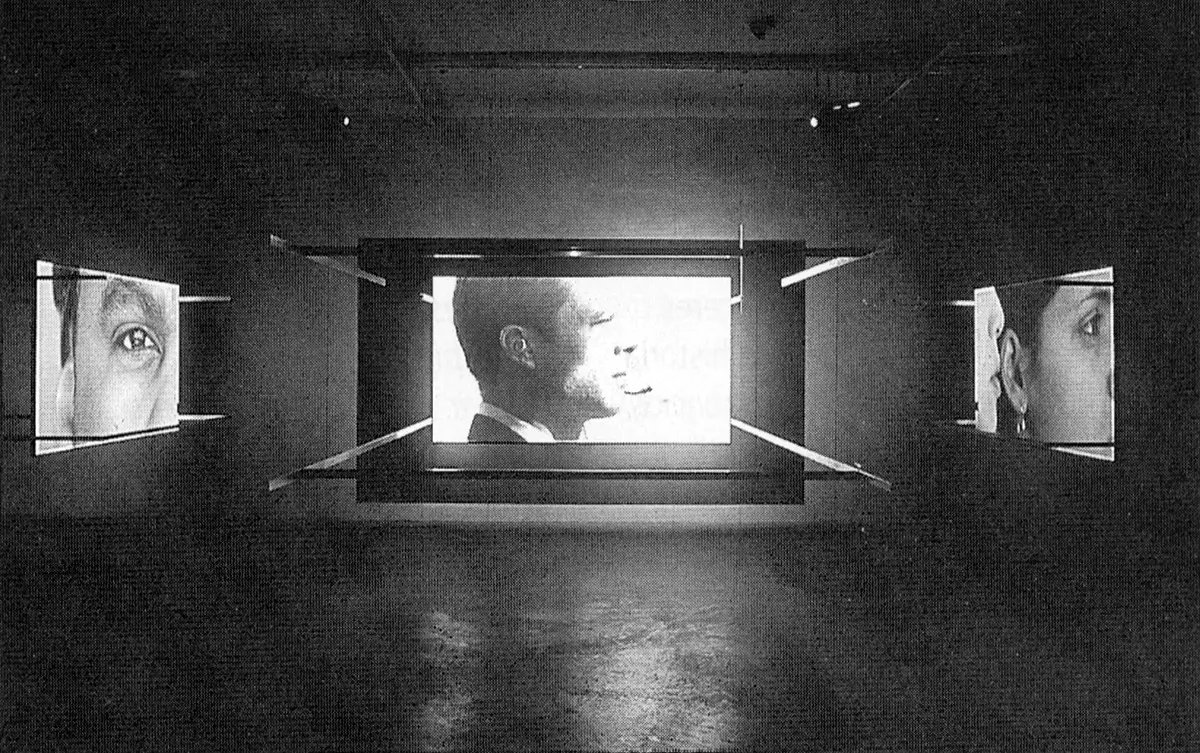
The meteorological text in Korean which could heard murmured in the installation revealed that the frontiers of the world have been eliminated, and the climatic changes are bringing about changes in natural regional environments which in turn have a direct effect on the software conglomerates and corporations.
In this complex installation, Manglano offers us a macabre vision of globalization, in which difference has ceased to exist, as well as the notion of “foreigner”, and has been replaced by a world governed by the “new transparency” (described by the artist in a text), in which “everything is for everyone and at the same time” —a slogan which is no less demagogic than the voices brainwashing the newborn babies in Aldous Huxley’s Brave New World. In this vision of the future, the obsession with the systematization of life, the economy, and nature transforms the planet into a place in which uncertainty has been practically eliminated and the only variable—the climate—is used by a group of persons in power to control the fluctuations in financial profits of the corporate conglomerations.
Manglano’s incursion into this semi-narrative is not far from the context of his previous works. The work entitled Raftman, for example, consisted of a suspended raft, with projections of a person seen from behind and a similar use of strategies for the presentation of imagery, themes, and problems. Manglano’s works tend to be equations in which a human element co-exists with a natural or scientific element, within an almost clinical framework, and resulting in a series of eloquent and powerful reflections on the human condition.
Furthermore, in Climate, the artist returns to some of the themes, which have constantly interested him. Amongst other things, Manglano is a keen observer of variable and constant coordinates, the combinations of which determine social and cultural policies. In another earlier project, The Niño Effect, the climatic phenomenon known as El Niño provided a metaphor for all those circumstances more powerful than ourselves that transform our future, but which are also forces to which we abandon ourselves so that they can decide what we ourselves do not have the courage to decide.
Climate returns once again to the metaphor of the climate as an uncontrollable and naturally arbitrary element, which in turn dominates other aspects of human activity, whether the economy or individual lives.
The modernist architecture of Mies van der Robe (another work by Manglano-Ovalle included in the Whitney Biennial, shows the artist washing the window of a famous house designed by Mies), which can be seen in the images and to which reference is also made in various geometrical structures which surround the projections in space, emphasizes the sensation of being in the presence of some imminent scene from the future.
In Climate, Manglano-Ovalle once again makes use of several characteristic features of his work: he has a great intuition for creating icy images that penetrate, like a surgeon’s scalpel, into the heart of themes related to the human condition, and explore the place of the human being in a series of processes in which we seem to have increasingly less control. His works have a latent aggressive passivity that is ready to explode violently at any moment, but which is always contained at the very last minute.
PABLO HELGUERA