
The Palacio de Cristal presented a small show of work by Kcho, which coincided with the recent edition of ARCO. The exhibition served, among other things, to strengthen the presence of the artist at the fair where he was represented by a number of galleries from various countries. Thus as a strategy (whether deliberate or not) to increase the visibility of his work, the coincidence was particularly felicitous, though it also led to a review (not always fortunate) of the formal and conceptual proposals of the Cuban artist.
The exhibition, which featured pieces made over the last ten years, inevitably included The Worst Trap of All (1990), a ladder made with palm trees and machetes that can now be considered one of the paradigmatic works in contemporary Cuban art. Also on display were Infinite Column (1996), made from tires, and a version of The Path of Nostalgia (1994-1999), entitled Wet Ideas, which was placed in the pond facing the Crystal Palace. The work recreates a kind of abandoned dock made with pieces of wood and found tires. The show also included Kcho’s “arte povera” version of Tatlin’s Monument to the Third International a work entitled In the Eyes of History (1992-1995). These and other sculptural pieces were accompanied by large drawings almost all sketches suspended in a fragile way from the columns of the exhibition space.
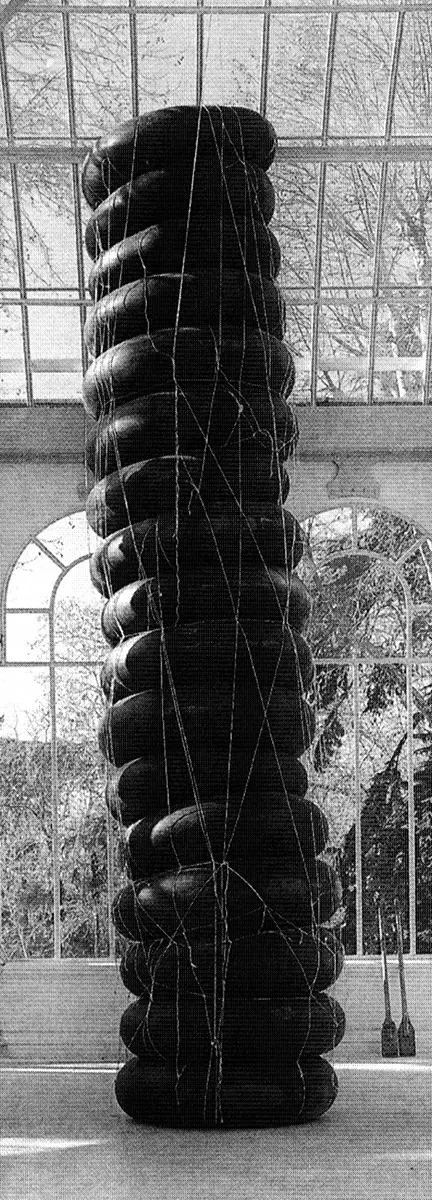
Both the simplicity of the materials and the apparent precariousness of the installation contrasted with the architecture of the Crystal Palace. Although for some, this strengthened the paradoxical discourse on art being proposed by Kcho, it is also true that except for the monumental central piece or the repetition schema of the Infinite Column, the rest of the works tended to get lost in the enormous vegetation of the Retiro, which infiltrated through the glass.
A careful look at the show highlighted the undeniable talent of the artist, especially in the drawings, which perhaps went unnoticed by many visitors. It was also quite easy perhaps too easy to recognize the formal and conceptual axes of his work: on the one hand, the presence of the materials (glass, wood, rope, textiles, etc.) found and collected “on his walks along the shore and in the streets of Havana”, and recycled in his works; on the other hand, the imminent topos of the raft and with it, the sea as a frontier the theme of insularity, journey, and migration. To which we must add the works presented as commentaries from the periphery on the history of modern Western art. At the end of the visit, the visitor had the general feeling of a hackneyed kind of rhetoric, even in the Spanish context, enclosed within a circle that seemed too difficult to break. Despite its condition of necessity who can deny that these problems and questions exist and that it is necessary to make them visible? The discourse proposed by Kcho’s work seems to be stuck on a one-way street. This has proved to be very seductive for those who have been able to use it to their advantage but has been of doubtful effectiveness for its main proponents, for whom it almost always proves counterproductive. The trap lies precisely in the fact that a work that does not seem to have any “back doors” more complex and less domesticated exits loses its critical effectiveness and its ironic potential, qualities which are in fact present in Kcho’s work. The Worst Trap of All is that the undeniable plastic qualities of these objects get lost in the excesses of discourse without any nuance or subtlety.
ISSA MARÍA BENÍTEZ DUEÑAS