
Libero Badii is one of the most versatile artists to come from Argentina. He has used sculpture, painting, graphic work, and objectualism with the same mastery.
The distinct aspects of his praxis show some of the paths of reflection through which the artists of his generation traveled. From a very early age, Badii established the problem of feeling like a point of confluence between two cultures. Today we shall therefore look at him specifically in his character as an emblematic figure of what Beatriz Sarlo calls a “culture of mixture."1 Born in Arezzo, Italy, his family moved to Buenos Aires (1927). His case is thus included in that migratory flood that gave several Argentine cities their rather peculiar character, made up of ethnic, cultural, and social mixtures on different levels.2 The interesting thing, when we extrapolate the aesthetic expression from that situation, is to see how each individual resolves his or her own personal equation.
Son of a marble craftsman, Badii studied at the National School of Fine Arts where he won a scholarship that would prove to be a determining factor in his future praxis. Thanks to the scholarship he was able to travel through northern Argentina, Bolivia, Peru, and Ecuador, carrying out “research of artistic expressions through the South American High Plateau."3
Texts and drawings gave testimony to his journey through Cuzco, the ruins at Machu Picchu, Ollantaytambo, Saccayhuiman, and Copacabana (Bolivia), through Potosi, Lima, and throughout the Peruvian and Bolivian high plateau.
The meticulousness of the drawings and the precision of the annotations tell of the cognitive avidity and the bewilderment with which he undertook that journey. The vitality of America began to question the criteria inherited by this European son, for they proved incompatible with his lived experiences.
In the ‘40s, when Badii made that trip, the process of Europeanization that Argentina had suffered had already exceeded the dizzying development of the end of the nineteenth century and the beginning of the twentieth century. It had entered a slowdown due to the drop in numbers as well as to the change in the generation of immigrants. That dynamic provoked shifting, innovations, and changes, both social and cultural. A nationalist restoration had already taken place in the ‘20s and ‘30s, led by writers like Ricardo Rojas and Manuel Gálvez, the architect Ángel Guido, and the painter Alfredo Guido, among others.4
The journal Martín Fierro (1924-1927), decisive in Argentina’s cultural milieu, recovered images and points of view linked to the preColumbian past and to the ancient American populations which revealed a desire for formal renovation and a search for cultural identification.5 Let’s not forget the commentary by the Argentine poet Oliverio Girondo in that journal: “An anonymous Aztec thus opposes the sculpture of Rogelio Yrurtia."6 Moreover, it is documented that Argentine sculptors of generations preceding Badii’s had turned their gaze toward “the primitive,” though this did not always mean talking about the American past, but rather about the primitivism that was taking place in Europe.
The fact is that the journey through pre-Columbian America would mark Badii’s work in a definitive way, and he brought back from that voyage a remarkable number of drawings that show human types, urban aspects, sacred monuments, sculptures, masks, and plans. His texts do not only explain the details, but they are also a record of his sensitivity before the works, and they raise questions that would remain with him to the present. They find that “those forms overflow in force and power,” and that they are “truly sublime.” Standing before a head he observes “the concave plane of the skull,” and “that the large eyes allow the gaze to be powerful.” Before a figure presumably of dried clay, he points out that “the face is completely flat, with the small line drawing eyes, nose, and mouth on it. Here these idols lie the sound of the simple and at the same time lasting. It’s all solid, dark splendors don’t exist as in the baroque”.
In each case, we witness a lived experience that deepens and attempts to hasten that moment, which he would take up again countless times in the future.
He published four files from his travel diaries: one from 1945, 60 drawings from the North, another from 1945-1946 with fifteen drawings, and a poem, Las cosas del canto. He also made two editions with texts in 1946, which are unique manuscripts. One has 15 drawings and the other has nine. In 1959 he made 100 offset copies of this latter edition.
He returns time and again to the commotion that for him meant coming into contact with the vital force of America’s ancient civilizations. In 1966 he wrote the following from New York: “I’ve never felt the emotional state in my body as strong as in this act of seeing New York; maybe when I was at Machu Picchu it was the same; back then I didn’t call it an uncanny emotion, but I think that they were the two impacts that I’ve had in my life”.
He perceives an enormous force in New York and he even dares to dedicate a rhymed prose text in Spanish, with which he was always a little clumsy due to his Italian origin:
Nueva York: hecha de blancos y negros
grandes hombres
encontraste tu manera en arte.
¿Cómo ves en el tiempo?
Serás juzgada.
Tu imponente mole al
igual que Machu Picchu
quedarán en la historia
como primacia del Siglo XX
(New York: made of black and white/great men / you found your way / in art. / How do you see in time? / You’ll be judged. / Your imposing bulk / the same as Machu Picchu / will go down in history / as the supremacy of the / twentieth century).7 From the point of view of the impact that Large cities and his need to compare them to his images of Cuzco provoke in him, I should point out the drawing that he made superimposing the facade of the Cathedral of Notre Dame in Paris and that of the fortress at Sacsayhuaman.
That ripping, that conflict of being a man of two cultures, appears frequently in an indirect way. For example, throughout his entire life, Badii has made some small editions about various themes related to his art in order to send to his friends at New Year’s. His colleague, the sculptor Aldo Paparella, called him “the man of the Little Books” because of this. In 1967 he chose Diálogo inconcluso más allá del Atiántico (Unfinished dialogue beyond the Atlantic) by the critic Maria Scuderi, who recalls that another Latin American told her: “.... you knew what a transplant was and how much plants suffer with them. From the beginning a radical maladjustment is produced, that is, in the root, although in appearance the plants prosper normally. Something similar occurs to you Argentines from Buenos Aires. The majority of you are children of foreigners, transplanted beings. And that’s why you can’t Live calmly. You plant your feet on the uncomfortable edge formed by two planes; for this reason, you’re neither on one nor the other. You are Europeanists and, at the same time, your Europeanism disturbs you: you want to be Americans, fully; but how could you forget your origin and your vehement European desires?”
The following year, in 1968, he chose a text by the critic Sigwart Blum that is illustrated with drawings from his 1945 trip. The anecdote consigned to the first one is the following: "One day, sitting in a café in Aries, García Mugica observes a gold brooch that Picasso’s wife was wearing. Its American character catches his eye; it looked like one of those amulets that his Peruvian ancestors used. The artist unclasps the adornment and proudly indicates a signature: Picasso. It was a work inspired by a zoomorphic piece from the period of the Inca Empire."
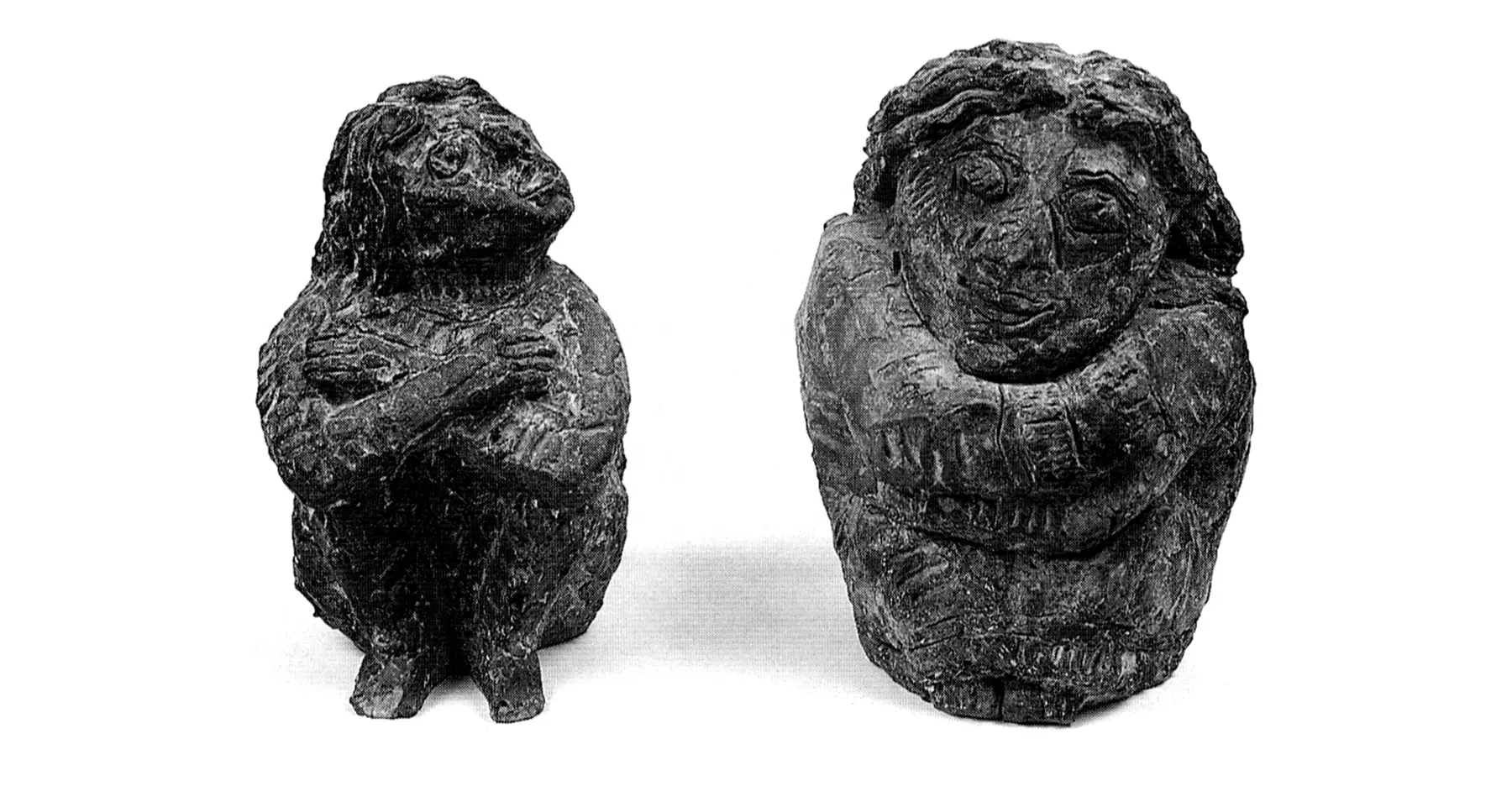
But Let us now go through the testimony of his sculptural work. “Northern” heads and figures exist of which there are male and female versions in bronze and plaster, some of which are currently on display in the Badii Collection at the Banco Francés Foundation. There is a series of family groups—man, woman, child—that would independently have to make up a thematic constant of his work; here they appear in their “northern” version. There is a version from 1951 in reconstituted cement stone that is in the Museum of Fine Arts of La Plata. It has also been given the name of La Familia Americana (The American family). Hermanos norteños (Northern brothers) were awarded at the National Salon and the Santa Fé Salon. In La fecunda (The Fertile One) a theme that he had carried out previously with naturalistic traits the figure is inscribed in a pyramid and the planes are simplified in order to give formal grandeur to the work. La madre (The Mother, 1955-1957) is also “carried out according to this Linear-planar sequence based on the Mayan pyramid.8
When Badii—who has always been very reflexive with respect to his work—traces a diagram, he distinctly separates two Lines starting from 1945: one of a European influence and one of an American influence. In the latter he also places El anuncio (The announcement), La muñeca (The doll, 1952), El artista y su mujer (The artist and his wife), and Seres de la ciudad (City beings). At the beginning of the ‘60s, according to the artist, the fusion of both orientations occurs. Thus, between 1959 and 1963 Badii sculpts a series of great themes: Los símbolos (Symbols), La gloria (Glory), El amor (Love), El tiempo (Time), La libertad (Freedom), and El alma (The soul). They are created in bronze and their image stems from basilar geometric bodies which he called mother forms.
In 1963 he charged forth with the creation of the series Las voces de la patria (Voices of the Fatherland),9 a group of works that mark his desire to manifest himself as an interpreter of the historical events of his adopted country, the one in which he had chosen to remain and where he had settled his family.
It is only in the ‘70s when Libero Badii confronts the duality that motivated him in the previous period and he found conciliation through praxis.
If the use of color gives the sculptures of this series their American character, the composition through decomposition of the form may be considered a personal variant that we can place within the cubist tradition. But both currents will be emphasized by radiant focal points Like eyes distributed on different points of the surface by the duplication of the edges that give the group a very special dynamic play.
Color appeared in Badii’s sculpture in 1967 with the series Los muñecos (The dolls), a group of 16 Large figures that were exhibited for the first time in the show at the Instituto Di Tella the following year titled Libero Badii and Space. They earned Argentina the Grand Prize at the 1971 São Paulo Biennial.
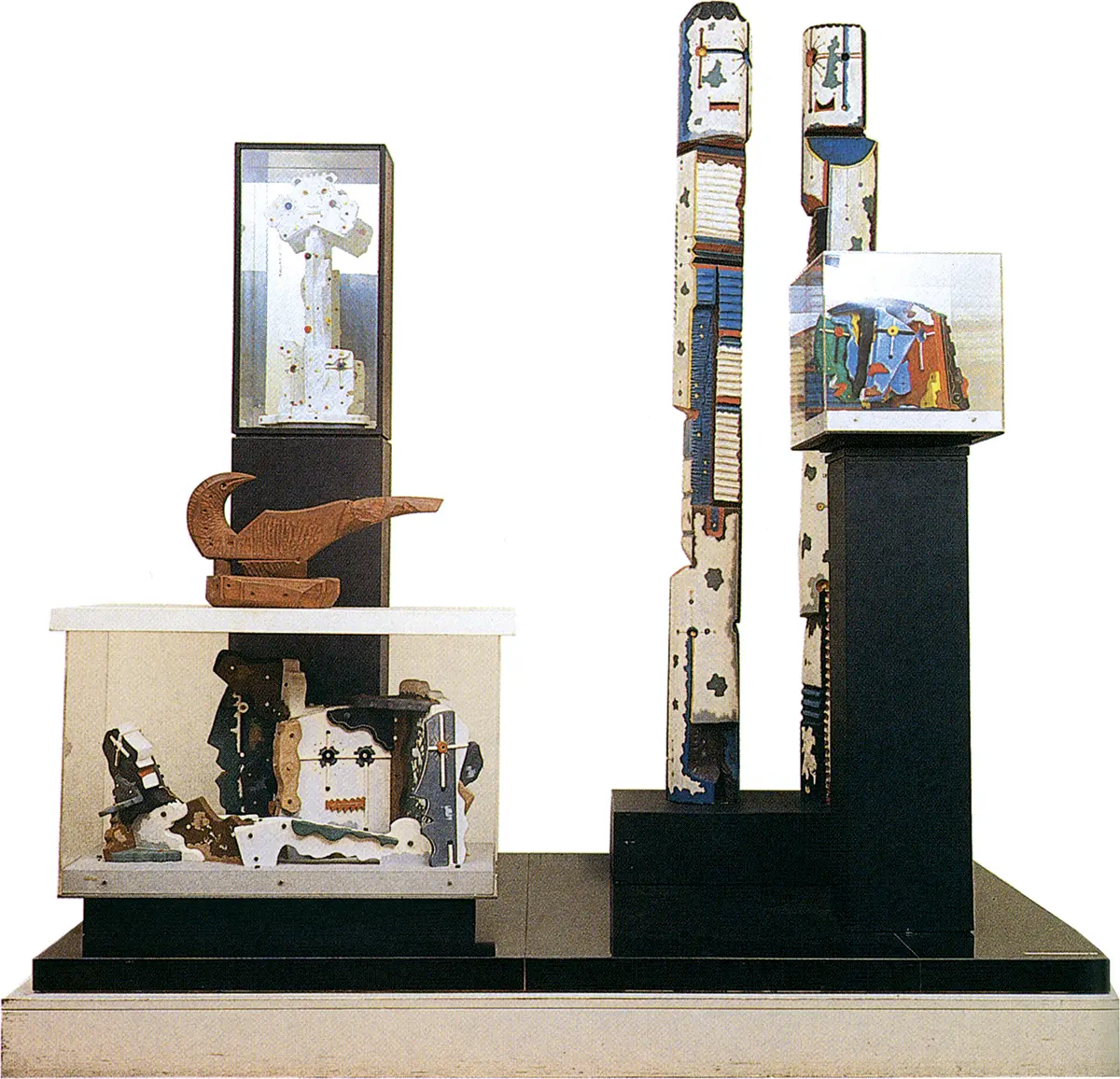
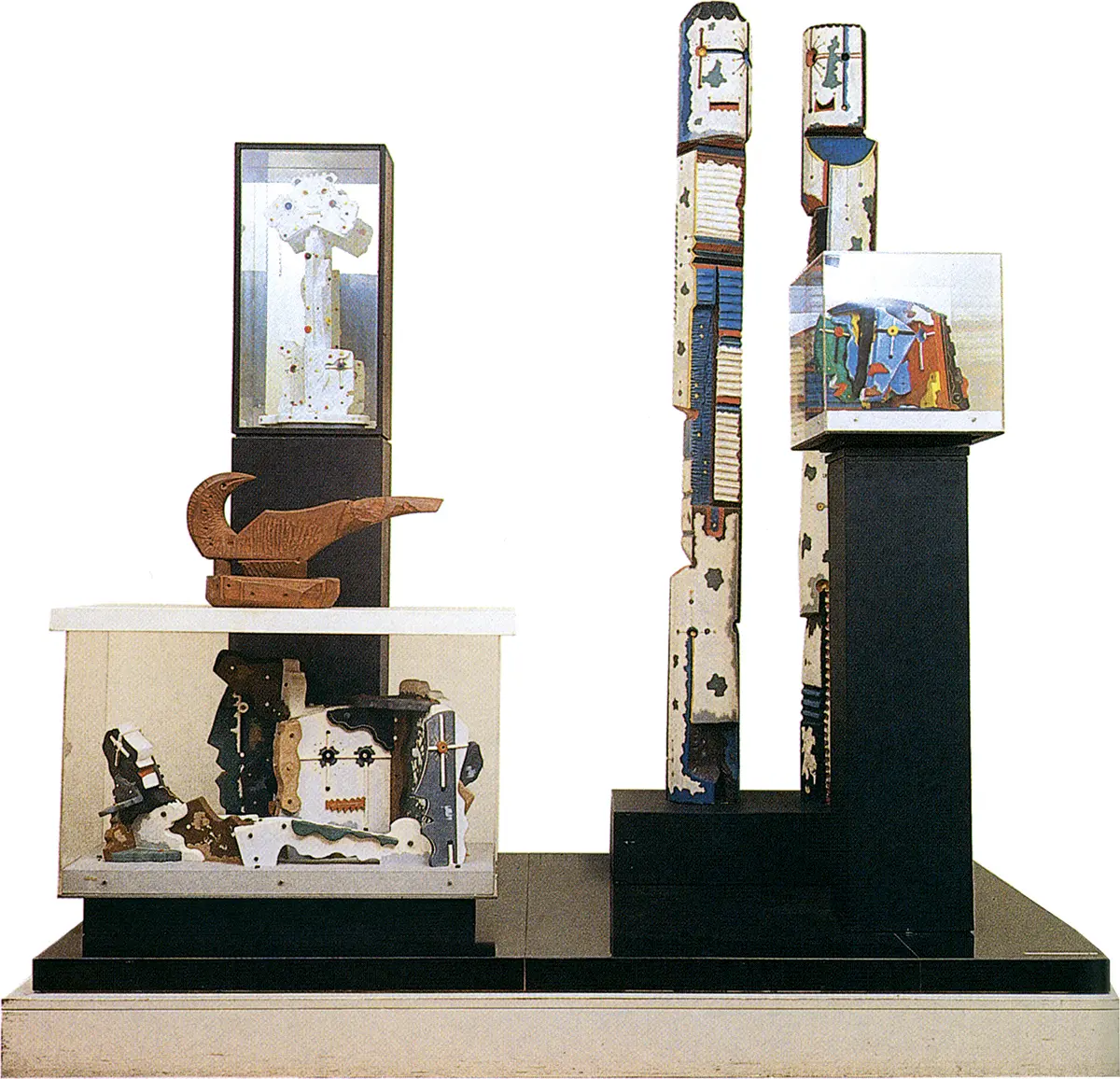
His concern for the American root found a high level of realization between 1971 and 1972 with the monumental group El sacrificio (The Sacrifice).
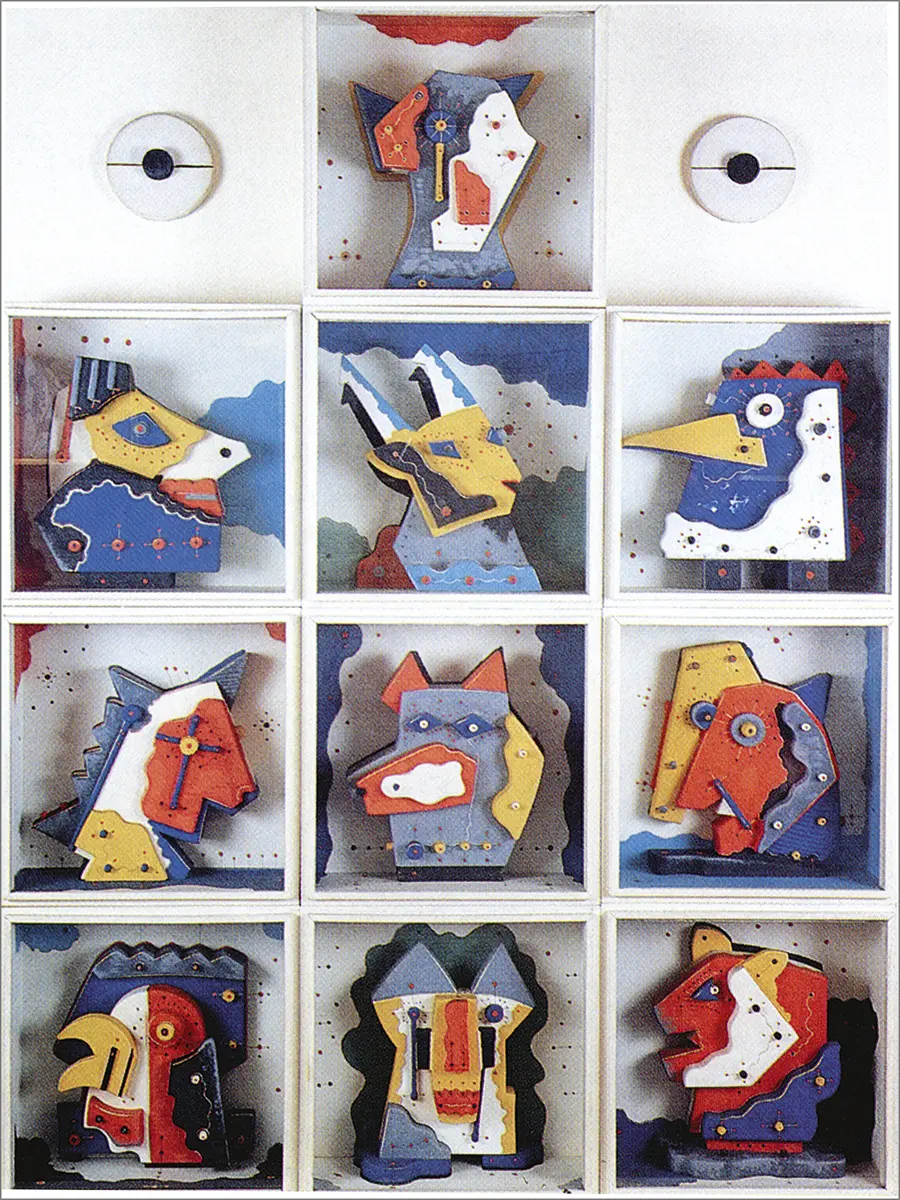
This enigmatic work somehow attempts to capture and express the magic-religious energy of pre-Columbian art. It is mounted on a base stage that interrelates the elements, some of which—El anuncio, América, El duende (The familiar spirit)—are kept in translucent boxes. El anuncio alludes to the access of sinister knowledge following the artist’s thought at that moment in which a sudden revolution is produced, a sort of entry into spiritual Life. Revelation implies, on one hand, a path of total stripping and a profound sacrifice, both of which are symbolized in La herramienta (The tool), a ceremonial axe destined to carry out the initiation rite. El dos (The number two), is a monumental male and female figure that presides over the group “Like pre-Columbian gods.” América affirms its existence with a certain solemnity, while El duende seems to confront the dynamic forces of Life, creative imagination, change, creative transgression, and the constant search for a renovated balance. Related to this work, which delves deeply into Latin American questions and the persistence of earthly magic, is La reencarnación (The reincarnation), conceived as a Large panel, subdivided into boxes that contain symbolic representations of different American animals. La madre, an imposing pyramidal figure that presents a woman with the son meshed into her body, is the culmination of the works made in bronze on this theme at the end of the ‘50s.
Very much connected to his reflection on his Americanist task are his texts on Arte siniestro (Uncanny art), a theme that he continued to elaborate on after its appearance in 1960 in a show realized with the painter Luis Centuri6n. The sense of the uncanny allows him to investigate ever more profound areas and to justify a process of de-idealization of inherited concepts. He thus tells us: “Mayan art is uncanny, not so with the Greeks.” “In school why teach the Venus de Milo and not the pre-Columbian Venus?” Ídolos (Idols) and Máscaras (Masks) continue to give testimony of his search for valid spaces for the circulation of energy. As recently as 1993, he created a series of oils inspired by erotic drawings that he made in 1945- 1946 after witnessing a popular festival in Resto Faisani, near the border between Peru and Bolivia, which made him write: “What a beautiful spectacle of human orgy.” There is no doubt that this penetration into Latin America’s vital force coincided with a moment in which Lucio Fontana was working in Buenos Aires. Fontana had temporarily abandoned his incursion for geometric abstraction and he dedicated a great material expressionism that possessed, as Enrico Crispolti has said, “an intimate connection to a vitalist disposition of spatial expansivity."10
That presence of material vitalism came out in Badii in a play of oppositions from the very moment in which he considered that his work had achieved joining the American Line with the European Line. Let the series of symbols and Legendary figures, such as El centauro (The centaur) and others, suffice as an example.
If the emerging power of matter was present in many of his works, there are others to which we shall refer presently that allow us to underscore another interesting aspect of his connection to pre-Columbian art.
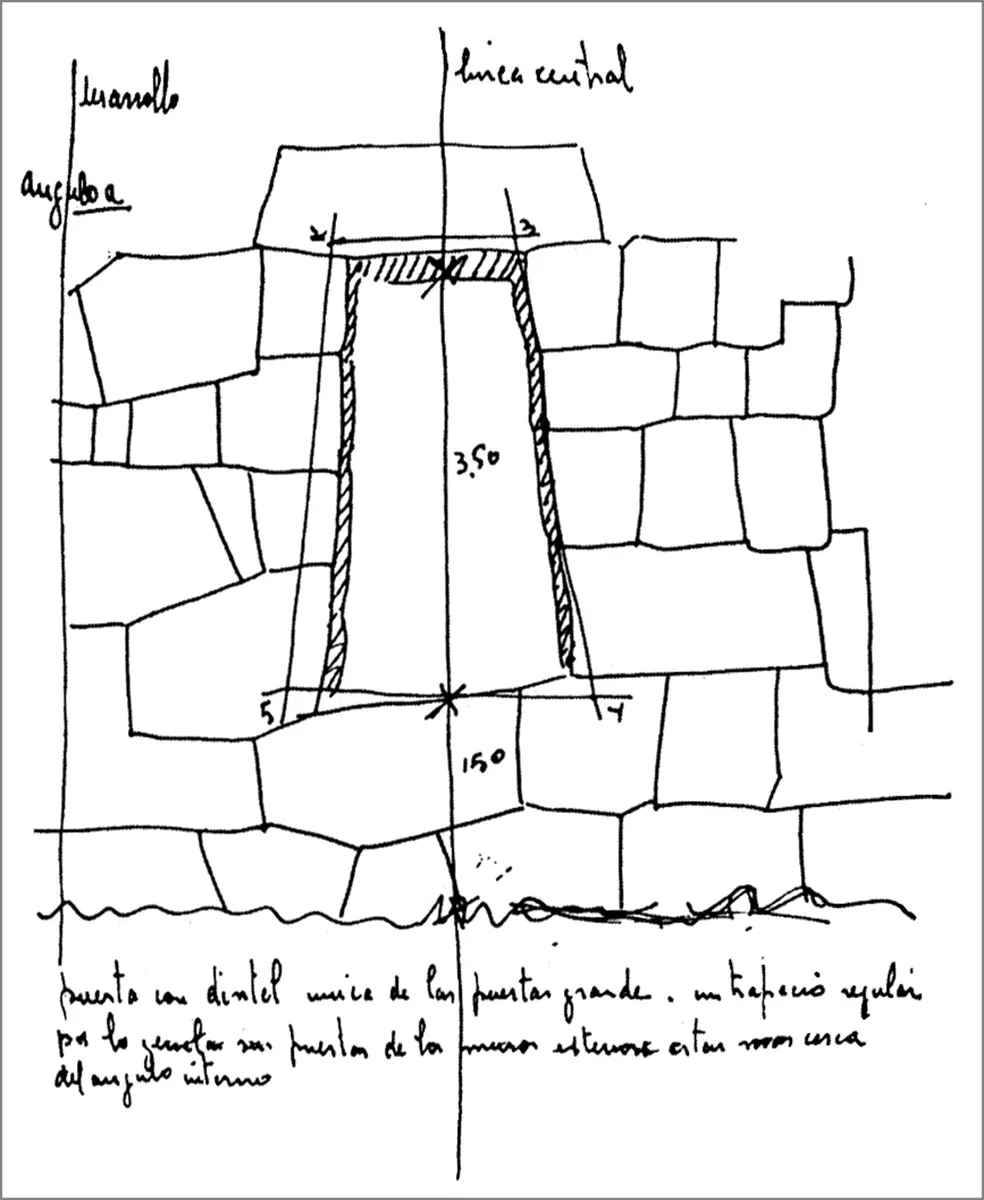
When Badii traveled through the ruins at Ollantaytambo and Saccayhuiman, he Left in his drawings and notes a highly detailed record of his perspectives and points of view of the place, especially of the walls and the stones.
When he saw them he could not avoid the reference to César Paternosto. When he wrote about those ruins, he pointed out:
"The trapezoidal 'minimalism' of the monoliths, that devilish constructive prowess that today we call the Temple of the Sun, was the first and most indelible impression. Later, gradually, the sense of formal instances of that mute text became more legible: the progressive refinement of the walled terraces that establish ascending hierarchies toward the ceremonial center, and the rhythmic sequences of the 'lithic knots' that would have to be enlarged before the extraordinary monoliths or expanded like sharp reliefs, thus arranging a powerful forgotten symbolism."11
Badii notes “the pulchritude of these people and their exactness in small angles, without a broken corner.” And Later: “two stones that they place jutting out dramatically from the wall, that serve [as] steps to climb to the terrace. On all of the terraces of the wall there are these jutting stones” that cut into all directions indicating, for example, that “the most regular stones are the ones that are worked, while some piece is placed as a sort of padding.” Or that “on all of these walls, the stones are placed on clay mortar,” and he adds: “They made their walls and steps on Living stones with a primitive rusticity completely different from the Large stones which we can see were places designed for the cult”.
He thus details the doors, Lintels, the shapes of stones, their color, the niches, and the steps, with the avid desperation of the artist dazzled by a Lived experience and his desire to retain it.
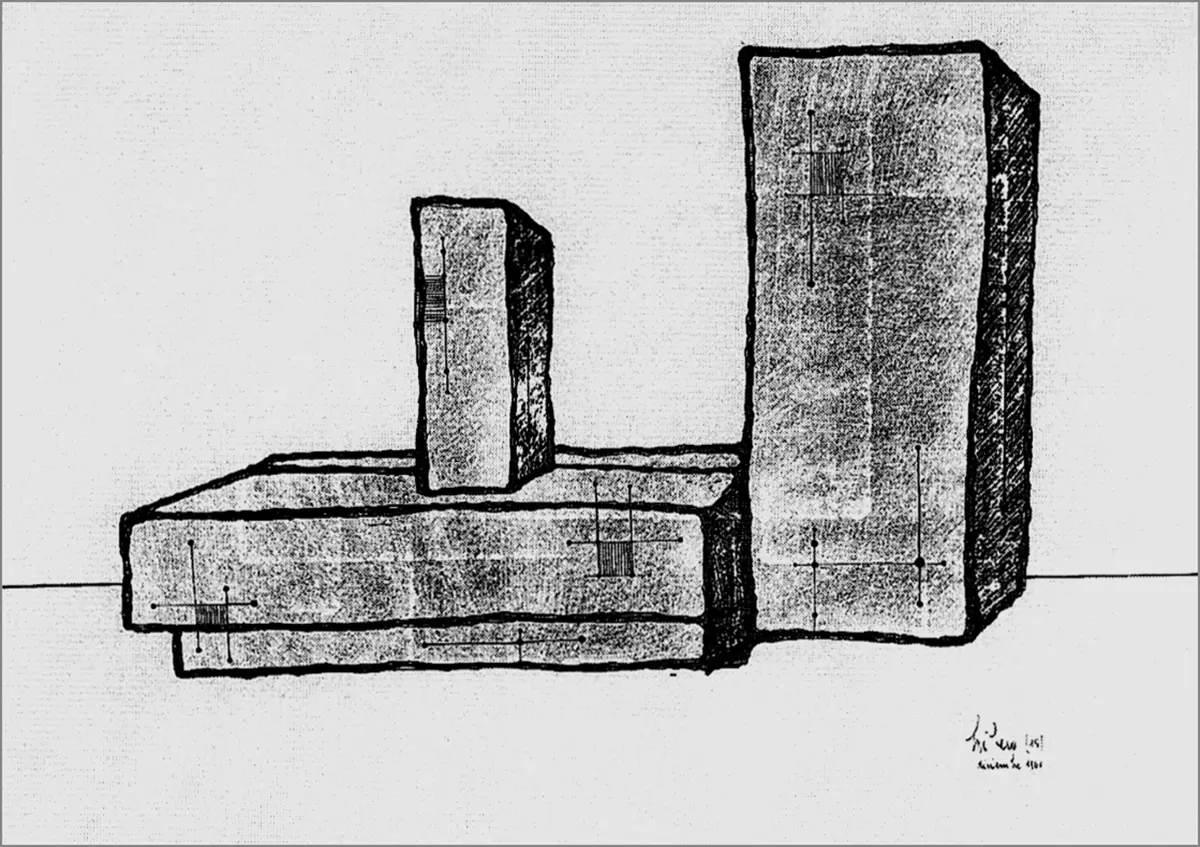
I went back over César Paternosto’s analysis, as sensitive as Badii’s, but with a more elaborate intellectual approach when he speaks of the intentionality of signs or symbols in each detail, the comparison with the visual-tactile semiotics of the qipu, of the refinement of the stone construction, the parallelism that he establishes with Russian constructivism, and other themes of similar interest. Like Paternosto in this way: “The symmetries of his painting suggest imaginary facades and, at the same time, the almost erased Lines on the foundation of the palaces and pre-Incan sanctuaries."12 Badii made several files called Stones on stones, drawings, and etchings on the same theme, in which he evokes the grandeur and technical and significant perfection of the Lithic structures that revealed to him “their American feeling”.
Alejandro Puente is another Argentine artist closely tied to Paternosto through his investigations on primitive American art and its possibility of fusing its image with contemporary geometry.
It has been gratifying for me to highlight Libero Badii’s interest in preColumbian cultures, not only because it was a key to his art, but also because, on one hand, he Lies chronologically in an area halfway between the indigenous of the ‘20s and ‘30s and the interesting theoretical work of Puente and Paternosto. On the other hand, because he was a protagonist of the clash of two cultures, he fought individually and autonomously to integrate himself by integrating them.
NOTES
1. Beatriz Sarlo, Una modernidad periférica: Buenos Aires 1920 y 1930 (Buenos Aires: Nueva Visión, 1988).
2. In the second decade of the twentieth century, immigration reached a third of the population according to the 1914 census.
3. Libero Badii, Dibujos (Buenos Aires: privately printed, 1981). This edition was limited to 50 copies made by the artist in his studio.
4. AIfredo Guido painted ceramic with calchaqui motifs, he elaborated decorations and costumes for an opera of an Indigenous nature by the Uruguayan musician Brogue. Alfredo González Garaño also elaborated designs for the opera Ollantay.
5. Adriana Armando and Guillermo Fantoni, “Presencias precolombinas, primitivismo y vanguardia estética: el caso del periódico Martín Fierro,” 20 jornadas: Estudios e investigaciones en artes visuales y música (Buenos Aires, Instituto del Arte Julio F. Payró, 1996).
6. Martín Fierro, 2.18 (1925): 12.
7. This incomplete text appears in Libero Badii, Vivencias (Buenos Aires: Ganglianone, 1983).
8. Laura Buccellato, “Argentina: 1910-1960,” Voces de ultramar. Arte en América Latina y Canarias: 1919-1969. Las Palmas de Gran Canarias, September-November 1992; Madrid, December 1992-January 1993.
9. The works that make up this series are Independencia (Independence), Civilización y barbarie (Civilization and barbarity), Martín Fierro, and El tango (The tango).
10. Enrico Crispoli, “Historicidad y actualidad de Fontana,” Fontana. Obras maestras de Ia Colecciún Luclo Fontana de Milán (Buenos Aires: Fundación Proa, 1999).
11. César Paternosto, Piedra abstracta. La escultura Inca. Una visión contemporánea (Buenos Aires: Fondo de Cultura, 1989).
12. Álvaro Medina, “César Paternosto: El lugar de Paternosto en el Arte de América Latina ArtNexus, 19 (1996): 52.
NELLY PERAZZO
University professor, art critic, and researcher. President of the National Academy of Fine Arts, Argentina.