
This recent exhibition by Marco Arce in New York was a show of contrasts. 33 x 4 = 132 works on paper painted in watercolors, divided into 33 sets of 4 works each, in an obsessive need to refer to the uncontrollable elements that have passed before his eyes. The largest wall in the gallery and two other smaller ones were covered with these polyptych quartets. Seen from afar and up close, the pictures revealed a marked sense of contrasts and inconsistencies, some of which are described below. A lot of space was taken up with small pieces that had a concentrated and rhythmical presence, the same sized support but not the same treatment of content, since each watercolor was a work in itself. This was indeed life. In one of the quartets, the artist seems to have grouped together four portraits, while in fact what Arce brought together was openings, splits, closed and open vaginas, echoes of those who had “opened up” options, such as the Brazilian artist Lygia Clarke and the Beatle Paul McCarthy. These were aspects of the “moment” between the end of the twentieth century and the beginning of the new millennium and of what is happening in the enigmatic centrifuge in which we live, the centrifuge of the globalized world that is changing direction and which with each change is accelerating more and more, increasingly stripping and laying things bare. At the same time, little bursts of questions rise up like electricity wires with bare poles and no insulating tape, confusing us by serving up risks for pleasures.
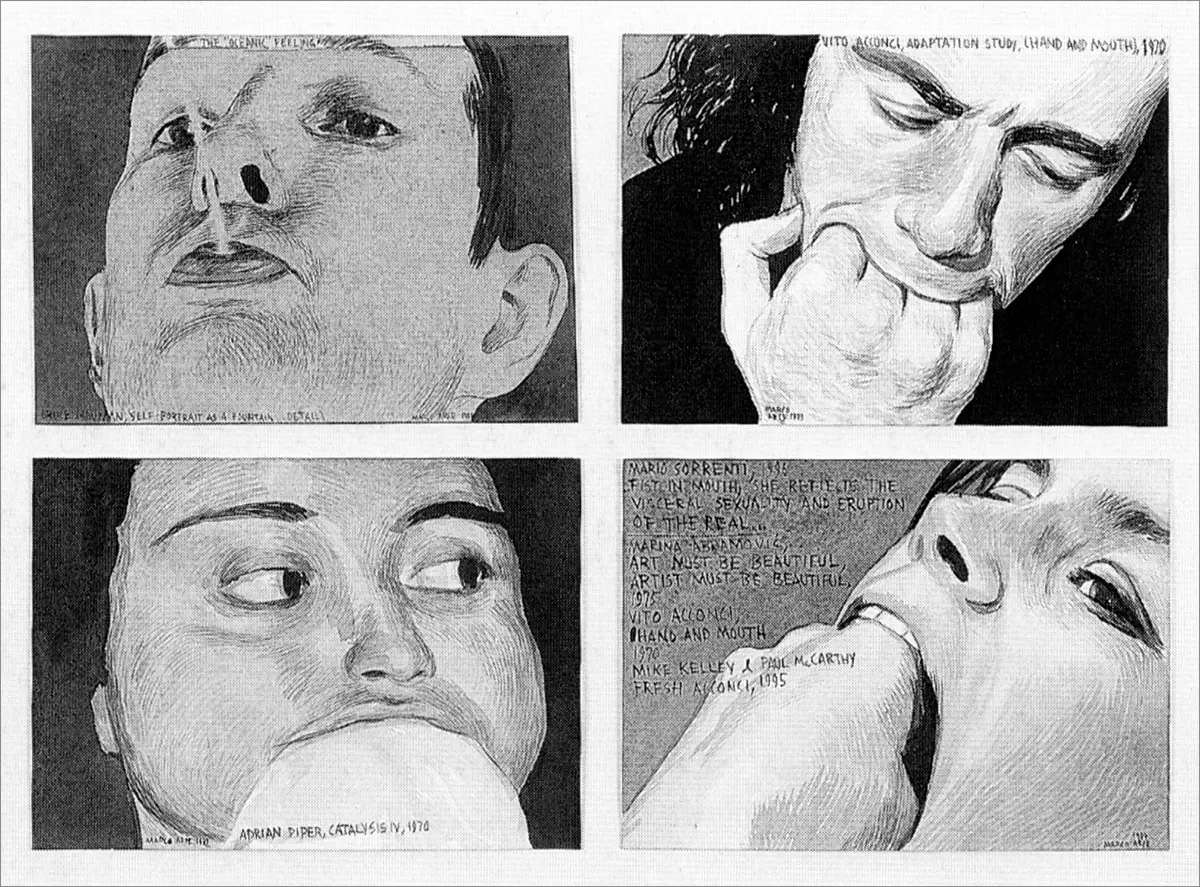
Linking together moments in the recent history of society and using advertisements, postcards, and photographs, Arce created watercolors that seemed to be notebooks of some scientific investigation. Neither the portraits nor the animals are the “themes” of the artist; he paints both with natural calmness and both happen because they are part of the modus vivendi of the conflict of conflicts, which he is exploring. In New York, in addition to To Dissolve/To Collect, there is a place showing the portraits of Manzoni which Marco Arce has been doing for some time now; although they are good works, they are rather different. Despite the marked presence of linear elements, all the work takes the form of commercial watercolors done with a brush: the pencil is only a support in the development of the process. The artist reworks the careful appearance of images from old zoology or biology books but resolves his compositions with elements that are almost perverse, asserting the importance of drawing and watercolors as compared to the status of oil works, and revalorizing the status of paper as a support vis-á-vis canvas. While these two aspects are not the personal discoveries of the artist, they are attitudes that will always be welcomed by those of us who do not want status to prevail over content.
As the artist himself says: "The comic strip is a means of retracting all that has been accepted. I work in this “format” but / integrate concerns, such as the scientific interest of the biologists of the eighteenth century, to express other aspects of this jungle of books in which we live and to isolate these more biological more taxonomical aspects that occur in modern art." It is a kind of comparative biology in which we come face to face with how things are related to one another. Although in the artistic context, this is nothing new—neither in the past nor in the present—Marco Arce adopts specific and characteristic approaches as a means of escaping tautology. The entire exhibition seemed to be traditional (in its size and order, with drawing, painting, and academic elements), but at the same time, the entire show created false expectations. Some of the factors, which have determined the artist’s personal path were evident here. This is the world of today which bathes in the limelight of the stars of Hollywood—who have replaced the haute couture models on the covers of fashion magazines. Similarly, there are the yuppies and their successors, the inhabitants of a global, virtual bubble, reminding us of something that already seems very distant: the 1980s, another fictitious moment, especially in the world of the visual arts (for example, the case of the Van Gogh picture which, as a result of the ticket sales generated, allowed the purchaser to recuperate his investment). Marco cynically and categorically refers us to the world of speculation, with a certain distance that is chilling even in the most torrid situations, and with various kinds of expectations (some simple, such as those created by dark sunglasses—we are used to seeing celebrities hiding behind these shades, i.e. use dark glasses if you want to create expectations, speculations if you want to call attention).
At the same time that this one-man show was held in New York, Marco Arce was participating in a group show, entitled Erógena, at the Carrillo Gil Museum in Mexico City (with only five works from a few years ago, presented in the form of a vertical polyptych, without any frame, and placed at the end of one of the walls, in a museographical setting which reflected a clear understanding of Arce’s work). In both exhibitions, the artist used drawing in a very broad manner, opening and closing the “cards” of his game, which was much more serious than it looked, and taking care not to disperse himself however redundant that might seem to be.
Given the importance of the black and white colors, the appearance of little touches of color acted like dynamite in these quartets. In broad terms, all this work could be compared to a musical score (classical and dodecaphonic), since the very detailed watercolors contrasted with others containing fewer elements, some works being very dark or black, and others with notes of color. Seen from a certain distance, the impression is that of a grid due to the grouping and framing of the watercolors. As we draw closer, bang, within each frame, we discover four different explosions—organic, eschatological, distorting, some delicate, others more violent. This is a serious collection of work, which explodes through all its pores, full of perversity, irony, and situations that seem resolved but are in fact unconcluded. Sexuality would seem to be the main subject: however, the predominant impression is the anguish of the postmodernist world, which is only compounded by Arce’s generation, the AIDS generation. The Acquired immuno-deficiency syndrome concerns not only the illness itself but also other aspects of present-day society which have undergone changes as a result. The result: everything we thought we could identify has changed some of its codes.
The eye continues to be the eye, but it must now be able to read mixed disciplines, which do not address the traditional visual narrative, or even that of the comics to which we had grown accustomed, with humor and willingness.
GRACIELA KARTOFEL