
Throughout her artistic career, Mari Mater O’Neill has managed to construct a work which, with great technical skill and originality, reveals her intelligence and courageous feminist (and now post-feminist) point of view. She challenges us to understand both the avant-garde art produced since the 1970s as well as the existential changes that have given women and men at the end of the twentieth century the opportunity to be different without being penalized as drastically as before.
O’Neill belongs to what is known in Puerto Rican art as the “generation of the 1980s.” The artists of the very important generation of the 1950s had generally taken a political approach—their objective was to recover recreate, or even invent a Puerto Rico which began to disappear with the advent of the Commonwealth. Their successors, the “relay generation”, were also influenced by politics (Puerto Rico as a colony and the pathetic Vietnam War), the generation of the 1980s—whose members include such outstanding artists as Arnaldo Roche Rabell, Nick Quijano, Zeno, Rafael Trelles, Carlos Collazo and of course, Mari Mater O’Neill—would adopt a more intimate, existential view. Their work is like a mirror of themselves, in which they reveal their faces and inner thoughts.
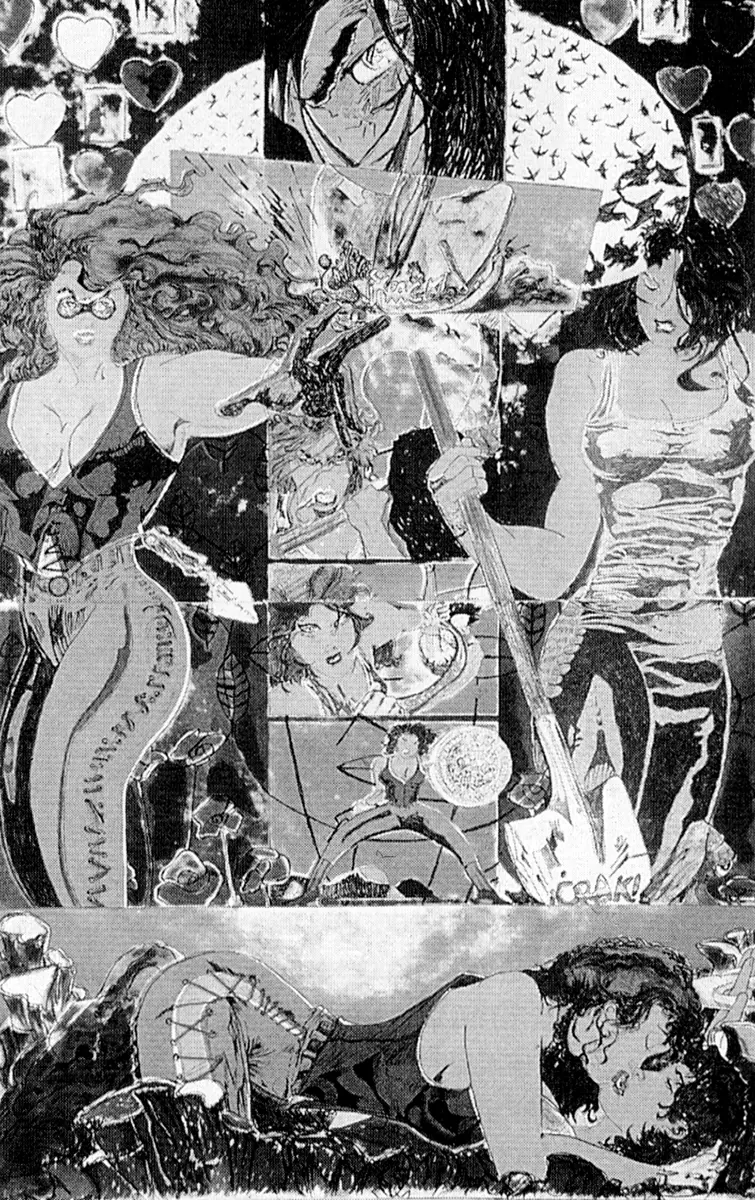
O’Neill’s painting has always been strong: it challenges and forces us to see things in a different way, to question, like Dante in his Divine Comedy and Cervantes in Don Quixote, our own journey. O’Neill has always been a painter even when she stopped painting for several years due to heading the most important electronic magazine in Latin America, the famous Cuarto del Quenepon. Both O’Neill’s handsome and controversial self-portraits and her beautiful, enigmatic maps of Puerto Rico, as well as the paintings-constructions which she presented at the Ponce Museum a few years ago, reveal an exceptional woman and an honest, brave artist. Through her work, she wants to make us the accomplices (as Nietzsche would say) of our presence and importance in the journey of which we are part.
This exhibition of work by Mari Mater O’Neill at the Botello Gallery in Hato Rey, entitled End Game, was an excellent show of painting that is well conceived and thought out. It reflects part of the reality we have lived in the twentieth century—the fusion of “reality” and fiction. They appeared first with comics, then with television and film as absolute presences, and finally with computer games and the Internet. Although O’Neill says that her work is based on comic strips, Pop art, and everyday reality, I can also see her new compositions as important mirrors in which we are present, from the television programs we grew up with to the absurd historical games that were served up to us in programs like Xena, Warrior Princess, as well as all the things that have been opened up as a result of the feminist movement of the 1970s, and the half-hearted kind of post-modernity that views us as the colony of the world’s most powerful nation.
For O’Neill, the presence of a Jet-Ski, a flying saucer, or a detail from a picture by Oller or Frade, is as important as the presence of Eros defining each one of our steps. Her new works are totally postmodern topographies in which she humorously recreates part of what defines us at the moment.
The title End Game suggests that we are at the beginning of a new “game” in which Mari Mater O’Neill takes us on a splendid but painful journey towards what we are and what surrounds us. There is no doubt that this is a controversial show, that many art lovers will not want to truly experience or understand. But this is what avant-garde art is about, to be “ready” long before the rest of us are.
MANUEL ÁLVAREZ LEZAMA