You enter the gallery like a grotto in the Mediterranean or the Gulf of Mexico to find yourself in the midst of a paradoxical video installation; further on, you can see a path along which the artist has worked with photographic objects. Such was the visitor’s impression of this show, one of the most solid of the current season. It was the first one-woman show by Monika Bravo in New York, where she lives. She was born in Bogotá in 1964 and subsequently studied and presented her work in Italy, France, England, Bangkok, New York, Colombia, and Greece. It was in Greece that she had her first individual show, from which the word Symphasis is taken. This was a successful exhibition in all respects: there was an expansive use of technology, an inter-relationship established between static and mobile elements, the transportation of urban realities to undefined fields, the transformation of the gallery space in a way that was appropriate to her specific aesthetics, rather than the adaptation of her contents to the gallery space, the alteration of our perception of the cubic space of city architecture, plunging us into grottos, a “fish bowl”, and undefined calm seas. The sensual and at times bucolic character of the installation included an occasional burst of red color that gave a kind of bloody touch to the sensual aquarium, which enveloped the visitor with a sensation of greenish-blue serenity.
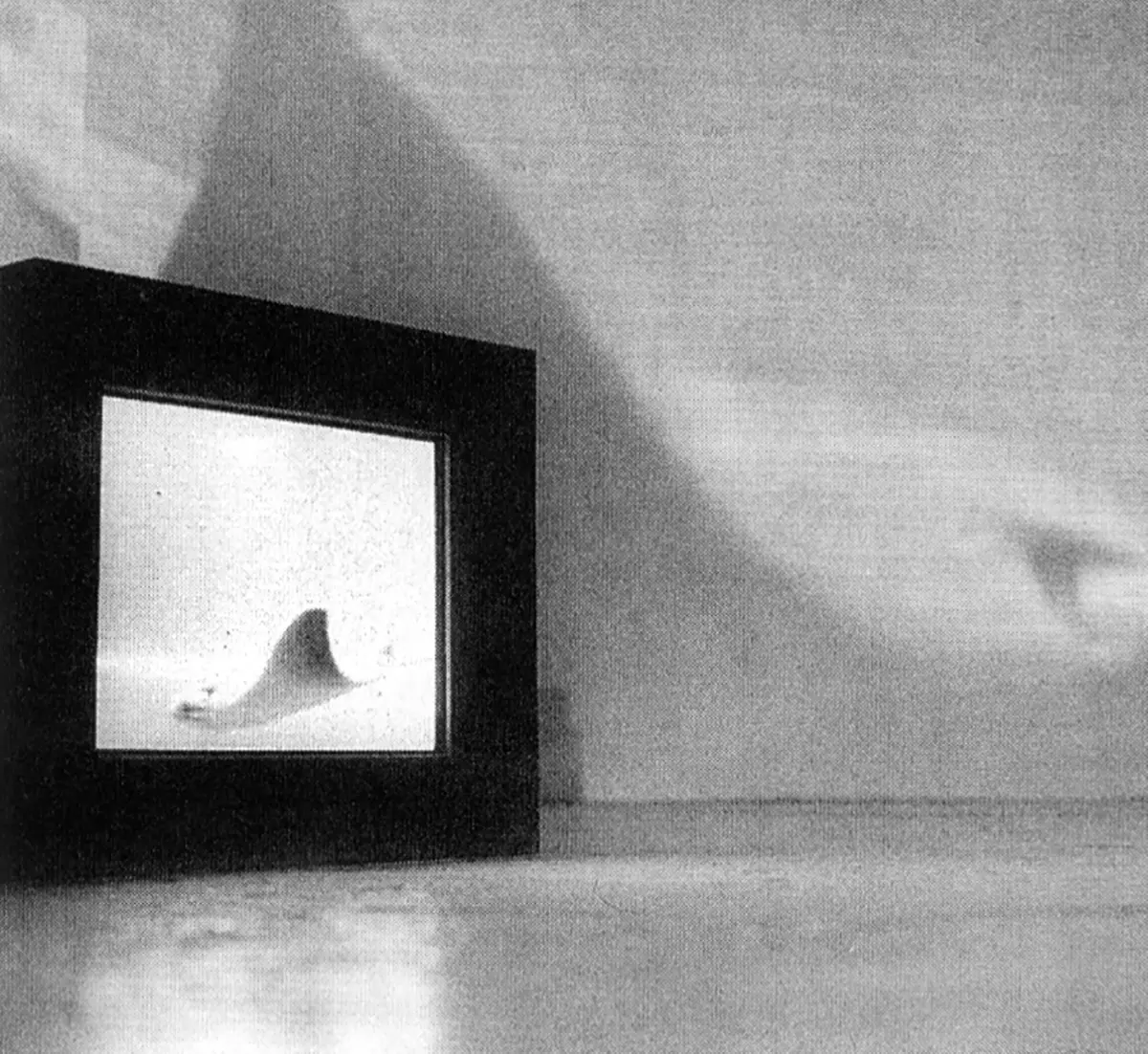
The movement of the fish emphasized the sense of simultaneity to which the artist referred, since we did not know where they would appear, what their movements would be, or for how long they would last. Neither did the video control the two aspects of time and movement as regards the spectator. Everything occurred simultaneously but with individual rhythms.
On noticing another space alongside the “fish bowl”, the visitor moves on, without wanting to abandon the aquatic experience, but at the same time keen to know what lies ahead. Stills from her videos, selected and mounted with precision, take the film work to another sphere of artistic expression, transferring the same elements from the moving dimension to the static realm, in an interaction with metal frames designed by the artist, in diptychs and polyptychs that looked as if they were rungs on a boat’s ladder and at the same time the thesis of a piece of photographic research. The question frequently asked "Who would buy this?” has an answer that is also “simultaneous and dynamic”: one or more female collectors, a museum, an enterprise working in the travel sector, a hospital, a concert hall that wants to encourage its public to listen to music rather than comment on the social events in the community...and the answers could go on. As regards simultaneity and different simultaneous appearances, intercultural relations were also expressed in the use of open spaces and nature and in the ambivalent and subtle use of technology. Almost at the same time as the inauguration of Bravo’s exhibition, I went to a province in Argentina to see another large “fishbowl”: a work of generative architecture by Alberto Rodríguez Saa (i.e., in a constant process of construction), which was different and unique in its conception, and which tries to make better use of water and achieve a better integration into the landscape. A week ago, an exhibition by Ulla and Gustav Kraitz opened in East Hampton. These Swedish ceramic artists create installations with natural environments that try to create a sense of serenity and integration, by creating situations that are ambivalent for the visitor who walks through the gardens, over the dunes up to the lakes. The sense of simultaneity in the work of Bravo, Rodríguez Saa, and the Kraitz couple is a key factor: although each of these artists resolves it in terms of nature, each develops his or her own sense of dynamics, originality, and language. The sensation of being outside the limits Bravo created in this installation might be explained by saying that the artist presented non-opaque screens that allowed the visitor to see and see through images, which continued to be reflected beyond the limits of the screen onto the darkened walls of the gallery, thus creating certain deformations in the architecture. The paradoxes of contemporary life are reflected in the work of Monika Bravo, who creates this formless aquatic space by breaking with and yet ratifying the laws of orthogonality. She alters our perception of the gallery walls while ratifying the concept of box or cube on the television screens which are inter-related through the visual signals they send out. By changing the space of the installation and changing the physical environment, the artist changes the parameters of reality, increasing or decreasing the experiences of simultaneity felt by the spectator. To what reality are we referring, to that of the screen, or that of the water and the fish? Or perhaps everything is a simultaneous appearance, with the reference being only to the video installation and the editing? The sense of fluidity is confirmed by the integrated sound, which can be guessed and even evoked mnemonically. The exhibition was accompanied by a carefully produced non-traditional catalog, the design of which was consistent with the nature of the installation. In conclusion, topicality, ecological aspects, professionalism, memories of Latin America, and other travel experiences all came together to make up the virtuality of this exhibition. It was a non-surrealist installation, which in various ways created a sense of oniric fluidity.
GRACIELA KARTOFEL