
Fleeting, but stimulating. Such was the presence of Pablo Helguera (a Mexican artist living in New York) in Bogota, where he carried out two closely related activities: his participation in a seminar on contemporary museographic practices and the presentation of his exhibition entitled The Vocal Archive of Florence Foster Jenkins. The common denominator in these events was the artist’s research and verification activity, which he used as a creative instrument in his work as an artist and museographer. Helguera the museographer investigates the origin and social-historical context of objects, while Helguera the artist also explores real and historical events, giving them plastic form and weaving them together in intense and suggestive narratives.
The museographical language used by Herrera (historical texts and documents, images and vignettes from encyclopedias, newspapers, and magazines) is only his apparent strategy. This is used to give the work a didactic dimension, despite its complexity, that obliges the spectator to engage in an arduous process of reading and exploration of the various connections, which underlie the narrative structures of the exhibition.
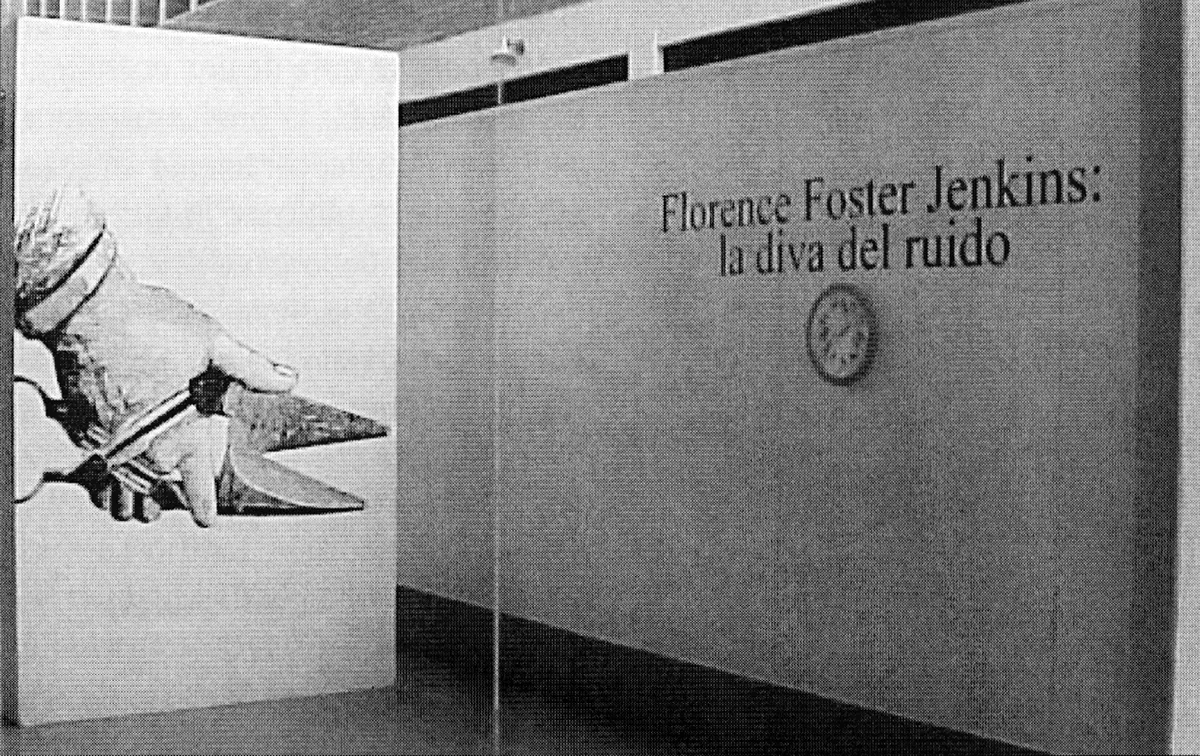
In fact, the narrative character of the “vocal archive” was the conceptual axis of the work. Helguera brings into play a number of narratives, which seem to be independent, though they are in fact subject to a subtle and suggestive association of ideas which encourages a multiplicity of readings.
The biography of Florence Foster Jenkins plays a protagonistic role here. By means of a handsomely articulated text, Helguera introduces us to the life of this legendary “soprano” who presented herself as a diva despite her evident vocal deficiencies. Helguera reveals his interest in questioning the predominance of formal elements by an artist and their validity with respect to a given public. He asks: is it worthy of praise to have an Eva Grinstein implacable faith, including in something about which we are mistaken? Is creativity as inextricable from human beings as the instinct to procreate? These questions merge into the story of this figure, obliging us to ask whether her existence was part of reality or imagination.
The earlier narrative component is complemented by two others which in my view form the second narrative block: the history of Alexander Moreschi (1858- 1922, the last eunuch recorded in history; and the delicate large format photo prints on translucent materials of extinct birds of the Americas and Hawaii. The third narrative element brought into play is the historical reference to the Crusades, the name given historically to the struggles of Christianity to recover the Holy Land.” This is represented in the exhibition by images and texts taken from printed sources.
These three components form the apparent structure of the visual text which is expressed through an intense exchange between image and literal text whose inter-relationship results in the interpretation, which is where the deep structures of the construction are to be located. While the entire biography of the diva is presented as a story, the images dealing with castration, the extinct birds, and the visual documents of a historical kind, act as visual agents that stimulate the implicit narrative. This gives rise to what we might describe as the deep structures that the spectator has to activate through a demanding hermeneutic process. Mention can be made here of the way in which various narratives are interrelated: those of repression, castration, suppression, and extinction. These ideas circulate actively from one narrative to another creating a network of associations that moves from the castration of the singer Moreschi to the annihilation of another culture by the Crusades and the extinction of the birds.
These ideas appear in all the narrative components and converge in the biography of the singer the focal point of the exhibition. It is here that the possible symbolic readings become evident. Her life emerges as the triumph of the idea of the natural artist; the suppressive nature of the critique of the diva is the counterpart of an obsolete practice, that of the castrated person. Aesthetic imperfection is vindicated, while aesthetic perfection (the contralto male voice) acquires a negative connotation. It is a triumph in its way of nature over artifice, of the will over subjection.
The strength of Helguera’s strategy lies in the conception of the work as a visual text. It proposes the action of an active hermeneutics, the meaning of which emerges from a process of interpretation between text and image. Helguera does not close off his contents or make them impenetrable but compromises himself with realities and specific historical densities, from which he offers a new kind of gaze and a new kind of meaning. It is a meaning that is constructed freely through allusive references that provide the necessary link between stimulation and thought.
Helguera conceives the exhibition as a whole with divergent narratives and solutions analogous to literary or cinematographic narrative.
Here one story predominates, although others are latent and no less important. The artist brings into play a very unusual dialectics in which particular elements act autonomously and contribute to the formulation of an open-ended, unfinished kind of whole. Thus the visual texts composed of several inter-relationships which together make up a multi-faceted and polysemic work.
Helguera’s practices require some consideration of the practices of contemporary art, although this is not the place to engage in extensive theoretical speculation. It is necessary, nevertheless, to indicate the artist’s conceptual affinities. The apparent dislocation of the visual text may be compared with the procedures of deconstructivism. Generally speaking, such procedures have sought the displacement or cancellation of meanings of a work within a specific context. Lyotard proposes game as the pure pleasure of engaging in play, the destabilization of meanings, and the encouragement of other ways of reading and looking. Helguera seems to endorse the doubts cast by Eco when he refers to deconstruction as “a mere game which disassembles the apparatus” (the text), but does not commit to anything. Helguera does not seek the loss of meaning of the visual text, but rather its active reconstruction; the meanings do not cancel out one another but are inverted and made problematic once again. In the midst of so much deconstructive speculation in the field of art today (at least in Colombia) where the term “deconstruction” is often used to justify works that simply play with the idea of dismantling the whole and presenting its component parts as a purely formal exercise, Helguera’s work is paradigmatic.
In contrast to so much vacuous and meaningless speculation (what Adorno calls “the formally false in the loss of meaning”), Helguera uses certain deconstructive procedures not to recreate them in themselves, but to reinvent, in plastic terms, a new meaning. It is for this reason that his museographical strategy of investigation, clarification, and contextualization of the visual text, which is like an archeology of motives and in this case of a real event does not compound any crisis in aesthetic meaning but rather encourages the reconstruction of meaning. In this way, his Vocal Archive of Florence Foster Jenkins is the reinversion of a real story which is given strength and meaning by other stories. Thus the work acquires the necessary verisimilitude to go beyond the merely procedural considerations to attain a level of creativity where it is almost impossible to distinguish the dividing line between fiction and reality.
RAÚL CRISTANCHO