
The Claude Bernard Gallery (one of the most prestigious on the Left Bank in Paris) recently presented 24 oilworks on canvas by Roberto Matta small and medium-sized works done for the most part between 1997 and 2000. The Chilean painter who is now almost 90 expresses his youthfulness in large essence of his pictorial being. Matta remains faithful to his palette of cold colors (greens and blues), where the emphasis this time is placed on fluorescent and acidic greens, counterbalanced by incandescent reds, as if to express, within this symptomatic sense of abundance and profusion, the vitality and energy which inspire him.
The work on space, on the meaning of space, remains however at the center of this work, as a subversive and invigorating aesthetics. But space has acquired an additional autonomy, for the famous blotches still present a few years ago have given way to a predominant effect based on matter. Compartmentalization and fragmentation, both constructed and moving, no longer function exactly with the same circularity. Everywhere there is a sense of implosion/explosion created with the complicity of the combined use of brushstroke and matter. There is an abundance of pictorial “knots”, which are like pivots that concentrate the pictorial and symbolic energy, punctuating the space and playing perhaps the role previously assumed by the transparent blotches, bringing together into more precise points the plastic discourse and visual grammar. In these recent works, Matta’s pictorial writing is released with the stain or the diluted “stroke”, which is both painting and linework.
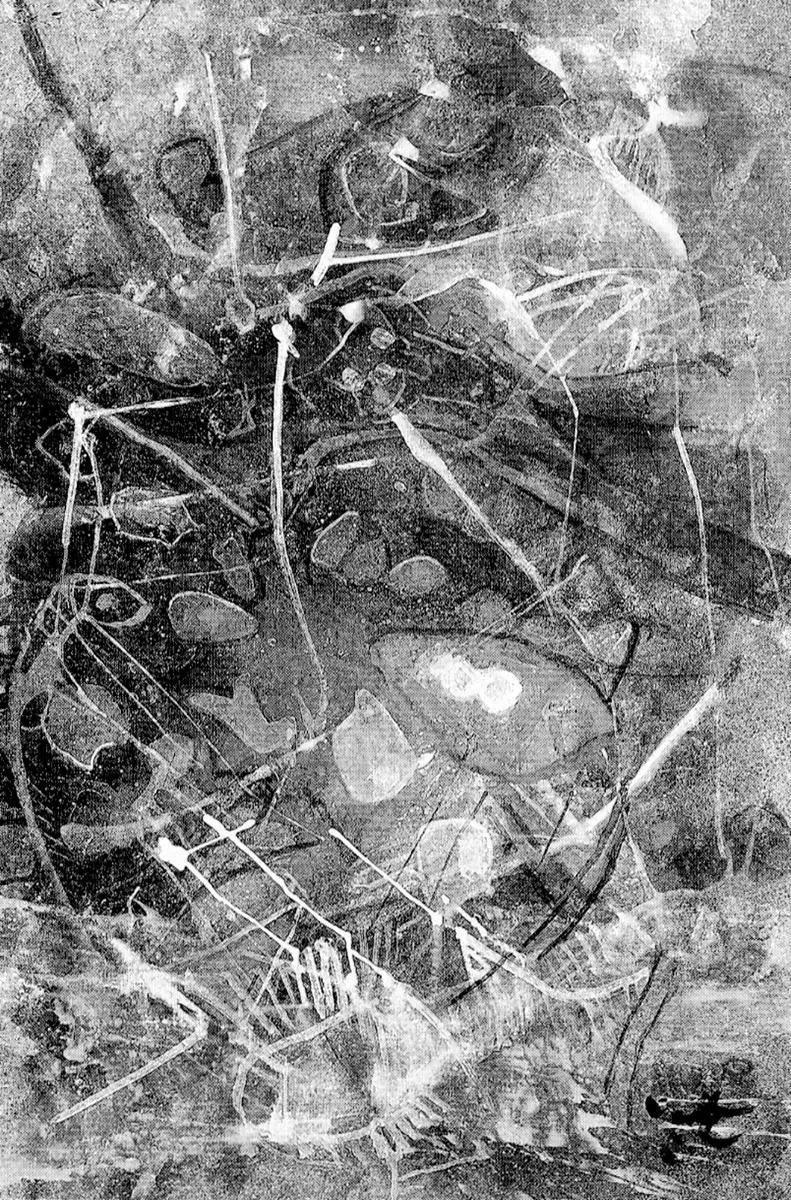
In a magnificent work from the older pictures included in this show, Mineral Voice (210 x 260 cm, 1988, oil on canvas), the warm colors orange, red, and earth colors dominate in a very volcanic world where eruptions, conflagrations, “bursts of energy” (of which Matta speaks) zig-zag across the canvas like flashes or fleeting trails. We are at the heart of a new mineral and electric landscape, even if we are still in a painting that is both spatial and earth-bound. It is a material and transparent universe, light and solid, and yet enveloping and invisible, like a spider’s web.
Some other large format works treat space in the same way, by incorporating forms that constantly return, such as the broken dented circle (which has always characterized his spaces) and which rolls along, bringing with it other rounded forms (red stains) or sketched circles. The pictures are sometimes rather geometric like Terrakama (210 x 295 cm, oil on canvas, 1998) or Mira Ia Mira (160 x 214 cm, oil on canvas, 1998). These works are shot through with this twofold kind of energy the energy of the physical force of the body and the more abstract energy of the waves that make the fleetingness of time radiate, the heart of imperceptible things vibrate, waves which are the very soul of these new works by the artist. A few reminiscences, in the form of totems and disappeared effigies, make a brief appearance, as in lnhazardant (180 x 215 cm, oil on canvas, 1998), and it was a delight to see that the fantasies of the artist have lost nothing of their vigor or meaning.
In some canvases, such as L’horoscope du jardin (138 x 93 cm, oil on canvas, 1997), or La Cumbre del Fuego (145 x 172 cm, oil on canvas, 1998), we come face to face with the organized chaos that is dear to Matta, and which is closer to irradiation overflowing with forms and colors. The iconographic codes, like palpable “proof” enabling us to recognize the works as typically those of Matta (more mechanical, more technological), have here become effaced and diluted into a polychrome tachism, sustained by an almost invisible structure where only transparent or evident forces (forms, stains) emerge, like the indications of some new eternity.
The small canvases, which accounted for almost half the works on show provided a sense of balance since they revealed another dimension of the iconographical discourse as well as of the pictorial and symbolic discourse. With a pleasure in narrative that is more evident in these works, Matta continues to display his mastery of space in these little scenes which are like drawings or prints, where once again there is an interplay between the freedom of form and the word. In a range of blues, greens, and yellows, the light from the red stains bursts forth like a wound that restores life.
At the center of the exhibition, there was an immense picture entitled L’original de l’originel (200 x 315 cm, oil on canvas, 1998), which appeared as the emblem of this world of Matta which is constantly renewed and yet always the same. From this tangle of lines in permanent convulsion, there emerges an energy that creates a real sense of vertigo. These two superimposed “worlds” which Matta has painted in strata which are nevertheless interwoven below, the ardor of the pictorial brilliance, and above, the ardor of the gesture and the infinite lines, are both moments of eternity that is confirmed in the wordplay of the title, and which is not so enigmatic as it appears. For “to enter into the matter”, as Matta writes, “is to enter into an ocean of lives.”
CHRISTINE FRÉROT