
Sergio Bazán (Buenos Aires, 1962) has always been attracted by the idea of the abstract language of musical notes, movements, and scores, which he now paints on monochrome backgrounds. He is also interested in the possibility that someone may or may not read it as something different, as something not belonging to a musical system.
Even though most of these large-format paintings literally transcribe sections of original scores of contemporary music composed by Alcides Lanza (an Argentinean musician who participated in the experiments at the Di Tella Institute in the 1960s) or allude to such religious works as Bach’s Magnificat, this show at the Diana Lowenstein Gallery was more enigmatic than revelatory.
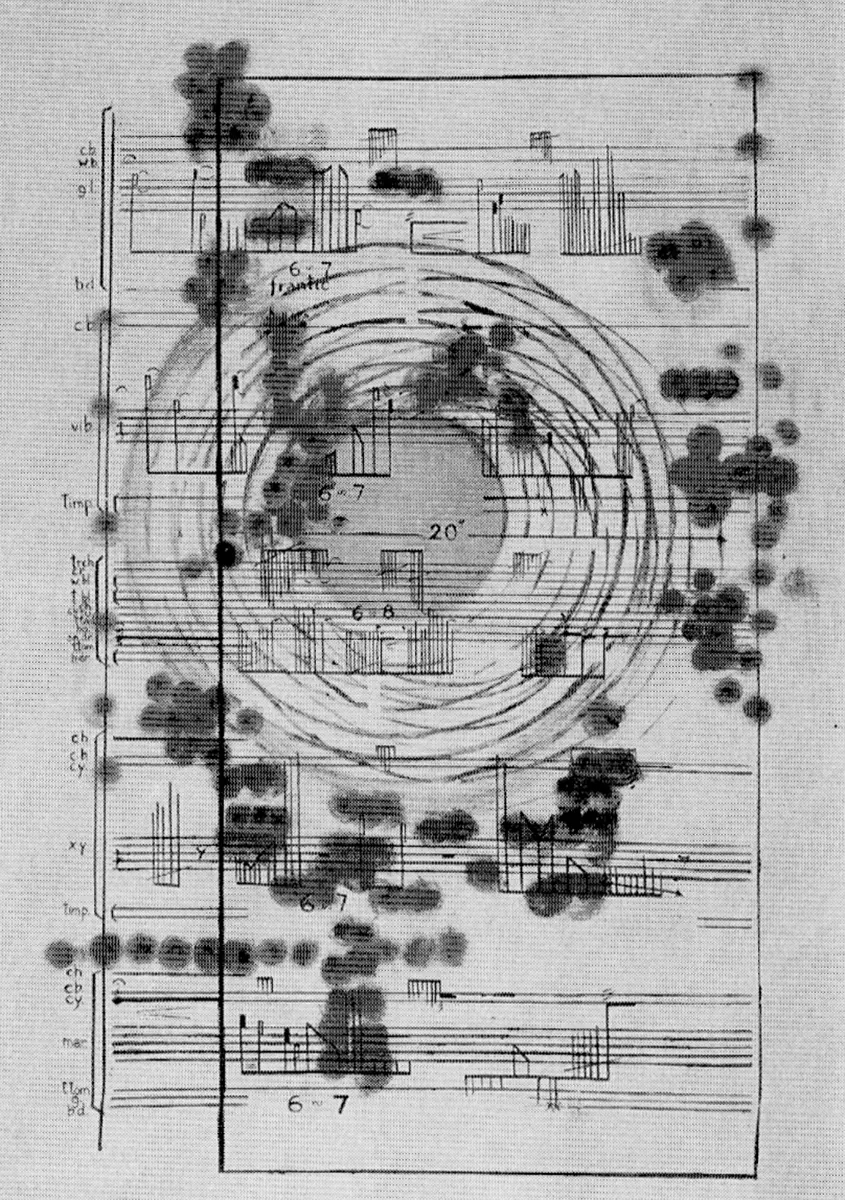
Thus the Latin and Italian words of the Magnificat function as thin—or empty?—lines of meaning floating in what seems to be a sea of organic forms and almost de-centered circles, from the center outwards, and stains of white and black light. In other pieces, such as Network and Prelude in Hospital V.S. Bazán uses the musical signs and fragments to construct a narrative that suggests the remains of something without a name, incomplete images on indefinite textures. Are they private symbols, blurred memories, or repressed emotions?
The works in this new “musical” series seem to move within a strange and ambiguous lyricism, while the announced sense of rhythm is thwarted by stains and doubts that suggest setbacks rather than certainties. However, for some people, certain aspects of these pictures might seem to be decorative. At time, the musical notes begin to dance and may even suggest a joyful ode to life. It is precisely this point of ambiguity, which Bazán tries to capture in his work.
His relationship with music is not new, neither in his work nor in his own reality. As an adolescent, he thought he might take up music as a career. He moved between rock and the visual arts until he finally made his decision. He still likes to play the piano, but his life now revolves around his artistic activity, mainly in the form of paintings, although he studied sculpture for at least three years with the well-known artist Juan Carlos Distefa no.
"What I most like is jazz. I listen to music very often. In my painting, as in jazz, there is a lot of improvisation. It is not something mathematical but I think that I have a basis here and then, depending on what is happening in my life, my work takes particular features and nuances... There is always an intention transformed into metaphor, into a poetic flight of fancy, and this is really what my work is about. I am not worried about what other people might think, but I believe that I work with my head, with my memory of experience, but not in any referential manner. I believe we all work with what we are. In the end, we are the product of where we live, of what we feel do, and have. Although I always try to make my painting as least confessional as possible," he told ArtNexus.
"Yes, music which makes me think in various directions is one of my earliest and most persistent memories. I listen to music for different reasons, whether good or bad: to feel a sense of exaltation or to find refuge. Music has this capacity to make what is painful beautiful to transform sadness into beauty. Of course, sometimes the opposite happens, and the chasm becomes deeper; that also attracts me," he adds.
These enigmatic pictures take us on a journey toward a state of mind that is different from what we might think at first sight. The more we look, the more we discover a host of unexpected allegories and contradictions. There are no certain affinities or connotations here. The accents change their functions and the black colors may become joyful and the musical notes somber.
His images, which are shot through with ambiguities, seem to promise something which they cannot deliver. They are the silent witnesses that remind the spectator of the melancholy absence of sound. In the same way, with their traces of a language that is unable to communicate any lasting links, the paintings from this series seem to confirm the fragility of meaning and the illusory nature of an imminent harmony that never arrives. Is this what they are all about?
Bazán says that despite some indecision, these images mark his “departure from music.” While he meditates on his next moves, the artist continues to teach. His workshops are lively meeting points, overflowing with imagination and an enthusiastic desire to work. In close contact with his students, Bazán too places his bets on diversity and the lack of restraint.
VICTORIA VERLICHAK