
The opening of Bernice Steinbaum Gallery in Miami’s burgeoning Design District was the occasion for a collaboration by two of the most renowned installation artists, Amalia Mesa-Bains and Pepón Osoria. For many South Florida art lovers, this was an introduction to one of the most diverse and democratic groups of artists represented by a gallery anywhere. Bernice Steinbaum has long had a mission to exhibit works by women (50%) and people of color (35%: Asian-American, African-American, Latin-American, Native-American) in her New York gallery, and with the move to Miami, she brings her celebrated group, including Miriam Shapiro, Carmen Lomas Garza, Luis Jiménez, Hung Liu, and Ken Aptekar to the Miami scene and a welcoming new audience.
The installation/collaboration of Amaia Mesa-Bains and Pepón Osoria, entitled Relocation, Separation, Transition, and Transformation, features the first art gallery exhibition of Transboricua, one of Osoria’s renowned community installations first seen at the Rhode Island School of Design Library, followed by the Young World Children’s Department Store in Harlem, and the El Museo del Barrio in New York. Combining sculpture, photography, video, sound, and an array of found and handmade materials, the tall figure of a man standing in the center of a locked, fenced-in area guarded by a stuffed peacock is immediately identified as a Puerto Rican by his pava hat and the small Puerto Rican flags covering his suit. His clothing bears the names, images, and icons associated with Latino people. Osoria uses the peacock, a symbol of transformation, to provoke questions about change, identity, and transculturation.
The same issues concern Amalia MesaBains. Her Mexican and Chicana heritage plays a vital role in her work as she explores ethnicity, gender profession, and identity in complex projects that bring history, religion, politics, and memory together. In a remarkable installation, done expressly for the gallery’s inauguration, her work dominates the space physically, emotionally, and intellectually. El fin del siglo: Latina World’s Fair 2000 is dedicated to Latina women who have made an impact on history, fashion, labor, and science. Divided into “halls” that invite interaction and contemplation, the work addresses Latina women’s contributions to life and culture through the ages. Beginning with a timeline of the 20th century marked with the names of Latina women who have had an impact on history, she encourages viewers to include their own additions, from family to personal relations to historical personages. Photos, objects, and other notations transform the wall into an area for milagros, offerings for the famed and forgotten.
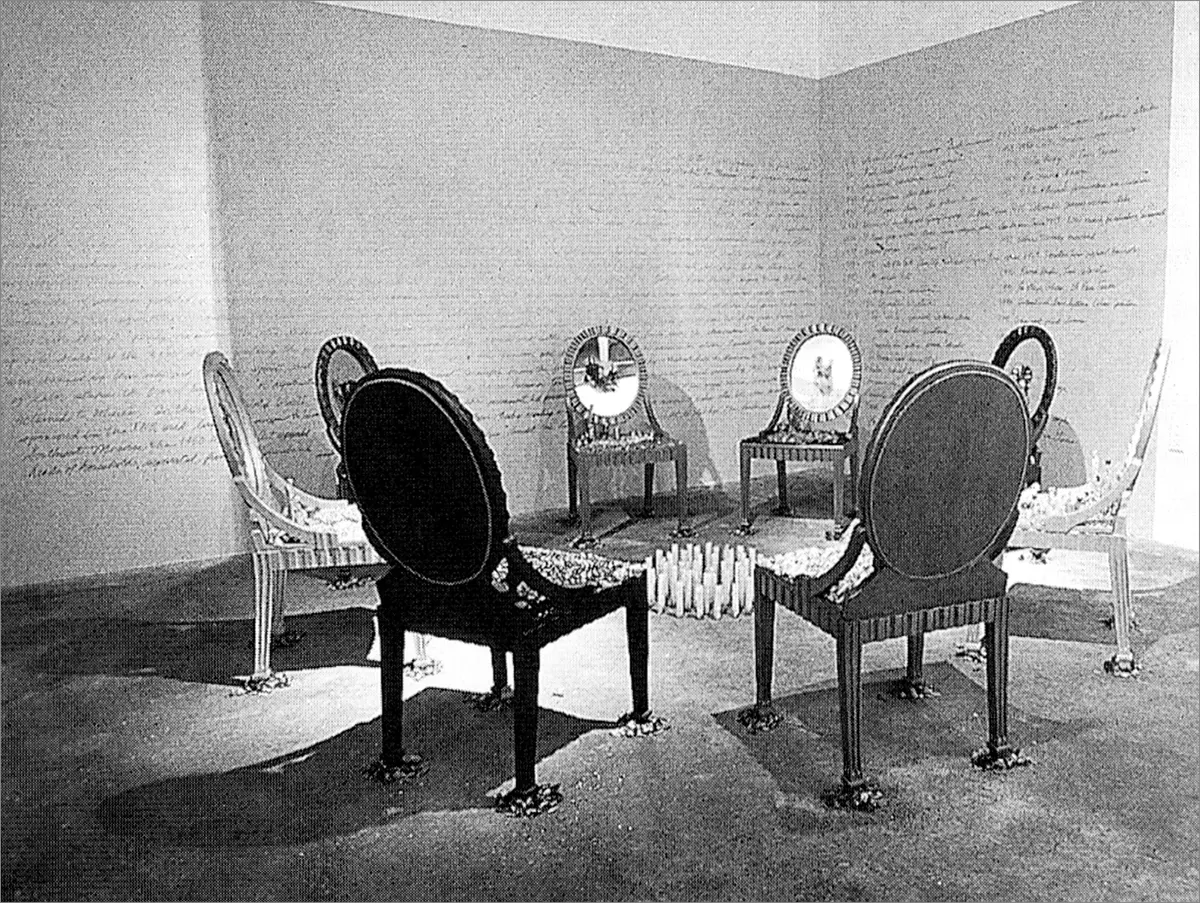
The Hall of Fashion is based on the wartime exhibit Teatre de Ia mode, when French fashion houses were forced to close and sent their collections in miniature to the United States. In tribute to Latina fashion icons, including Frida Kablo, Evita, Carmen Miranda, and Rita Hayworth, she sets a parade of costumed dolls before a wall mural with Castas paintings of the 19th century that depict the racial mixtures of the New World—the first racialized notions of beauty. The Hall of Labor is a Circle of Ancestors that begins with the Aztec goddess Coyolzualqui, who pays image to soldiers, farm workers, nuns, her family, and, finally, herself as the descendent of their significant contributions. Using a circle of chairs decorated with beads, jewels, glitter bullets, candy, and other materials and distinguished by photos on their mirrored backs, she addresses the dignity of labor and the working class as the foundation of social structure.
The Hall of Science brings everything together in the most disturbing commentary about the plight of women, racial stereotypes, and scientific racism promulgated for years in museums throughout the world. In stark contrast to the banners that present “exotic” images of women as gendered categories for scientific investigation and titillation, a laboratory arrangement of beautiful hand-blown perfume bottles celebrates the artistry, accomplishments, and significance of Ana Mendieta, Tarsila do Amaral, Rita Hayworth, Gabriela Mistral, Maria Felix and the Black Virgin of Monserrat in a uniquely fascinating manner that questions concepts of allure and ideas of beauty. Mesa-Bains presents notions of beauty and its association with adornment, and the long history of the struggle of women to affirm their contributions to culture and society, and the common good while asking why they are still misrepresented, stereotyped, and objectified. Her installation is a perfect introduction for a new gallery ready to explore and expose contemporary issues regarding gender identity and acculturation.
CAROL DAMIAN