
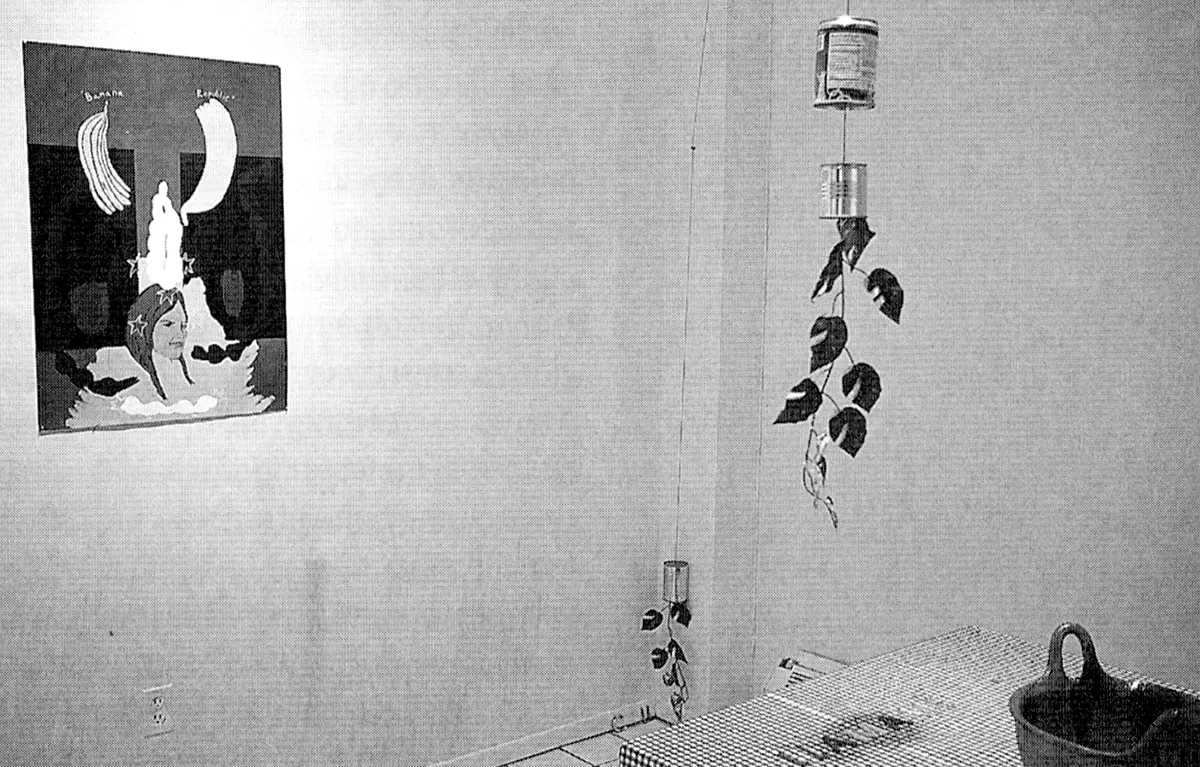
A table near the middle of the gallery with traces of food is the focus of Daniel Guzmán’s most recent solo exhibition, Magical Mexican Bean. The exhibition at the fairly new Art & Idea Gallery on the Upper West Side includes a couple of can-and-string telephones, plastic plants, and music selected by the artist. Guzmán also exhibits some of his pencil drawings and acrylic paintings thus offering a perspective on the wide variety of his work, which also includes video and wood sculptures.
Guzmán’s corrosive and ironic humor appears at its best in this show’s centerpiece: the familiar gathering place, that is, the table of food and drinks. For many people, this, the main attraction of any art show opening and here it takes center stage. The work deliberately takes a second place to the music, the atmosphere, and especially, the conversation of the crowd. By presenting his show as a pretext for sharing free beers and having a party, Guzmán is making fun of the one subject that seems to be immune to his sarcasm art and the art world At the same time, he transforms the show into some sort of rudimentary communication technology, though instead of focusing on the idea that the artist should communicate with the public, he encourages the viewers to communicate with each other.
Guzmán’s drawings are pieces of a bizarre puzzle in which words and images form an intuitive and personal diary or a chaotic comic strip. In a style reminiscent of graffiti and the banda esthetics (Mexican urban youth gangs’ appropriation and renditions of familiar images, from commercial brands to rock paraphernalia), Guzmán uses, cannibalizes, and turns upside-down popular iconography. His work with pencil on paper ranges from furtive and simple messages to baroque and obsessive compositions of amoeba-like monstrosities. His drawings evoke the pages of a notebook where a teenager has drawn away his anger, frustration, and boredom. In these series, the artist goes from the confessional to the childish fascination with the grotesque, the obscene, and the macabre. But behind the corny horror of every drawing of one of the members of the band Kiss, Guzmán’s work reflects on the very real anguish and confusion of a colonized culture dominated by a constellation of replaceable and displaced idols (Che Guevara, Kurt Cobain, Sylvester Stallone), media indoctrination, cheap and empty cultural references and pulp sentimentalism. But just as the artist seems to be very concerned with the influence of American culture in Mexico, he seems to be interested in the Mexican cultural virus that is spreading through the United States (Speakie Spanie).
Guzmán’s work could be compared to Raymond Pettibon’s simple but intensely idiosyncratic drawings. Both artists use word and image to weave intricate and cryptic visual narratives through their installations of multiple individual drawings. But while both use literature, cinematic influences, and many visual references, Pettibon creates an elegant and lyrical body of work, while Guzmán goes for the jugular, for emotional responses and for the immediate confrontation of the viewer with elements of our common past transfigured in a disturbing and yet familiar format. In that sense, his drawings have some resemblance with the chaotic voracity of Jean-Michel Basquiat’s work.
Even when Guzmán employs recurring motifs, his single drawings seem to be stranded in emptiness, neither connected with figuration, storytelling or abstraction. As a whole, each series of drawings creates a delirious internal dialogue, suggests intriguing associations, and builds conundrums with a pantheon of rock heroes, a collection of sexual puns, and assorted childish images. Guzmán’s universe could be considered “a space of zero-degree culture”, as feminist Nancy Fraser has said. Guzmán has chosen to use “poor” materials such as cans of beans and a diversity of found objects that he collected while walking around the city. With the same ingenuity, passion, and black humor with which Guzmán picks up discarded physical objects from the street (“... as a kind of garbage man, playing with notions about the exotic and the faraway,” as he explained) the artist plunders the garbage bin of the recent history of pop culture in search of strange, forgotten or shameful memories.
The main difference between Guzmán and most of those who have exploited the fascination for the culture of misery is best reflected in his phrase: “Careful there is no beauty in misery.” Poverty here is presented like some sort of waiting room. Just like Vladimir and Estragon in Samuel Beckett’s Waiting for Godot, Guzmán’s characters are inexplicably trapped in limbo, waiting to be liberated or redeemed by something or someone that most likely will never arrive.
NAIEF YEHYA