The Museum of Modern Art recently presented an exhibition of paintings dealing with the Trujillo dictatorship, at the same time as a major literary event, namely the mass circulation of the latest novel by Mario Vargas Llosa, La Fiesta del Chivo, which shook the foundations of our individual and collective memory. But this was a mere coincidence.
The artist responsible for the pictures at the MAM, Freddy Rodrídguez, had not been informed of the launching of the book or of the visit of the great Peruvian author to the Dominican Republic. He wanted to present in his country a series of pictures, painted for the most part in 1990 and 1991, and previously shown at the Jersey City Museum. At the same time, another series of his pictures was on show at the Larrama Gallery, entitled Forever Paradise, which can be seen as a preparation for the second series.
Since his adolescence, Freddy Rodríguez has been an opponent of tyranny, and his family quickly took him out of the country during the repressive period, which followed the execution of Trujillo. He completed his secondary education and formal art training in New York, where he settled. His professional career has also been pursued in that city, although he has participated in exhibitions outside the United States and made sporadic returns to his native country.
In 1974, at the National Biennial, he presented a geometrical painting, in the line of optic art. His first militant commitment was an abstract work, whose plastic lines followed a movement, which was unknown —if not rejected— in the country at the time.
In this memorable biennial directed by Gomez Sicre, these were the only paintings that emphasized line, rhythm, and color. From then on, the artist never abandoned the challenge. Rodríguez went on to become a pioneer in the sphere of installation art, and his creations/altars on the theme of santeria also marked a break with the established canons and resulted in considerable debate. He tried to remain in Santo Domingo, but the conservative atmosphere of the time and the lack of understanding of his work led him to become an “absent” Dominican. His success in the harshly competitive world of North America was a reward for his seriousness and his persistence in producing art that marked a rupture.
To these formal challenges, Rodríguez has, since the 1980s, faced the challenge posed by his themes. His construction of installations spattered with blood, in a reference to the death of the journalist Orlando Martínez, did not win him any prizes at the 1999 Biennial, despite the fact that the work was very moving. But it did attract attention and generate debate amongst the most forward-looking viewers.
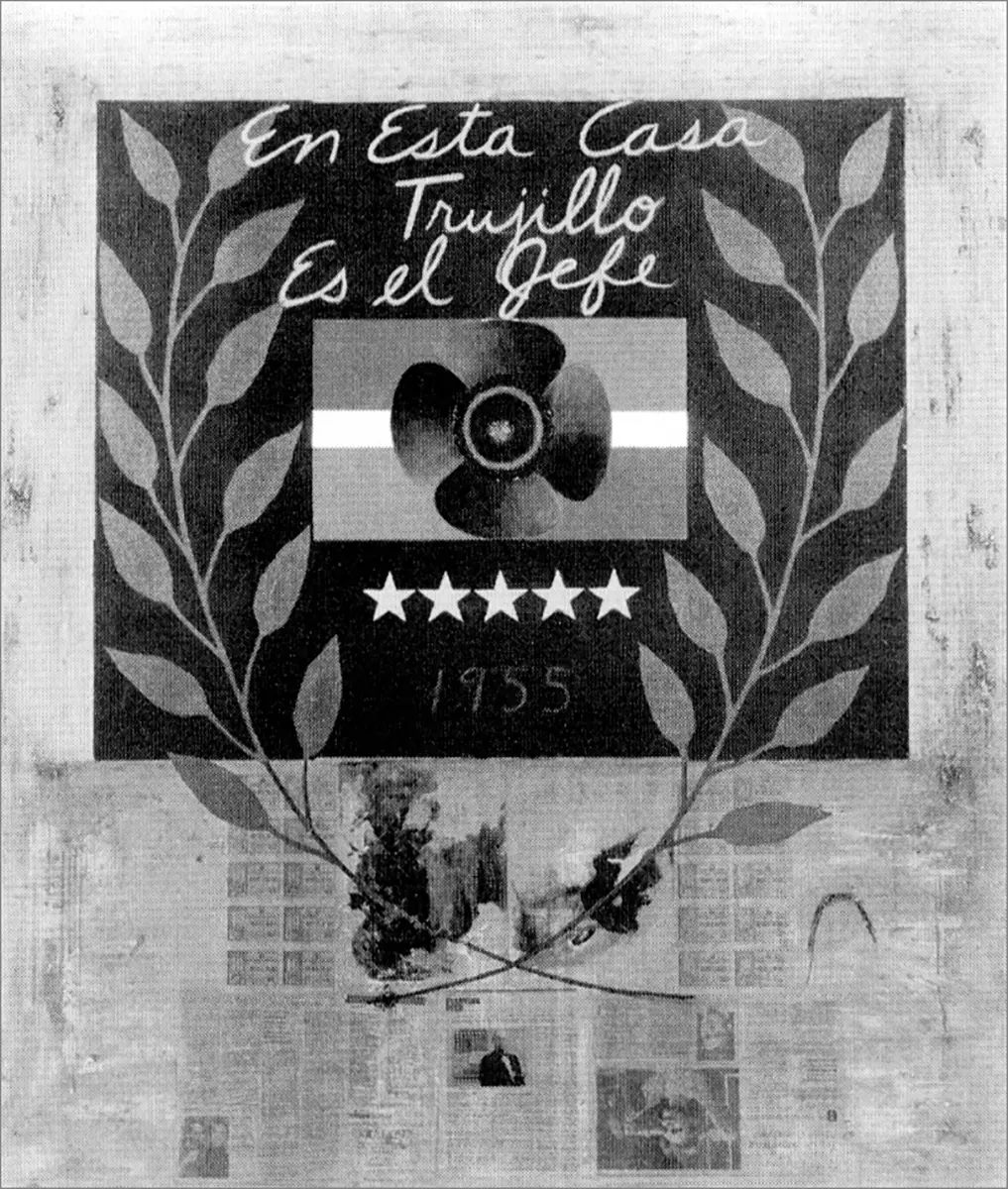
This new series of paintings inspired by the Trujillo dictatorship has the overall title of In this House Trujillo is the Boss, a symbolic sign and violation of intimacy, in the form of a small plaque placed in Dominican homes during the tyranny. The show comprised works done between 1990 and 1991, although the montage began with an earlier canvas, from 1983, which is entirely pictorial and characterized by a new and violent kind of expressionism. It does not need any more figurative precision: the burning colors, the wounding stakes, and the suggestive presence of the shark all plunge the spectator into a kind of Dantesque Hell.
In the sequence itself, the spectator can discover a textural process, which Rodríguez has used since the beginning of the 1990s. He has done research into the use of collage, mainly in the form of newspaper applied to the canvas, a personal version of papier marouflé, carefully selecting the pages and designs, if not the actual thematic content. The pigment is acrylic, of different consistencies, and occasionally mixed with mineral substances, all of which give considerable vitality to the surface.
Where does Trujillo hide or appear? In recurrent bloody stains, signs, and insignias, emblems which are reproduced literally (stars in National Symbol and Chapita), as well as written words which are integrated as plastic elements and direct messages, as well as the ineffable names of Great Dictator or the slogan of Chapita, and the anguished question of “Until when?”.
The works acquire an extraordinary lyricism through the fragile and exquisite butterflies—symbols of three martyred sisters, the flower—rather disturbing, like open eyes, the laurels—like lamentations, the sacrificed heart, the structures and informal/formless rhythms of the canvas entitled Paradise, the thematic development of which was presented in the show at the Larrama Gallery. There is also a codification of color—hot but often dirty, where the reds play a protagonistic role, along with the ominous blacks.
Freddy Rodríguez blames not only Trujillo but history since colonial times. A voracious reader he refers to Los Perros del Paraíso, a novel by Abel Posse. The thesis is that if oppression and tyranny come down to us from colonial times, then Trujillo simply marks a historical culmination.
The one-man show that Rodríguez presented at the Larrama Gallery was made up of 14 medium and large format paintings, almost all dating from between 1987 and 1990. They ironically presented a “Forever Paradise”, which was not necessarily that of the Dominican Republic, but of the tropical Antilles in general. The discovery destroyed the earthly paradises, and since then implacable attempts have been made to forge The Other Side of Paradise, the title of the last work in the show.
Very similar in style, signs, and spirit to the series inspired by the Trujillo era, this picture is less incisive in its symbols and reference texts, although it is curiously more violent in its colors, the size of the motifs, and its almost sculptural pictorial texture. The flowers, which are sometimes enormous and evil-looking, conjure up a planetary structure or some devouring body. In this exhibition, with its difficult and radical treatment of themes, there is none of the tenderness, which the artist feels for the victims of the tyrant or the suffering nation. The pictorial drama is focused on the forces responsible for the tragedy, including religion, which have even managed to turn nature upside down. In a contradictory way, Forever Paradise is more oppressive and painful in pictorial terms than the hells created by Trujillo.
MARIANNE DE TOLENTINO