
In a cultural panorama full of uncertainty, the Sala Mendoza in Caracas presents an exhibition program of great quality and dynamism. This was once again confirmed by the exhibition last March by Juan Carlos Rodríguez and Maira “Cayita” Bello, entitled Mara-Yanomani. The exhibition “put on show” the relationship which, for a number of years, has inspired the plastic artist and seminarian priest from the Disciples of Christ Church, Juan Carlos Rodríguez, and Maira “Cayita” Bello, a scrap dealer from the district of La Bandera in Caracas. The dialogue established by these two artists went beyond everyday pleasantries to become a demiurgical kind of exercise, in which they constructed an imaginary universe, co-propagandized by the Indian women Mara and Yanomani, who were dressed and who danced “in the image and likeness” of their ancestors.
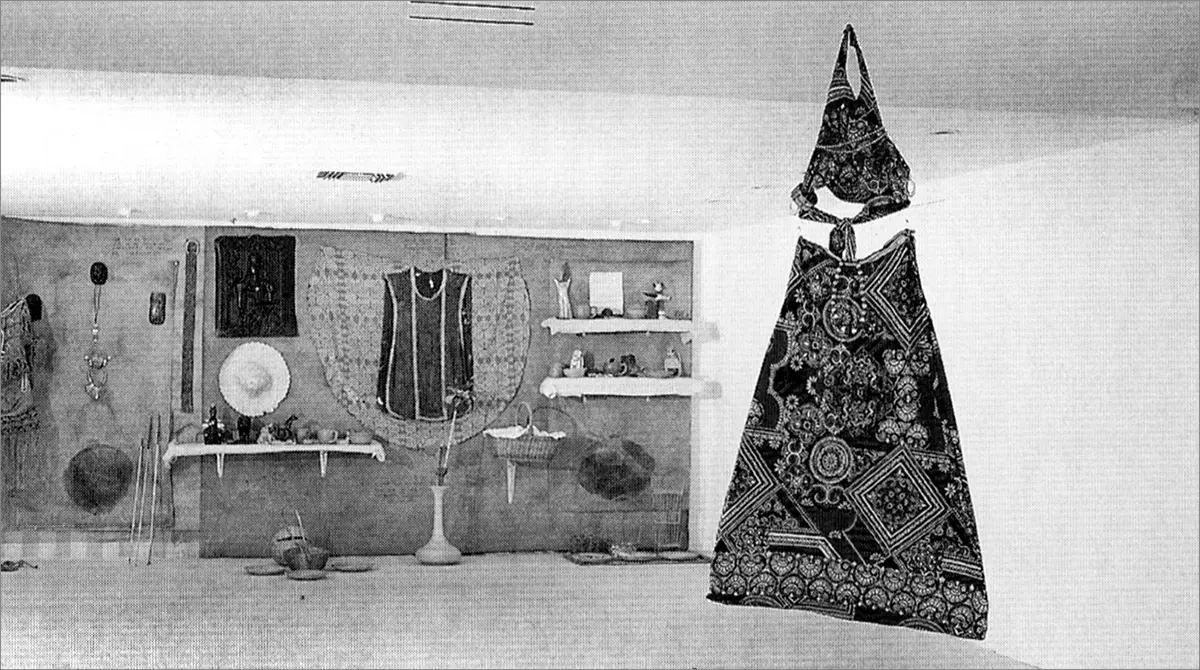
Although the links between ethnography and art are becoming increasingly frequent in contemporary culture, they are rarely focused on the study of urban communities. It is precisely this aspect that is the main objective of the work of Rodríguez and the tales of Cayita. They are not trying to elucidate the meaning of the Amerindian cultures in the distant jungle regions of our geography but within the human conglomerations around the hills of Caracas. Here, Mara and Yanomani are reincarnated in the flesh of Cayita, who imagines their discourse, paints her face, and dresses like them. Cayita invokes, whereas Juan Carlos facilitates the ritual. The result was a show organized on the basis of photographs, videos, objects, and texts that reflected these four figures and their various points of view. The proposal was structured like a didactic journey, in a parody of the exhibitions organized by museums of science or ethnography. In line with this idea, the voices of the protagonists were dubbed and edited by the Maya’ya Foundation, a fictitious body that is supposedly engaged in the study of indigenous groups in South America.
In fact the exhibition suggested a number of different but complementary considerations. Firstly, the “main” authors Juan Carlos and Cayita became fused with the fiction that they were creating, thus neutralizing the possibility of usurping the voice of the other or violating their integrity. Instead, authority was exercised by an abstract or illusory body the Mara’ya Foundation, which not only reflects the details of this relationship but exercises a patrimonial control over it. Secondly, the use and “musealization” of non-autochthonous objects, without any “real” ethnographical value, establish a critical distance with regard to the fetishism that to a large extent characterizes contemporary proposals on the subject of the Amerindian cultures. Thus the vessels, images, and artifacts brought together in this exhibition did not refer to any occult ritual from some unknown community, but to the everyday experience of Juan Carlos and Cayita, who used them to “put on show” the Indian figures of Mara and Yanomani. Thirdly, this was a proposal that did not refer to any specific place. All that we know is that geography is also a construct, i.e. an imaginary territory. If it were not so, how could fiction and reality be fused together in the same scene? What reason would there be for two Indian women to spend the night in an urban neighborhood?
The relationship between Juan Carlos, Cayita, and the figures they have created results in a kind of experienced-based anthropology, rooted in everyday life rather than in the supposed objectivity of some external observer. In this sense, the exhibition was “set” within a fictitious context that does not transform the strangeness of the “other” into some kind of trophy. It allowed a questioning of the models of representation that promote an idealized image of both Amerindian cultures and urban communities. Beyond the anecdotal level, there was also a desire to show the complementary relationships and exuberance of a shared imagination. Cayita is both Mara and Yanomani at the same time. Juan Carlos is the priest, the artist, and the anthropologist. The neighborhood is the jungle.
FÉLIX SUAZO