Not all international tendencies have the same chance of developing in Argentina. This was the case with Pop art and hyperrealism. However geometric abstraction and conceptualism have in the River Plate area had a number of practitioners. It is precisely the crisscrossing of these two currents that Juan Carlos Romero (Avellaneda, a province of Buenos Aires, 1931).
American Way of Life (1966), a work that introduced his show at the Museum of Modern Art (MAMBA), reflected a decisive influence: that of Fernando Lopez Anaya, his teacher in experimental printmaking. What we have here is a perfect concordance between content and form, which is the result of the precise cut of the press and the cold repetition of a white module. American Way of Life does not only provide documentation on the American invasion of Vietnam through a collage of journalistic photographs but also comments on events in constructive and formal terms.
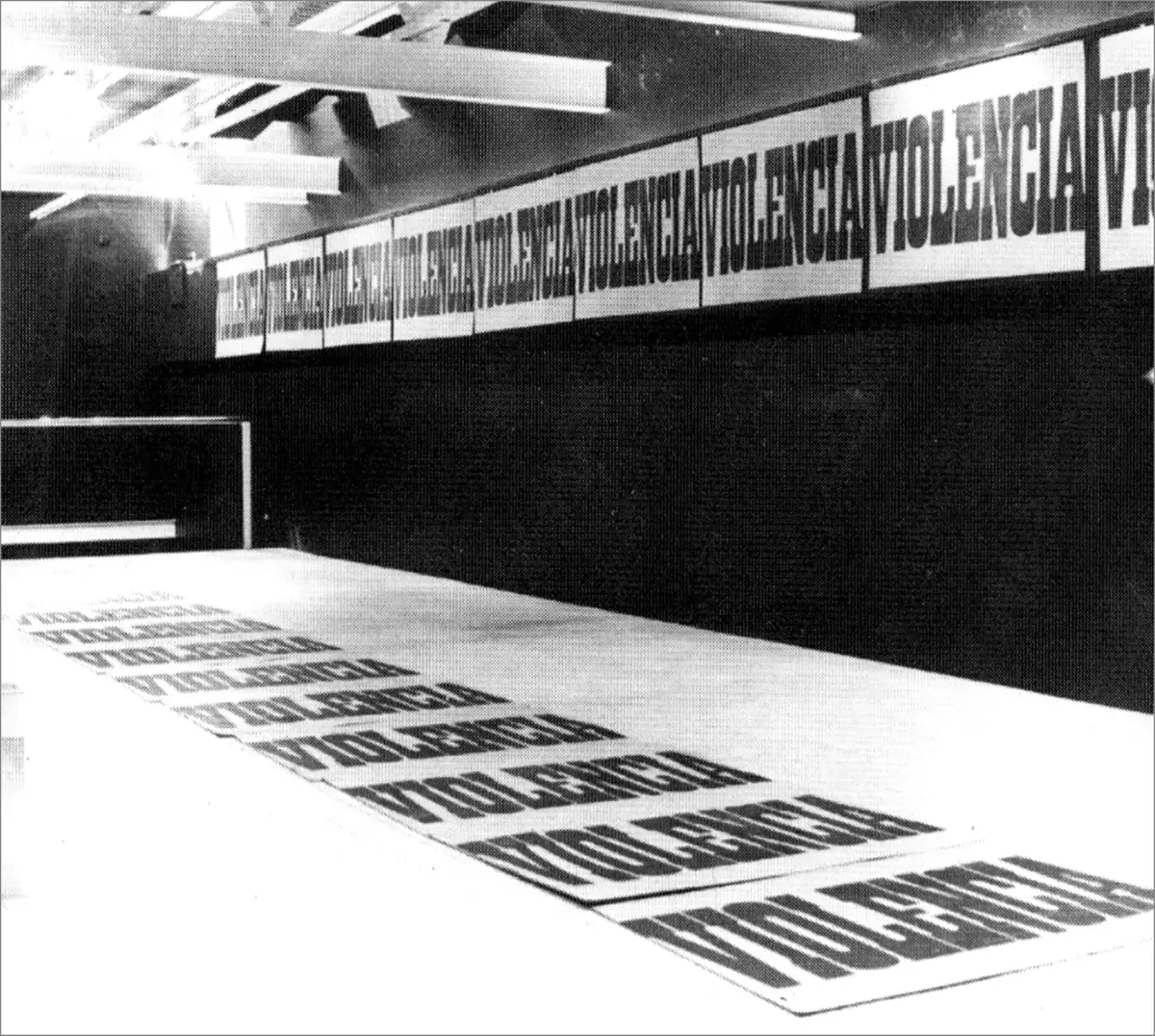
If the artist made use of the codes of geometric language, and in particular the variables of measurement, sequence, rhythm, and repetition, it was precisely because these elements create an intensification of critical awareness. This awareness is also evident in such works as The Fruits of the Quebracho (1972), with a photographic sequence revealing the exploitation of nature and man, and Violence, which was presented at the Center of Art and Communication (CAYC) in 1973. The reader will recall that in 1971, Romero joined the Group of Thirteen, which was directed by Jorge Glusherg, under the auspices of the CAYC. The group, which was conceptualist in its orientation, included in its ranks such figures as Luis F. Benedit, Víctor Grippo, and Alfredo Portillos.
Violence is the title Romero gave to his most recent show of work. The title recalls, documents, and updates his exhibition from 1973, which was an early example of installation work: a genre that came into fashion in the late 1980s. At that time, Romero’s strategy consisted of covering the floor and walls with signs that repeated the word “violence” in large letters. By inundating the space, the artist emphasized the meaning of a text that had been distributed and which read: "Violence is everywhere. omnipresent and multiform: brutal open, subtle, insidious, hidden, rationalized, scientific, condensed, solidified, consolidated, anonymous, abstract, irresponsible.
“One of the crucial points marking a fundamental difference between Latin American conceptual art and that of Europe and the United States is its ideological content,” wrote Gillo Dorfles, recalling at the same time the importance of the political element in the work of such artists as Joseph Beuys.
The ideological slant of Latin American conceptualism is clear in all the work of Romero, an artist who began to be active in politics at age 17 when he worked in a factory and was a staff delegate. With the passage of time, art would become for him the hest site for resistance and negation, i.e., for radical protest against all forms of power. Not only political power but religious as well, as can be seen from his series documenting collective suicides under the influence of leaders of fundamentalist religious sects.
The schematic but significant selection of works from the 1970s at the MAMBA helped remind us of the contribution of this artist whose work has still not been sufficiently studied or documented. In addition to representing Argentinean ideological conceptualism, Romero was one of the first artists to develop the concept of a multiple work based on photocopies. In Argentina, he has been one of the main proponents of postal art, political posters, visual poetry, electronic art, and actions in open spaces. As a member of the Escomhros group, in the city of La Plata, he carried out actions based on the “aesthetics of broken things” a critical reference to the irrational exploitation of nature, unemployment, hunger, and the nefarious consequences of reason when it is transformed into an instrument of domination. What was important for this group was to work outside the institutionalized circuit. “Our gallery is the street,” they proclaimed in their first manifesto.
For Romero, the main enigma against which we must constantly fight is oblivion. "It is easy to think that acts of genocide, disappearance, violations, racism, religious fanaticism, and terrible social inequalities that have occurred throughout history have taught us nothing. I believe that everything is easily forgotten." Helping us not to lose the memory of these things and creating a wave of collective awareness would therefore seem for Romero to be the best justification for art today.
ELENA OLIVERAS