
For Julio Larraz, visual reality has long been the result of an intense preoccupation with plastic forms combined with serious intellectual investigation. Fascinated by shapes and forms, color relationships, and interesting points of view, he maneuvers and choreographs the elements of his compositions for heightened perspectives and unique interactions. Land and sky, beautiful cloud formations, and fragmented architectural elements perform with the same ease of association as the fruits and objects so carefully arranged and magnified in his still-life tableaux. He has an extraordinary ability to focus and amplify a common object in order to impart new associations and force the viewer to consider aesthetic interaction above meaning. A white onion is transformed into a celestial body in Approaching the White Planet, 1999, and the curvature of a green apple appears to dominate the lovely highlights of a lemon for a solar dance in Luna, 1999. Placed against the infinite darkness of outer space, fruits are examined as plastic forms and compositional entities, serious concerns for Larraz who is intent on exploring the psychological aspects of visual perception and recognition through the analysis of physical objects.
This exhibition of recent works (1 999-2000) reveals other key facets of the artist’s exploratory approach to the depiction of visual reality, as well as the breadth of his sources, which derive from his interest in the historical, mythological, political and sociological, and an impressive collection of books. Coupled with his vivid imagination, these intellectual resources provide rich material for works that permit entrée into a fantastic world made plausible and brought up to date through the painterly vision of a gifted realist. In La Chambre du Roi (Chamber of the King), 1999, and La Chambre de Ia Reine (Chamber of the Queen), 1 999, paper crowns rest beside the decidedly modern canopied beds of the sleepers, alone and rather un-royal. Despite their provocative titles, the paintings consist of a carefully composed selection of elements that is as successful in its design as an abstract arrangement as it is a glimpse into someone’s private reality. Sensuously painted, they are complimented by another work, La siesta, 1999, which features a more evocative fragment of entwined legs that is equally engaging for its design and is a sensuous peek into a more enticing reality. The king may also acquire new meaning within the context of some of the other works in the exhibition that make reference to ancient lore, especially when he revisits the intriguing story of the legendary King Minos.
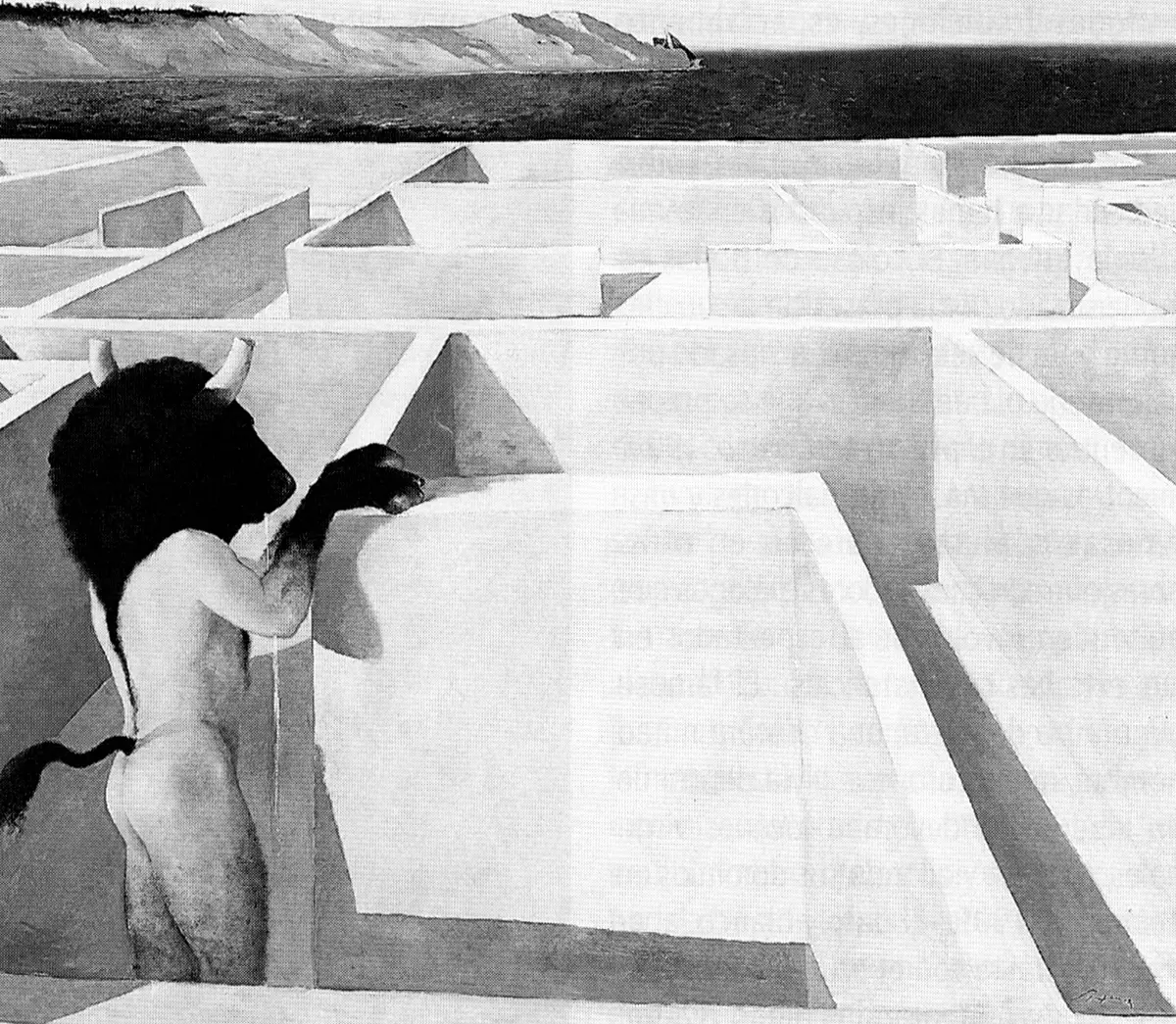
The most fascinating paintings are devoted to subjects inspired by Greek mythology. The Colossus of Rhodes is modernized by the presence of a sleek new white sailboat dwarfed by a huge bronze foot as it prepares to sail into the harbor in Coloso, 1999, while masks, falcons, and mysterious creatures appear in other works that are captivating dialogues meant to engage the viewer in their bizarre circumstances. The famed minotaur of Crete, a half-man, half-bull creature that lived within a labyrinth and devoured virginal youths, is shown surveying his domain in Laberinto, 1999. The labyrinth’s stark white maze contrasts against the blue of the island’s sea, from which the children will arrive. The beauty of the work belies the tragedy of the story and its implications for the future. Another work, Brindis (Toast), 1999, features a female nude wearing a falcon’s mask toasting an absent companion.
Such erotic overtones within strange scenarios elevate the works of Julio Lar
raz above mere depictions of the real or imagined into the realm of the subconscious. Exquisitely painted for mesmerizing effects that emerge like strange dreams, his haunting scenes invite numerous interpretations and endless questions.
CAROL DAMIAN