
The latest works of Manfredo de Souzanetto tackle the threefold challenge of matter technique and form. The works were done during the five months of an “artist’s residence” in the Arts of Fire Workshops at the National School of Decorative Arts in Limoges-Aubusson, with the support of the Brazilian Ministry of Culture. The use of non-conventional materials allowed the artist to introduce new spatial proposals, with greater freedom of form in the contemporary treatment of the three dimensions: from the expanded polyurethane foam that Cesar used in the 1970s to the rhodoids of Jesús Soto, from the fluorescent tubes of Dan Flavin to the felt pieces of Robert Morris or the resin works of Jaume Plensa. In the case of the Brazilian artist, the restrictions imposed by the technique on the carving and forms — in particular during the firing process — posed difficulties of adaption to his art and required infinite patience, which was not diminished by successive failures.
The interest of this experimental residency in the heart of a porcelain-making province had a two-fold objective. First, to open up a new field, that of contemporary art, a technique traditionally applied to functional objects. Secondly, it permits the initiation of an artist in this technique, with a view to developing a personal project. For Manfredo de Souzanetto, the learning process was an arduous one (around 12 hours a day) and the results were meager in terms of quantity since the technique is slow, complex, and unpredictable. Backed up by a technician and two teachers from the School, the artist — who did his own pieces himself — was not required to achieve any results, and had exclusive control over the works produced during his residency.
Established during the 1980s by the Ministry of Culture, the artists’ residencies have been developed throughout all the regions of France. Their objective is to take creation out of its original context, by encouraging the artist to discover another medium, confronting him or her with nature or a community with which they can exchange knowledge and experience. The residency may, as in the present case, initiate the artist in a new technique. The National School of Decorative Arts at Limoges-Aubusson, directed by Otto Teichert, has organized residencies since 1999, beginning with invitations to three artists from France, Japan, and Brazil. For the last ten years, this region in the center of France has pursued a very dynamic policy in the field of art, as part of the policy for the decentralization of culture. At present the region has a considerable infrastructure for the dissemination of contemporary art, making it one of the most important regions in this respect in France as a whole. Its institutions include the Regional Fund of Contemporary Art (FRAC), the Vassyvière Art Center (constructed by the architect Mario Botta), the Museum of Meymac, the Chateau de Rochechouart, the Arthothèque in Limousin and the Paul Rebeyrolle Foundation.
This exhibition, presented in two rooms, was conceived as a confrontation between 38 porcelain works and works in polychrome wood, which is the artist’s customary medium (II sculptures done between 1994 and 2000). I will concentrate on the porcelain works here, although the meaning of Souzanetto’s experimental work lies in the nature of the relationship or differences between these new works and his earlier production.
The first room was a former greenhouse of the Museum, which means that the visitor on the outside was able to look through the big glass windows, rather like a voyeur, at the installation created by the Brazilian sculptor at the Arts of the Fire Workshops. In this space, which is both closed and open, but with no physical access for the public, the artist suspended (by means of almost invisible nylon thread) thirty porcelain pieces in the form of “bells” or “pointed hats”, at different heights and in a reduced range of colors: greens, turquoises, ochers and greys.
Similarly, the register of forms was reduced to two, of the same size. The color was obtained through a preliminary mixture of the paste, although in some cases, the pieces were colored after firing. The work on texture resulted in alternating smooth and brilliant surfaces with others that were rough and mate, similar to the polychrome wooden pieces. However, these formless forms were related to primary forms (bags, roundness, cavities, grottos), which gave them a timeless quality. The installation acquired its full aesthetic, poetic, and metaphorical meaning in the darkness of the night, under the artificial light, which brought forth all its mystery.
In this way, the question of time (of both the technical execution and the changing and fixed nature of these punctuations in space) was reflected in the installation, as well as in the spirit of the porcelain works presented in the main room. It was also present in the ordered and precise stages of the manufacturing process, which raised the problem of the loss of control by the artist over his work. Firing is an uncertain and unpredictable process over which the artist has no control. The duration of 6 hours and the temperature of 1340 degrees involve the creation of space and time, which introduce discontinuity into the work time, from the modeling to the final product. The material escapes the artist, because it is subject to another kind of law, that of fire, which reduces by 14 percent the volume of the porcelain under the effect of the intense heat. Frequently, the hour of truth proves to be fatal. Manfredo de Souzanetto made several abortive attempts and had to abandon a number of preparatory drawings and re-examine others. The work would become scratched or swell, or the change of color proved to be unacceptable. The artist was obliged to modify certain forms because their full transposition was technically impossible, making it necessary to adapt the work to the technique, even if theoretical adaptation seemed possible. The relationship with real or virtual time in the apprenticeship of new ways of handling his material led him to reflect on form but also raised questions about skills and craft.
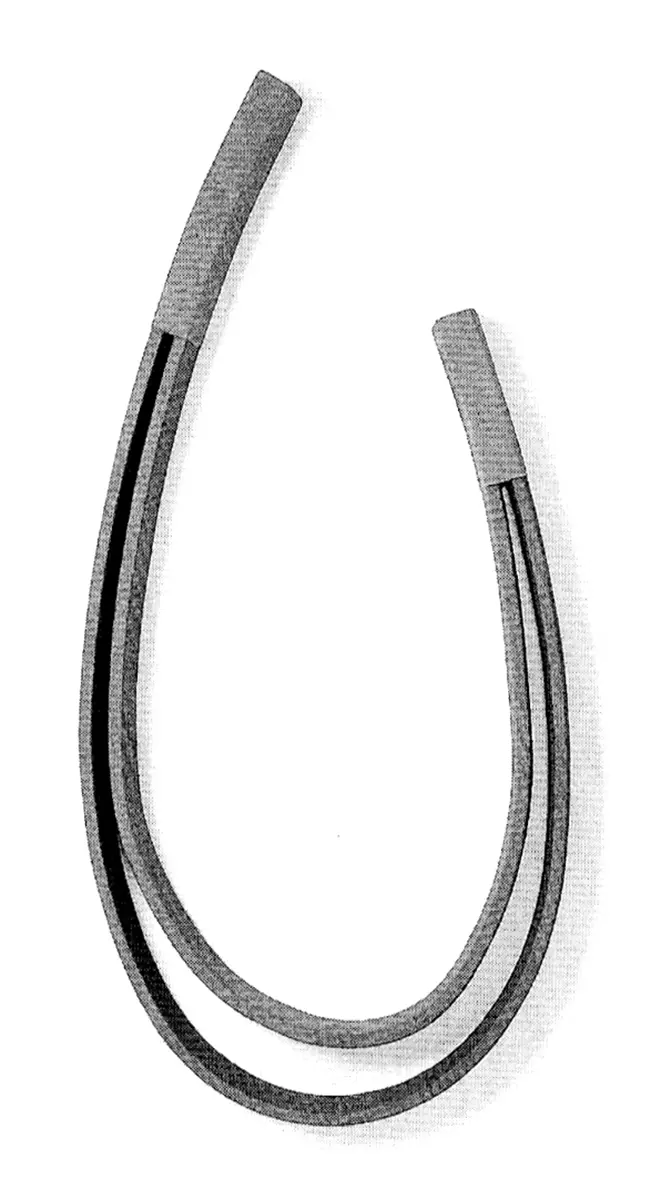
The eight porcelain works presented in the large rectangular room reflected the artist’s journey and his hesitations in the exploration of form. Conscious of his limitations and subject to various kinds of restrictions — it was impossible to repent — he had to move towards a more organic kind of work in which the desired intensity of texture resulted in a balance being established between opacity and transparency. And yet the pieces had a certain fragility about them. The almost imperceptible “swelling” which slightly broke the usual geometrical rigor made the forms come closer to those of nature (bones). With these new experimental forms, Souzanetto created a kind of “writing” which took him away from construction, while the transition from geometry towards “calligraphy” reinforced the impression of a more carnal connection with nature. There is an imperceptible break in the course of events, which humanizes the form. In this process, the artist feels himself more of a sculptor than a constructor.
There are also breaks, but these are recuperated by the artist. Souzanetto kept the fragments, remains, waste material, and the “shavings” (which he calls traces) which he decided to line up and present in a glass case. As has been the case for many centuries, the relationship with time, matter, and technique becomes an unavoidable reality and the artist has to separate himself from time to achieve fullness in his work and treatment, which are occasionally shaken by the surprises of form. What do a new technique and materials contribute to the essence and definition of a work of art? The question arises when the references change, become lost, or renewed. Souzanetto’s exhibition raised a number of questions concerning the relationship between form and “know-how”... Although installations do not normally give us the opportunity to engage in a reflection, which might seem to lie outside the scope of the period in question, the problems of the meaning of work remain at the heart of a contemporaneity concerned as it is with the question of time.
CHRISTINE FRÉROT