
I met Nam June Paik for the first time during the summer of 1968. At the time I was directing the International Artists Seminar at Fairleigh Dickinson University1 with a series of guest artists among which were Marta Minujin, Michael Snow, Allan Kaprow, and Emmett Williams. It was the latter, as a Fluxus poet, who suggested I invite both Paik and the cellist Charlotte Moorman to give some concerts during the seminar.
The first contact took place in Paik’s studio, where I found myself threatened by precarious piles of jumbled television sets. Without any soothing effort, Paik proceeded to plug them in and move enormous magnets over the screens. Mysteriously, the images were transformed into sine curves, some moving, others static. It was all very simple, devoid of tricks. There were no pretensions of any technological wisdom or aesthetic refinement. What I was witnessing was simply an act of cultural sabotage. The intrusive and insidious fluidity of information media had been transmuted into an innocuous dance. Paik hadn’t presented me with an act of destruction, but one of channeling. The magnets acted as dams that halted an enormous river and left it trickling into courteous designs. During the ensuing conversation, Paik described himself as an artist coming from the “first post-television culture in history.” Korea had vast television installations until the broadcasting centers were wiped out by the bombs of the Korean War during the 1950s.
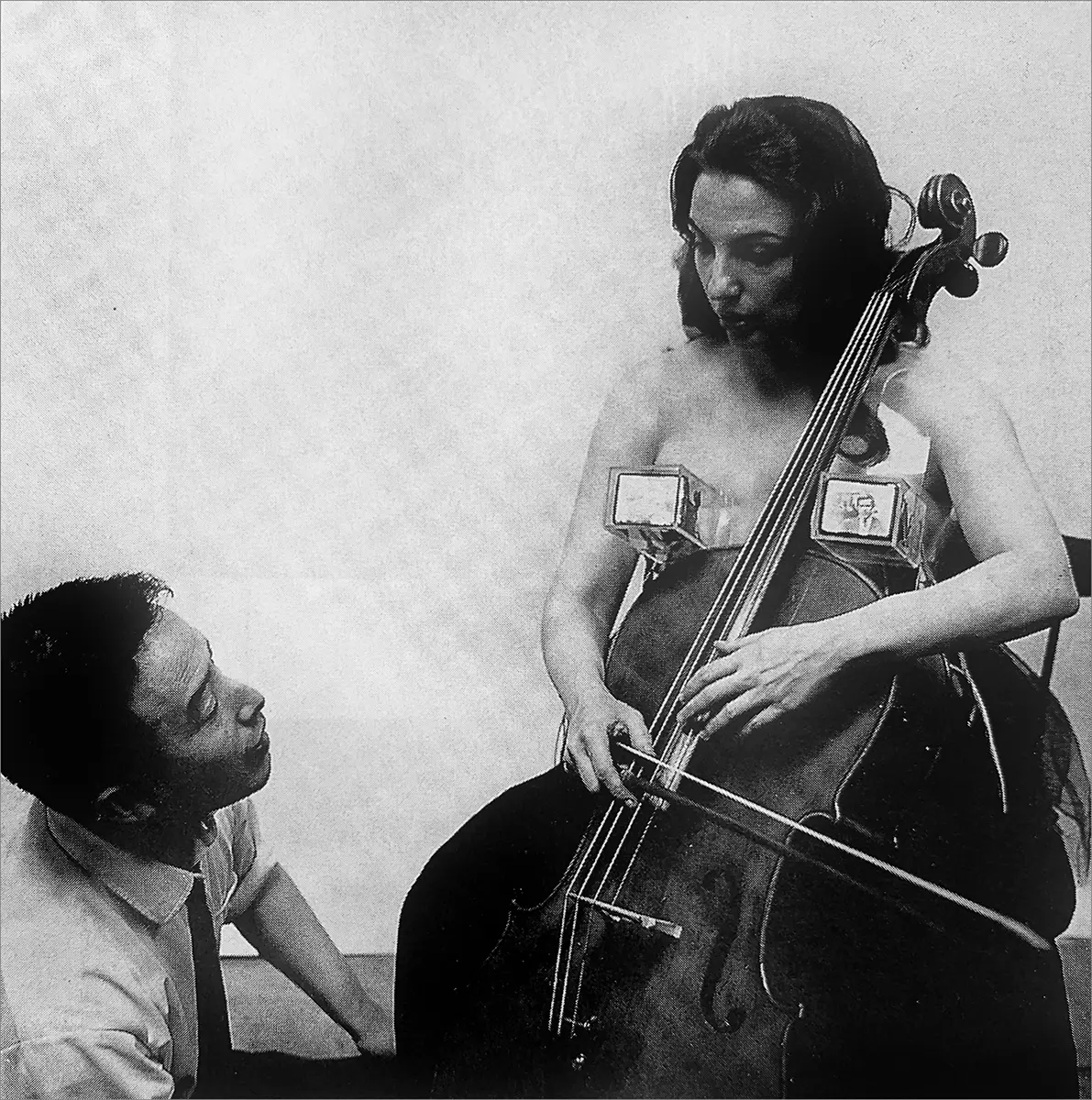
By the time we met, Paik’s myth was already well-established in international avant-garde circles. He had demolished pianos during a concert in 1959,2 cut John Cage’s tie during a performance in 1960, and was known for smashing violins during his concerts from 1962 onward. In 1967, he had been in prison with Charlotte Moorman for “indecent exposure”; the “exposure” had taken place during the performance of his opera Sextronique, where Moorman had played the cello with her breasts exposed. It was during a time when Lenny Bruce went to jail for cursing on stage and it was fortunate that the Paik-Moorman duo hadn’t been similarly punished.
What was most amazing in this adventurous life was that both Paik and Moorman were rather shy people and didn’t fit the profile of exhibitionists.3
Both with and without Moorman, Paik continued to develop a form of “aesthetic of clumsiness” where the stress was on the challenge. There was in his work an anarchic sense that was aimed at the power emitted by the work of art. The results managed to offend even his admirers. By 1965 Paik had exhibited an enormous and primitive robot (K-456, of 1964) that moved extremely slowly, and was on a permanent verge of collapse among hundreds of ping-pong balls scattered on the floor (if I remember correctly). It was one of the most courageous exhibits the Galería Bonino ever presented in New York.4 Not only did it ignore the prevalent aesthetics, but it went against the even more traditional taste the gallery was known to promote. Paik’s anti-aesthetic attitude continued well into his presentation at the Venice Biennial in 1993. There, among the spirit of anti-national globalization, intended that year by the current director (Achille Bonito Oliva), he acted as one of Germany’s representatives.
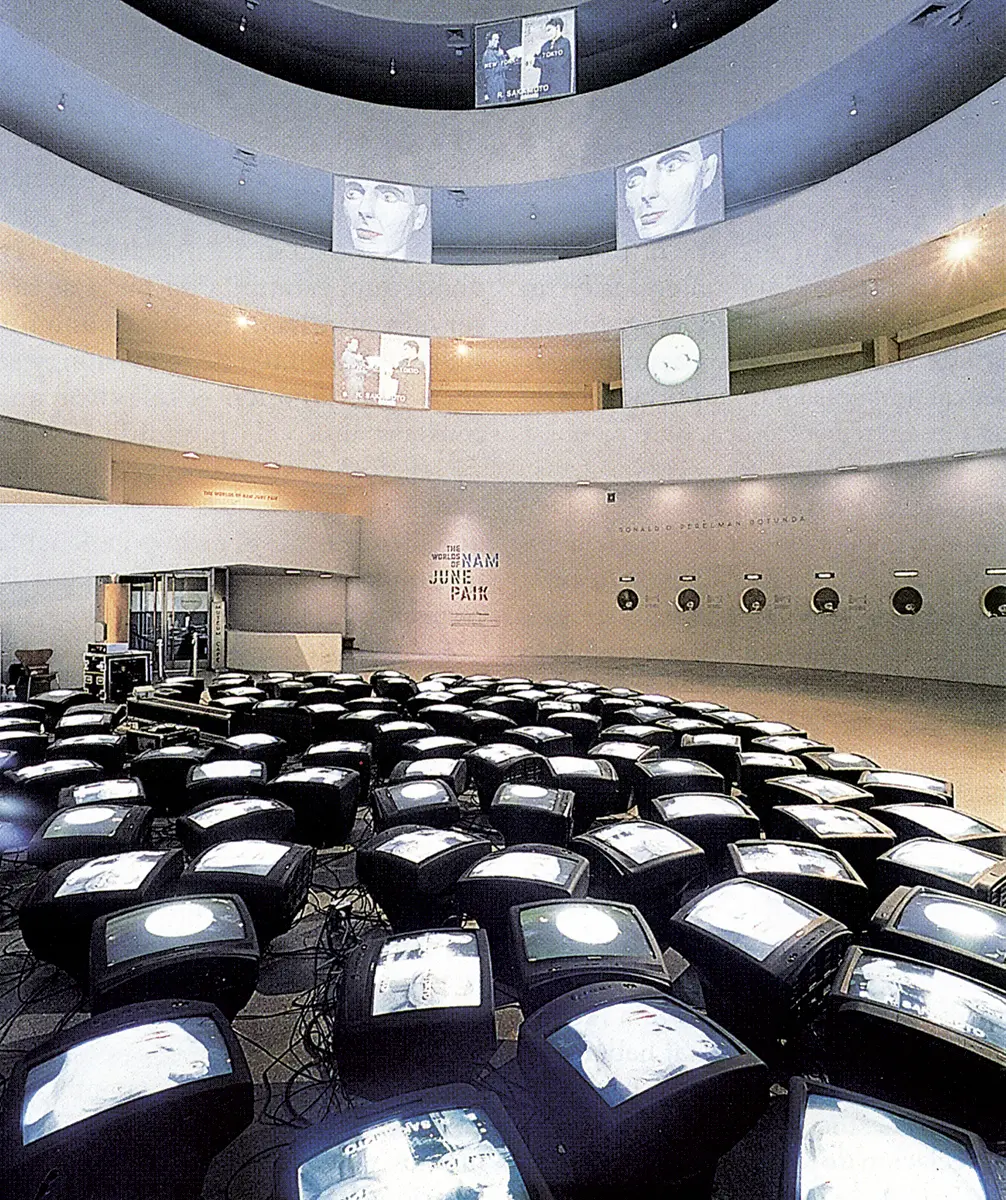
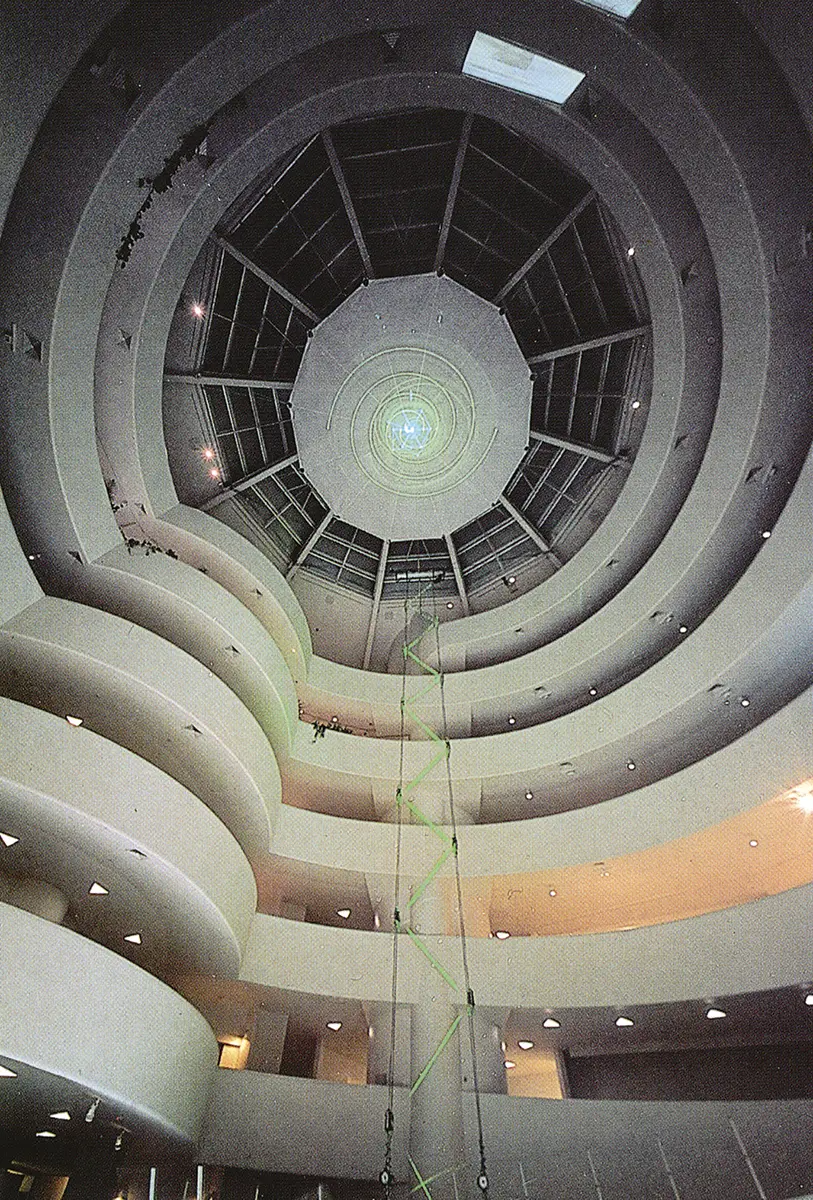
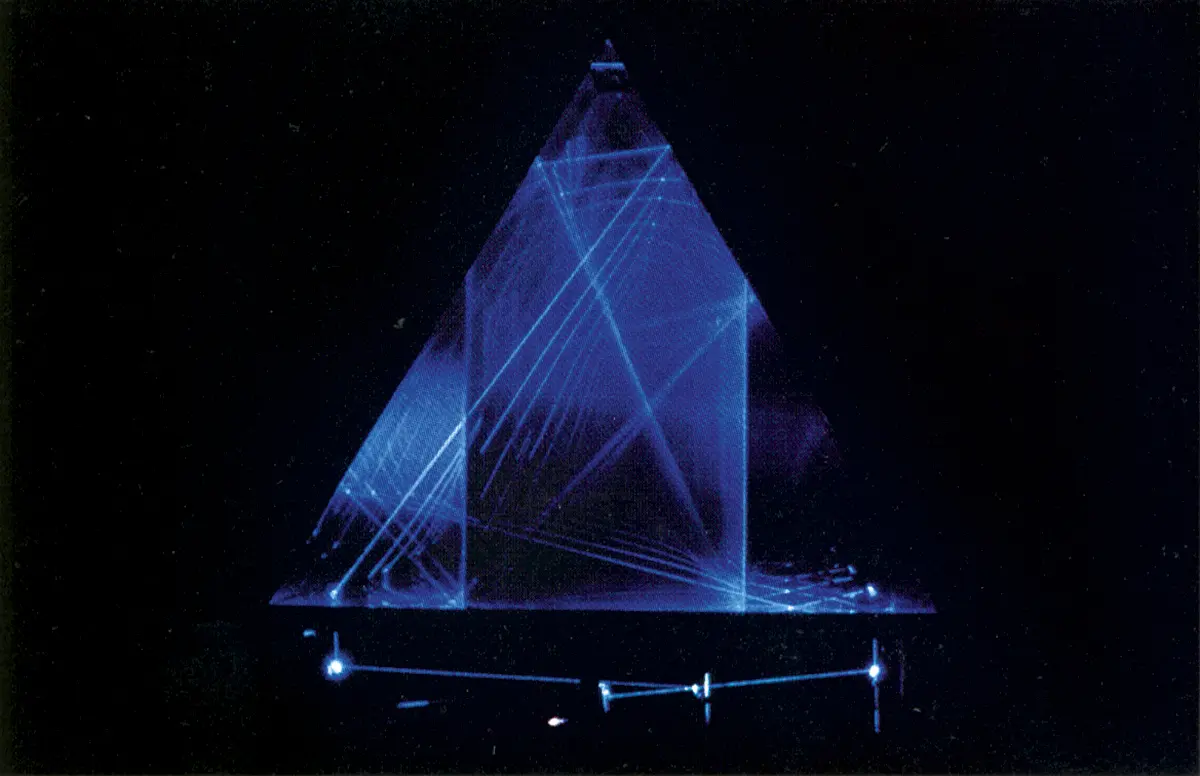
It was a surprise then to enter the Guggenheim Museum and see it totally taken over by a Paik retrospective. The surprise was not that Paik had a (well-deserved) retrospective, but rather what was selected as representative of his work. The Museum, dimly lit to extol the electronic effects, seemed like Disneyland compressed into a movie theatre. A wall of rain that falls six floors from the ceiling serves as a screen for a green laser zigzag line. Another laser beam draws images within a spiral projected on the museum’s ceiling. Multiple projections fill hanging panels and the floor is covered by television sets creating a media lake. Escaping the media carnival, one begins to climb the ramp of the museum to find three enormous acrylic pieces that look like a Polesello5 nightmare with infinite reflections of endlessly repeating geometric drawings. A little further one starts to see the television sets that are Paik’s trademark.
Though understandable, the show’s setup is overshadowed by a problem that seems to characterize the whole exhibition. The pieces exhibited are mostly reconstructions of the original works and that raises the question of what is actually a “reconstruction”. The television sets used here are “state of the art” and a far cry from the aesthetics of residue that normally described Paik’s work. The exhibition is submerged in an impeccable and elegant finish, where the TVs became designer frames. They bear an electronic image but remain distant and oblivious to the artistic essence.
The effect is disconcerting. The first impression is that the museum repackaged Paik’s work to make it presentable within the museum’s perception of the New York art market. On the other hand, one has to accept that there are arguments to justify the updating of the work. When Paik made his pieces, the sets fit into the everyday aesthetic of the time. They did not have the nostalgic aura one sees in them today. One could then argue that a faithful recreation of the objects, exactly like they looked originally, in fact, would introduce a distortion into the appreciation of the work. Accordingly, newly purchased sets would reflect the original work better than the initial pieces made by Paik. The problem may not have a clear solution, but it is undeniable that something essential seems sacrificed: the sabotage ceased to be visible.
While the Paik we can call “genuine” took the inertia of technology to direct it against itself, the hi-tech aesthetic of the Guggenheim seems to leave the original information flow untouched and safe. There is no dam anymore, it is the river itself that takes certain shapes and that aestheticizes and absorbs any form of attack. The work seems co-opted, exploitatively absorbed, and sterilized to transmute criticism into pleasure.
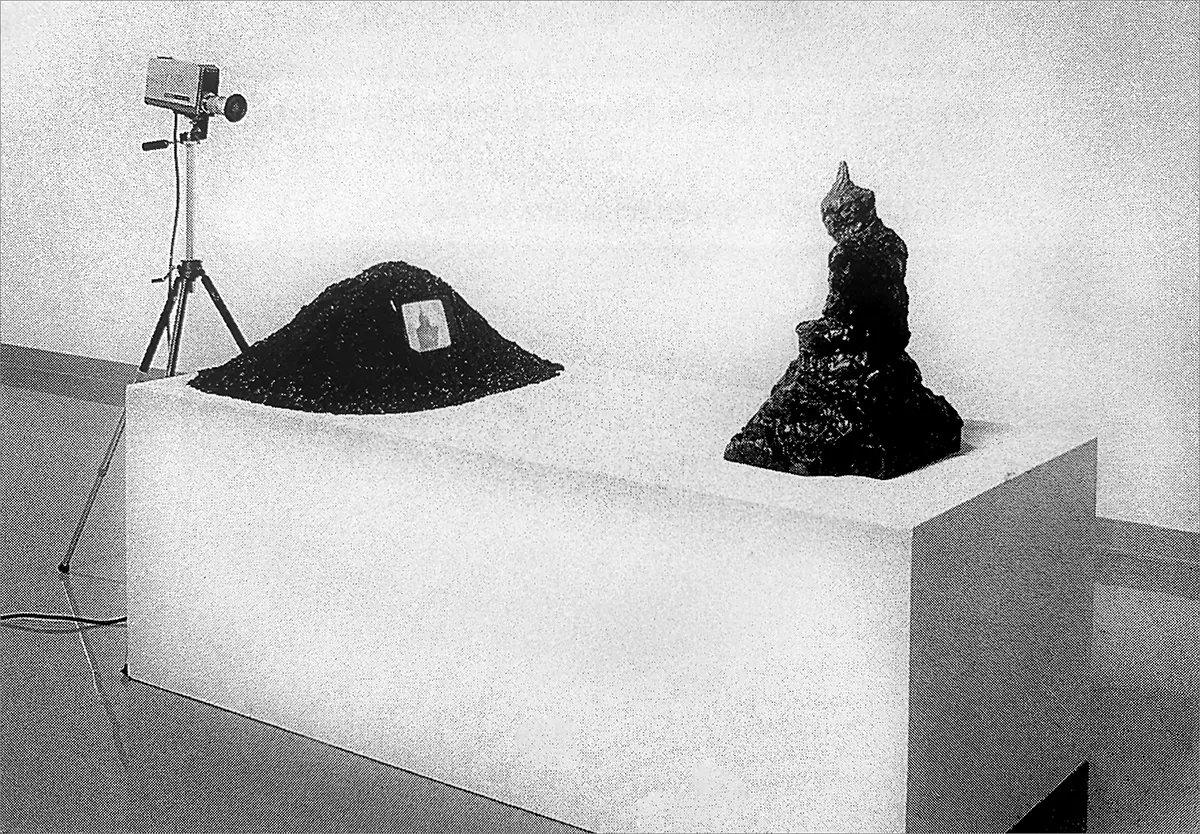
During a long walk on the ramps, the effect is that of a long and tiring series of TV sets occasionally interrupted by more interesting work. There is the TV Buddha (1981) where a Buddha statuette observes itself on a TV screen, and there is also the TV shell with a lit candle inside, Candle TV (1975). These are the pieces that maintain references to the past and philosophy, which Paik had synthesized in his phrase: “Too much perfection, God gets angry."6
In this context, however, many of Paik’s ideas seem emaciated or reductive. Often the idea is simplistic or late. Based on self-reference and tautology, as it was fashionable during the 1960s, the work of the 1970s and 1980s—in the absence of the original charm of rough finish—appear as irrecoverable anachronisms.
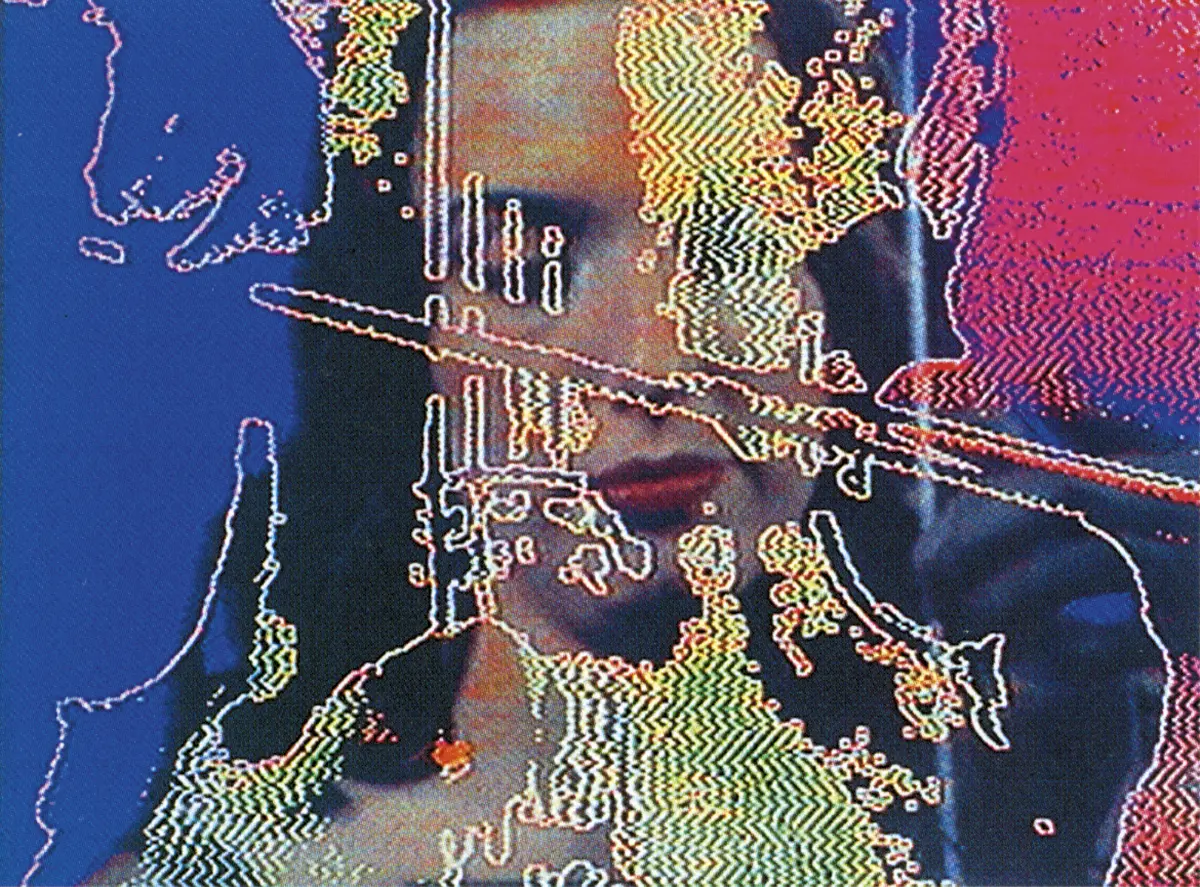
It is only once one arrives at the top floor, in a small historical room, that the true Paik is found. Besides some documents and a small homage to Charlotte, one can also see original TV sets and some interactive pieces that reveal why Paik is considered the founder of video art. As is frequent with the founders of movements, the processes that follow are not necessarily consistent with the initial premises. From Juan Downey to Bill Viola and Gary Hill, those who work in video appropriated technical suggestions but often ignored ideology.
Paik himself seems to have suffered the same, due to personal initiative or that of the museum. What had been a career marked by a criticism of the spectacle, here became the epitome of spectacle. It is a delight for both “children and old” because the challenge has been reduced to homeopathic levels. The historical room, though small, provides a bigger homage to Paik than the rest of the exhibition. It gives a much more accurate view of his contribution and has the precise scale of the real and modest character that I presume Paik still has after all these years. The rest is an artifice that better represents the museum’s policy of these years than the artist.
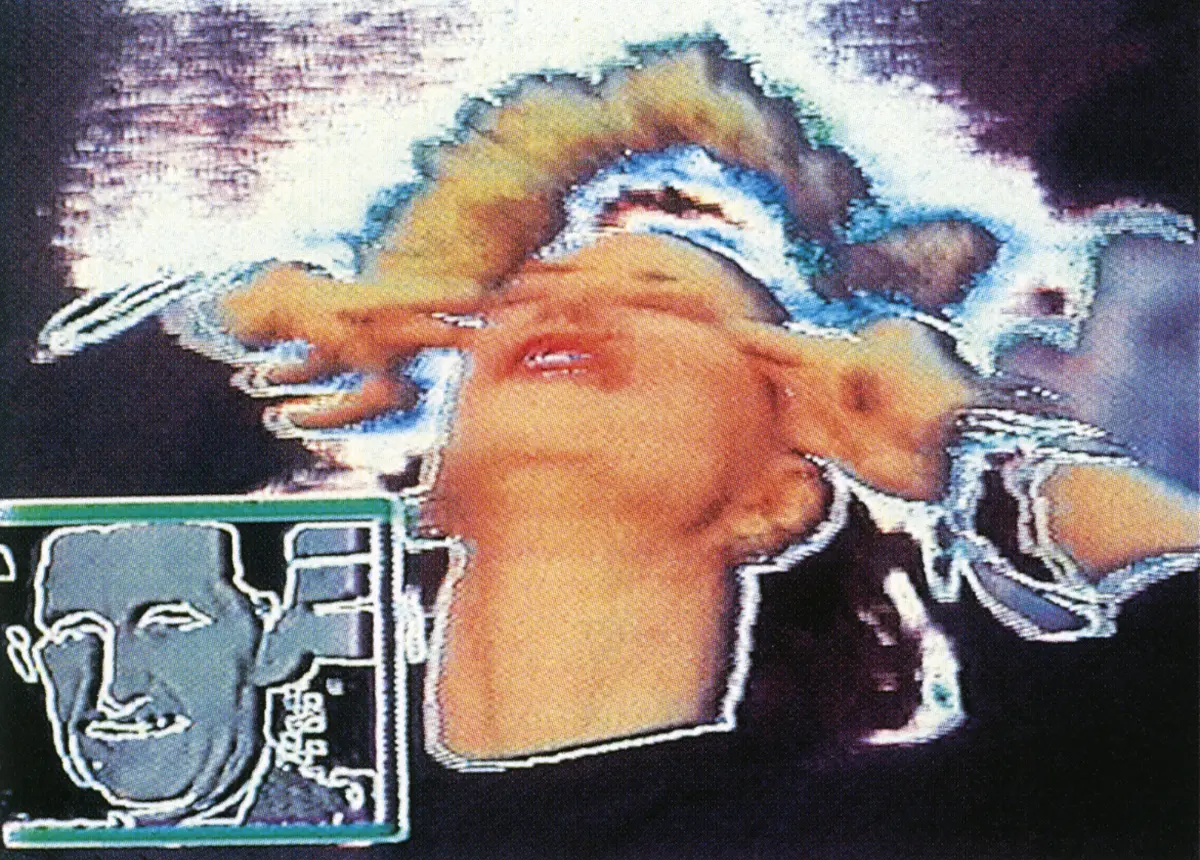
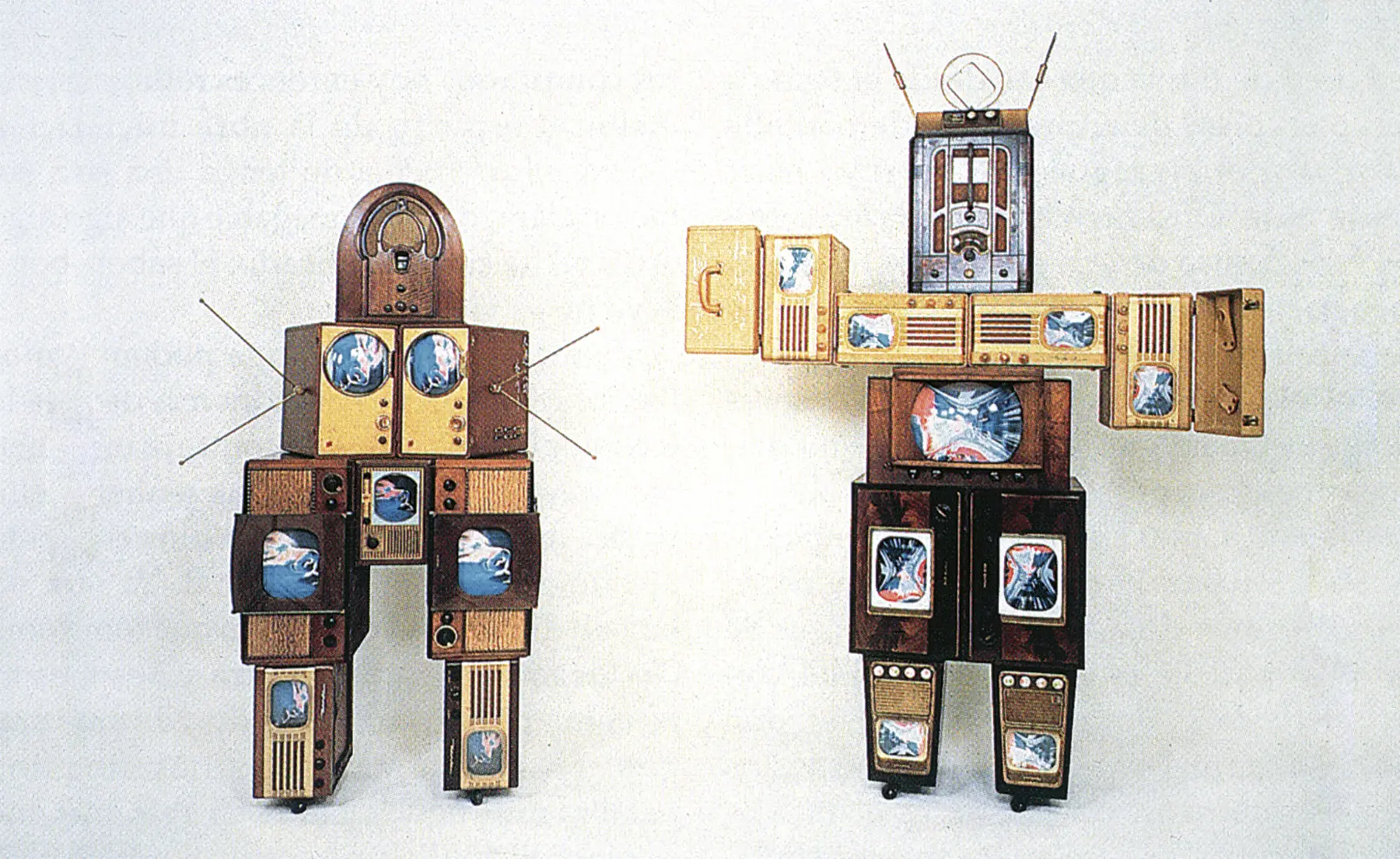
However, it would be unfair to accuse the museum of having full responsibility in this. Towards the beginning of the 1980s, Paik started building video-walls, accumulations of multi-channel sets that allow continuing images over multiple screens. These pieces were used from modestly some tens of sets to the huge Tatlin-esque construction The More the Better (1988) with 1003 pieces for the Seoul Olympics. In this process, Paik’s language splits into two directions: the continuation of irony and the perfect industrial finish. Robot Family (1986) exemplifies the split. The mother and father were made out of old TV sets. The child is a High-Tech Baby: perfect and according to the latest technological developments.
Within Paik’s anarchy, it becomes difficult to reach clear and definitive conclusions. One cannot ignore the possibility that the perfect technology may be no more than an attack on the disorderly aesthetic he had sponsored earlier. The work would then be a sign of resistance against his own principles. However, the reading of the work implied by the museum leads us through different paths. The crucial work here seems to be TV Garden (1974). Completely ambiguous, the installation can be interpreted as a foundation for the surrounding Disneyland in the museum, or as the apex of an accumulation of careless pieces.
In certain ways, TV Garden is solely a series of (working) TVs thrown among the bushes. It is the arbitrary conjunction of objects in an unexpected situation, where any possible poetry is only a product of chance. The presumptuousness of the piece is only given by its size and this is also arbitrary. One bush and one TV produce as many as twenty bushes with as many sets. On the other hand, TV Garden presents us with a coexistence of technology with a natural and uncontaminated paradise. The fact that the TV sets work rules out any association with a possible invading dump that ruins vegetal nobility. Both TVs and bushes are alive and they love each other in a new bionic garden of innocence.
If the true meaning of the piece is the latter, it means that a profound change has taken place in Paik’s art. The place of the initial humor has been taken over by playfulness. Paik’s humor had been a fighting tool, no matter if only a subtle one with a relative lack of aggression. He had forced a confrontation with the history of ideas and with aesthetic plans. It was a gentle slap on the back that ended up shaking the brain. Playfulness, however, calms us down and leads us to accept everything with a smile. The slogan seems to be: “To kid, but not to change.” It is the smile of self-awareness, without the possibility of contestation or revision.
Somewhat pompous is the exhibition’s title: The Worlds of Nam June Paik. The idea behind it is probably based on the variety of media used: Paik as a musician, as a video artist, as a sculptor, etc. But in the exhibition, these varied worlds lose their importance. One of Paik’s contributions is precisely that he fused all those techniques into one integral art form. If there are any worlds in this exhibition, the plural underlined, they are the two ideological worlds clashing. It is a battle that ends with the unfortunate defeat of clumsiness. We don’t know who is to be blamed for it: Paik himself, the museum, or is it a conspiracy of both together? However, seeing the show, probably “God gets angry.”
NOTES
1. International Artists Seminar, Fairleigh Dickinson University, Madison, New Jersey.
2. Joseph Beuys reenacted the piano destruction in 1963, when, wielding an ax, he went into a performance by Paik.
3. Moorman, who died in 1991, was infinitely sweet, with an amazing passion for her work and that of others, always ready to explain to the most obtuse listener why performing a piece during the time it took to fry an egg (on stage) was an artistic act of significance. A Julliard-trained musician, she played for three years with Stokowsky’s American Symphony Orchestra. Her earnings came from playing music for TV commercials and she spent them promoting the art of others. To this effect, she organized the Avant-garde Festivals, which were held every year from 1963 to 1981. During the 1968 Festival—a long parade along Central Park—I heard a greeting coming from the sky. Looking up I saw Charlotte hovering about 3D feet above me, suspended by helium-filled balloons and guided by a group of friends with their feet on earth. The ensuing exchange was relatively long and ignoring the oddity of the situation, we discussed the trivialities that had transpired over the months we hadn’t seen each other.
4. The representation was shared with Hans Haacke.
5. Rogelio Polesello is an Argentine artist known for his acrylic sculptures.
6. Kathrin Lutz, Die Zeit, No. 49, 1999.
LUIS CAMNITZER
Uruguayan artist. Professor at the Visual Arts Department in the New York State University College at Old Westbury.