Although Romón Oviedo has had a national and international career extending over more than 35 years, he has never shown such dynamism as in the multiple projects he has planned for 2000 and 2001.
After exhibitions at the Virginia Miller Gallery in Miami and the Crealde Gallery in Winter Park, the master artist Oviedo, as he likes to be known, recently presented a selection of new works at the remodeled premises of the Casa de Francia. The old colonial mansion, formerly belonging to Hernan Cortes, in the historical district of old Santo Domingo, has been adapted to house the French diplomatic headquarters and its cultural installations. The result is spectacular and Ramón Oviedo had the honor of inaugurating the new exhibition rooms.
The montage facilities are based on French standards and procedures, using the most advanced technology and adapted to a historical environment. Detachable panels capable of multiple combinations and a perfect lighting system provide full use of dimensions and an optimal reading of the works on show.
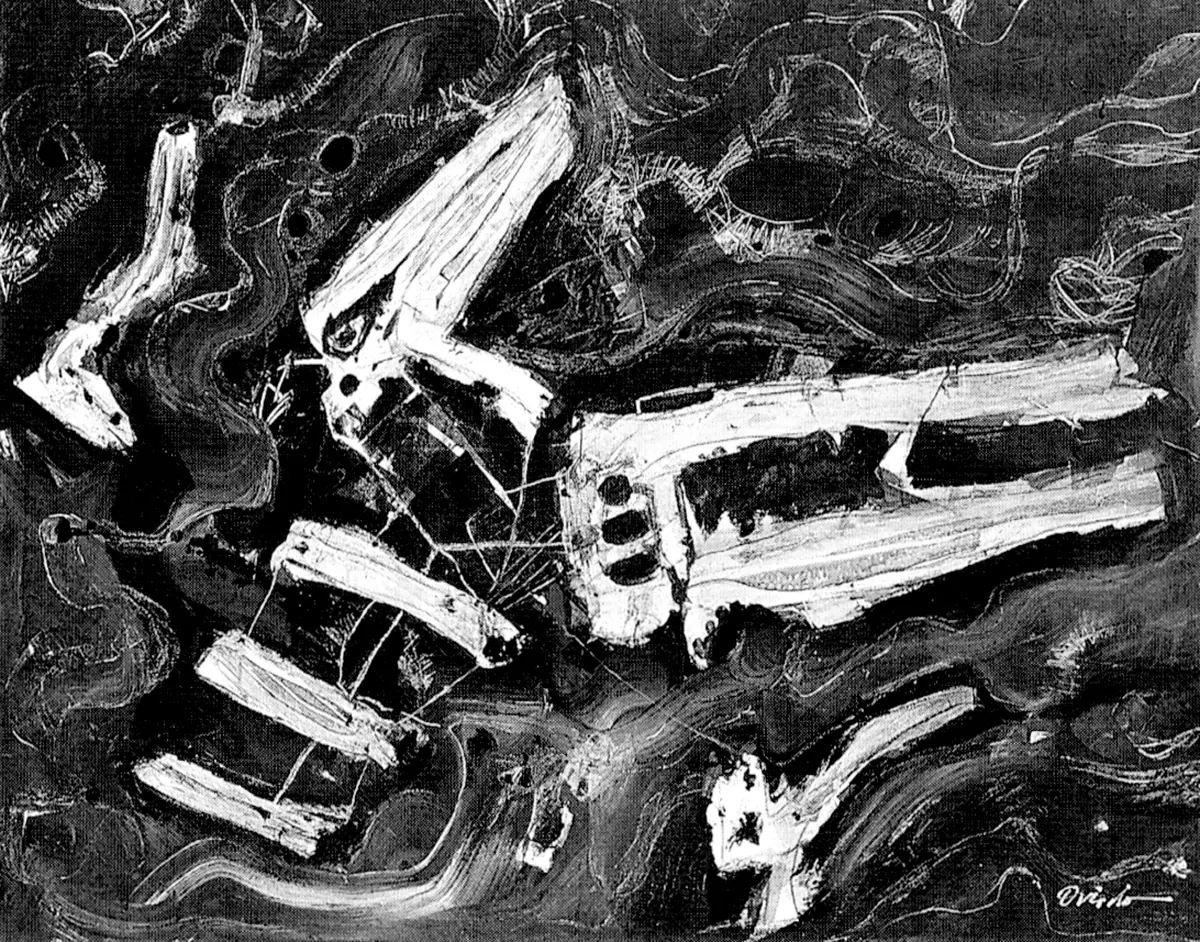
The museography and curatorship of the exhibition were the work of the expert Cesira Armitano, who is responsible for exhibitions at the Sofia Ímber Museum of Contemporary Art in Caracas. She provided a spatial design, which gave maximum effectiveness to the reading of Oviedo’s recent works. Without breaking with his earlier period and the “evolutionary persistence of form in the matter”, Oviedo this time presented a pictorial sequence that was a revelation, entitled the Traces of the Future, an anthology demonstrating both the development and homogeneity of his work.
While some artists take refuge in the comfortable glory of the past, satisfying their admirers by repeating themselves, or worse still by abandoning modernity, Oviedo has preferred the avant-garde option with respect to his own work. The title, Traces of the Future implies a commitment to the third millennium. Metamorphosis, the title of one of the pictures in the show, provided an indication of this unrestrained process of change.
Oviedo has said that he is not interested in abstraction. He does not reject it: rather it simply does not fit within his repertoire. He feels that his work is more involved in a variety of figurative expressions and in the recreation of what is known and identifiable. Very few artists have been able to achieve such richness as Oviedo, who maintains the unity of his proposal: to depict the human condition, from the beginning down to the future.
However, he has moved away from any kind of representation. His signs reconsider evoke, and suggest, while the descriptive reference is stripped of any motifs and structures. In addition to being a personal choice, this aspect is related to the history of art, which has eliminated the division between figuration and non-figuration, even within the same work.
There is a figurative expressionism and an abstract expressionism in the work of Oviedo, who is the most constant and defined expressionist in Dominican art. The present dissolution of the image into a fantastic kind of signography in no way indicates an impoverishment of the work, but rather a heightened sensibility and a process of aesthetic revision.
These pictures, which are deprived of any anecdotal content, and which can be looked at with equal intensity from any of their sides, are characteristic of Oviedo’s present production. However, there is a persistence of the dark reds, the emerging textures, the rich atmosphere, and the hallmark features of the artist’s previous work.
More than ever Ramón Oviedo transmits the impact of space, a cosmology of satellites which, in tune with his inspiration, travel through different territories, a consistency which is both unknown and yet plausible. Thus the neo-abstraction evident in his work showcases the virtuoso features of his drawing, and his mastery of visual experience, including the colors, but which are transmuted by a discretionary kind of fantasy. So he now creates a universe where there is no reigning duality between the real and the surreal, figuration and non-figuration, vigil and dreams. If he had dispensed with such bodily elements, which are often full of impasto, luminous, white, and phosphorescent there would remain, as plastic values, the strangely magical and visionary landscapes.
Cesira Armitano deciphers the mystery in the following words: “Focusing on the essential and the spirit, the sign which is eliminated and re-written a thousand and one times, Oviedo paints the sense of premonition.”
MARIANNE DE TOLENTINO