Since his return from Chicago at the end of the 1980s, Raúl Cristancho has shown a constant interest in the plural, hybrid nature of our culture in which certain aspects remain in a state of subterranean oblivion, but are nevertheless latent. This interest has shaped and determined his attitude in the field of art, where he has worked as an artist, critic, curator, and teacher. His approach to art is not based on cold formalisms or aestheticist postures and like many artists, he believes in art that is to some extent, belligerent and active, capable of undermining tranquil states of mind and calling into question apparently established facts. Hence the “narrative” character of his painting, which he describes as follows: "The challenge is to construct an open narrative. In fact, I try to ensure that there are various narrative levels: first, there is the apparent structure, which is what can be read in the first instance; then there are other structures that underlie the visible intentionality, and which become the most interesting content."
If we look back at Cristancho’s work, we can see his constant interest in our landscape and the nature of our land, with its exuberance and warmth, its mountains and jungles, rivers and valleys—a presence that is both magnificent and oppressive, as was evident in his last one-man show in 1995, entitled Symbolic Landscape. He is interested in, among other things, the rich and varied geography, with its traces of a distant past where the foundations of our urban and globalized culture lie hidden. For this new exhibition, the reference to our continent was made through a map, which has its place within a globe of the earth, which spins around with surfaces in dark tonalities that include dense blues and violets—colors that symbolize the mysterious atmosphere of the night and dreams. But the night and the dreams are of a special kind, evoking the oniric darkness and light of the American continent, or as the title of the show indicates, the special characteristics of the American night—a subject well suited to a dark palette. The show was made up of paintings in various formats, as well as some metal engravings and xylographs—a medium that has often attracted the artist’s interest.. Several of the works were began in the early to middle 1990s and completed later so that they reflect the artist’s concerns over the decade.
Some paintings opt for very elongated formats, accentuating the horizontal line, and then the vertical line. On entering the room and seeing the pictures from a distance, the visitor is confronted with a sober and balanced sense of order in which two vertical works, The Night of Patascoy and The North stand out. These two acrylic pictures, dating from 1999 and 1998 respectively, produce a solemn and ceremonial impact through the composition and symmetry of their vertical structure.
Other unframed canvases also hanging on the wall emphasize the sense of horizontality: these works are covered with a very liquid pigment applied with a roller with the successive layers creating a light and ethereal texture that serves as a backdrop for various emblematic figures of the colonization of the Americas, or the cycles of the moon, images which are printed by means of serigraphy techniques, recalling the language of the work entitled History in Red and Gold, from 1997, with which Cristancho won the Johnnie Walker Prize for the Plastic Arts in 1997-1998.
In this most recent stage of his production, according to the words of the artist himself, there is an attempt to "develop the iconic or symbolic character of the picture. So that the gesture becomes less protagonistic in order to encourage the conception of the picture as an image." This characteristic is evident in such works as Ora pro-Novis (1998) and The American Night (1992-1998), which illustrate the pictorial possibilities that interest Cristancho, and where the use of texture and color i.e., pure pictorial language, appears in a different way. In the first picture, there is a predominance of green and blue tones; the brush strokes are free and fluid, rising from the base up to the top edge of the canvas, like a fleeting flame, the constant flashing of which produces a momentary apparition. A dark serpent recalls the theme of original sin, as well as the inhabitants of the primeval humid forests; the dark, slippery moving body of the snake is enclosed in a halo of red light from which emerges the prayer Ora pro Novis. A rising yellow light illuminates the American continent under the gaze of a figure with an archaic and primitive face, whose hands, ready for prayer guard and preserve the continent. Because of the ethereal brush strokes, the image seems to reflect a dreamy, instantaneous event that gives the canvas the magical and religious air of an apparition. A very different effect is achieved with the diptych entitled The American Night. Here the pictorial treatment creates an image, that is permanent, stony, and solid, crystallized through surfaces of color made up of several layers of pigment worked with a spatula and brush. The picture possesses a rich and elaborate texture in which we can see an imposing and silent pre-Hispanic pyramid. Below, the headlights of a car illuminate the globe of the earth and the American continent objects which are resolved with subtle edges of color that give an unusual kind of mystery to a work that combines the hieratic world of the past with the rapid and mechanized world of the present.
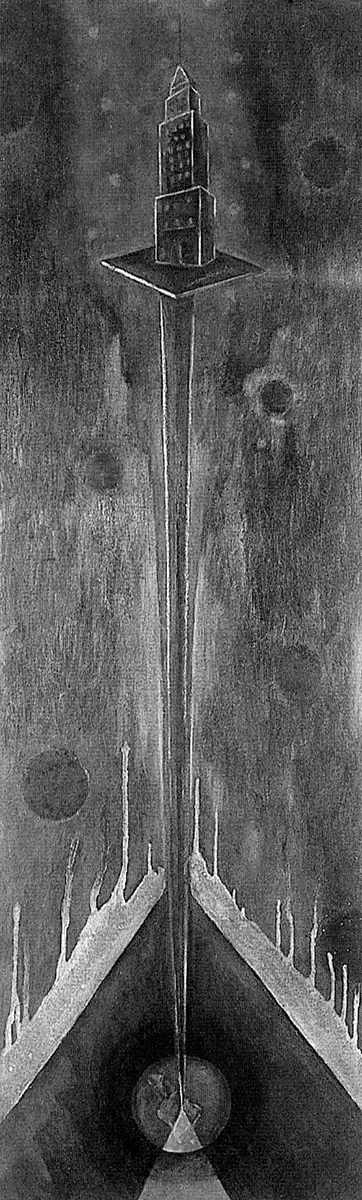
Other equally effective and suggestive images can be found in an untitled work from 1998. The elongated format (40 x 132 cm) offers a particular formal synthesis in which the blue, red, and green colors surround a sort of sword, the front of which is made up of a skyscraper and the tip of which is plunged into the American continent. Similarly, there is a marked formal and chromatic specificity in the small format works included in the show, all of which are presented in cubic proportions in which the floating head is shown submerged in a chromatic atmosphere with prevailing contrasts, turning and turning while the globe runs through different zones of the head.
The spirit behind this show, as the artist himself has said, is in line with the turn-of-the-century mood of our times. "Like at the end of the nineteenth century with the Romantic movement. Without aiming too high, I wanted to bring together a group of works in which the night can be seen as a common denominator that gives the pictures a paradoxical character of contemplation." Clearly, these works require the spectator to stop in front of them. A careful and meticulous process of looking reveals various levels of meaning in the imagery and composition, ranging from the meaning acquired today by the manual process vis á vis other visual media to the importance of the image and its relationship with memory—memory as the history of a past which is invoked and reclaimed from the present.
The exhibition was accompanied by a small catalog published by TallerArte Dos Graficos with an essay by Juan Gustavo Cobo Borda, “La punzante musica del color” that offered a reading of the works from a literary perspective. The special edition consisted of 500 numbered copies.
MARTA RODRÍGUEZ