
Now that video has become a mainstay of artistic practice, it can hopefully resist being subsumed into the formal spheres it so closely resembles. That is, the spectacle and technological sublime where the medium is the message. Although the video has broadened the purview of artistic possibilities in the post-Benjaminian era of “mechanical reproduction,” with it comes the potential to be critically neutralized by a technological fetishism equivalent to a regressive “art for art’s sake” posture. There continues to be, however, another type of video practice that eclectically engages its formal capacities and appropriates visual culture in its manifold articulations while not allowing means to become the ends. Exemplary of this is Adriana Arenas llian’s recent video installation titled Race Factory exhibited at Venetia Kapernekas.
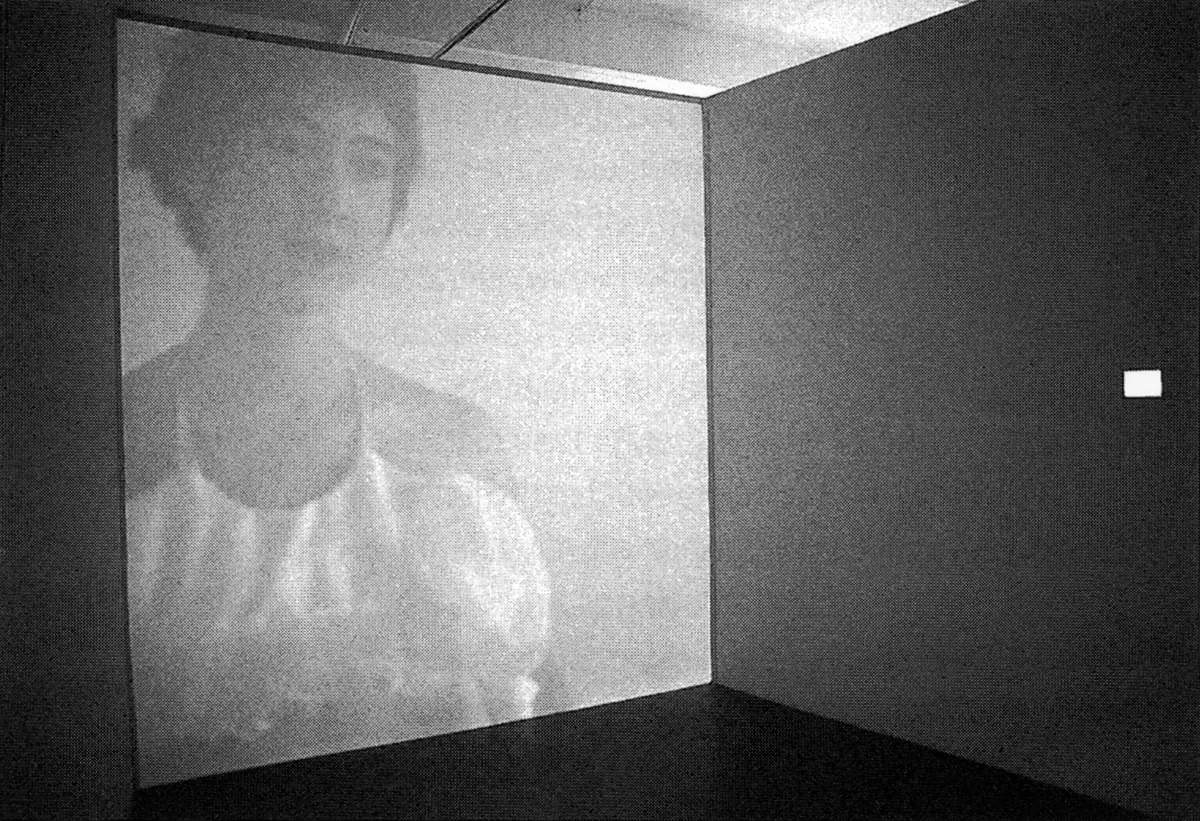
Race Factory consists of video projection, animation, and reproductions of Castas paintings on fabric. It focuses on that colonial genre’s discourse of race and difference through formal and conceptual strategies that are inextricably linked. Arenas llian’s modus operandi anchors itself in a variety of registers attentive to space, reception, and the medium itself through critical reflexivity via the formal parameters in which video traditionally operates. These video tropes are, in turn, reworked in the installation as a parallel to the Castas’ pictorial devices that are ideologically located and that present themselves as a given that is then extended into the realm of the moving image.
On entering the gallery, one was confronted with a video projection of Arenas llian in a rather claustrophobic installation environment exacerbated by her slow, cropped movements that mimicked the figures in the paintings now animated on the monitor. Instead of confronting the gaze of the viewer, Arenas llian focused on the figures as if they were semiotically instructing her on a typology of identity based on gestures that seemed to parody colonial etiquette. The dialogue of gestures between monitor/Castas and projection/ artist created an undulating formal rhythm that produced subliminal effects that underscored them as having an ideological dimension.
Where social manners and graces have traditionally been the province of civility, their exposure in Race Factory as signifiers of racial discourse reinscribed them with a whole different set of meanings: the curtsy, for example, now takes on sinister proportions within the context of acculturation. Arenas llian amplifies this already heady narrative through her role as a surrogate of miscegenation within a self/other polarity and transposes it into the present day. We, the viewers of the installation now become 21st-century stand-ins for the intended colonial consumers of the Castas. This conceptual sleight of hand is subtle and does not immediately register; subsequently, the viewer is enmeshed in a circuit of power beyond his or her control. In working through the semiotics of consumption and identity at the juncture of gesture and attire, Arenas llian links sign value in the colonial era with sign value in our own milieu constitutive of our political economy that concomitantly lubricates the wheels by which subjectivity turns.
This split, however, is not only configured thematically via such binaries as Old/New Worlds, subject/object, self/ other, and center/periphery, but also formally through the cleaving of exhibition space between technology evinced in the video projection and monitor, and the Castas’ reproductions in the fabric that evoke craft, the folkloric and “women’s work.” The installation mapped various themes like those previously mentioned, yet their formal and conceptual narrative points of entry converged on reception and the differential in power between hooking and being hooked at.
The symbolic linking of the original consumers of the paintings and that of the installation veered beyond identity politics and feminism and were underscored by Arenas llian’s lily white, feminine colonial attire that served as a marker of difference and imposed acceptance. These critical strands of thought are nonetheless germane to Race Factory and are poetically and conceptually intertwined and elaborated in the installation. Of equal importance, moreover, is Arenas llian’s commentary on the rhetorical construction of images, their conveyance and reception, and how vision is not just a bio-optic and synaptic event but one that is equally mediated through culture and articulated ideologically. It is at this level of complexity that Race Factory manages to successfully mesh electronic media and ideas without sacrificing its critical impetus. In so doing, Race Factory exemplifies the potential of video if it can circumvent being devoured and superseded by the formal and technological devices that make it such an exciting genre to artistically explore and experience.
RAÚL ZAMUDIO TAYLOR