
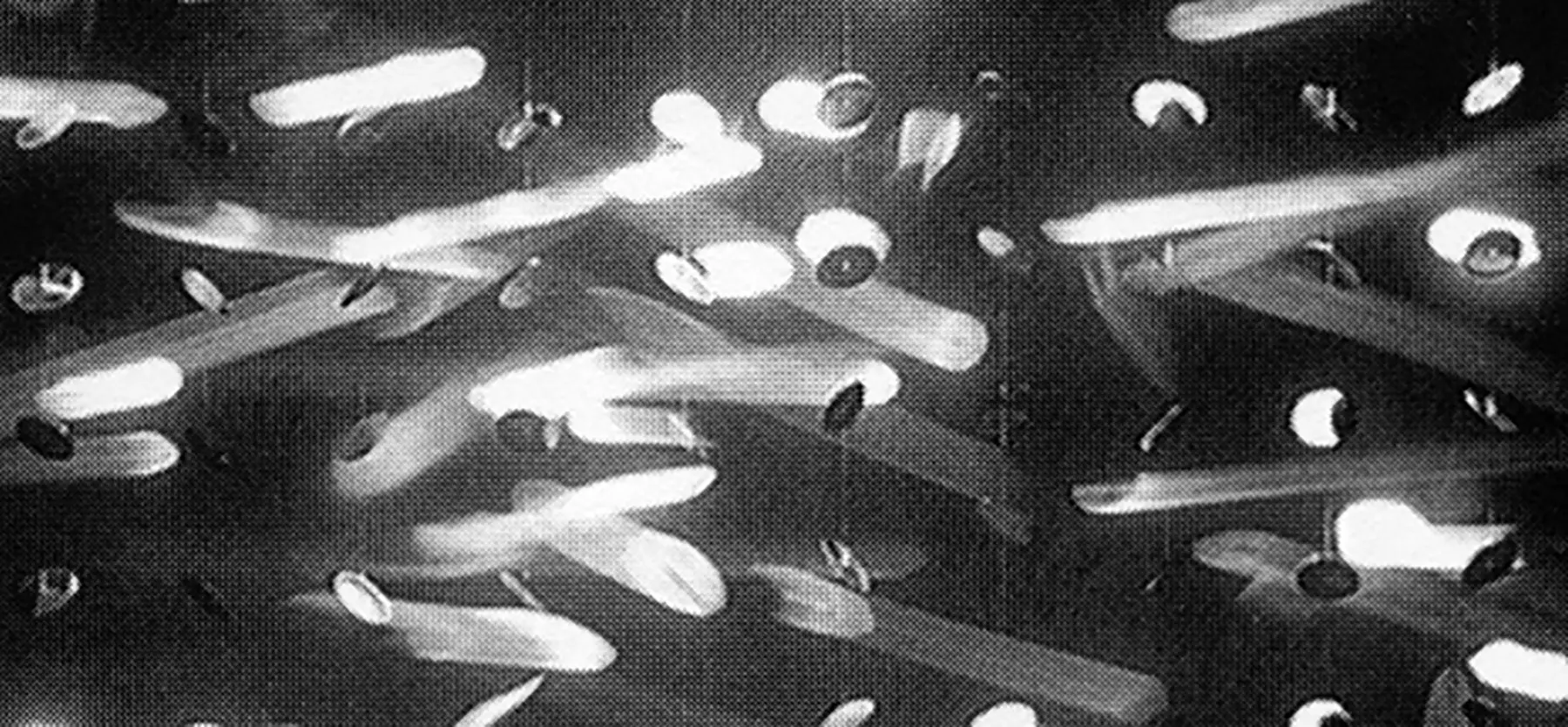
With the title Campos de fuerza (Force fields), the Museum of Contemporary Art of Barcelona (MACBA) has produced an exhibition that will later move on to the Hayward Gallery of London. It is an essay on kinetics. It proposes a new and very interesting reading on a series of artistic manifestations that took place between the end of World War II and the 1970s, realized by artists, diverse in scope, who came to an understanding simultaneously that art was a possible model of the universe.
Always maintaining itself within the parameters of the abstract and non-representation, the exhibition takes as its thread those speculative artistic processes that tend to create force fields through concepts like flow and void, through metaphors of space and time, or through consideration of the body in space. All this comes to reformulate a reevaluation of determined aspects of kinetic art of the 1960s, at the same time as it discovers that certain groups that have conventionally been considered antagonistic are not, as happens for example with the concrete art and informalism of the 1950s.
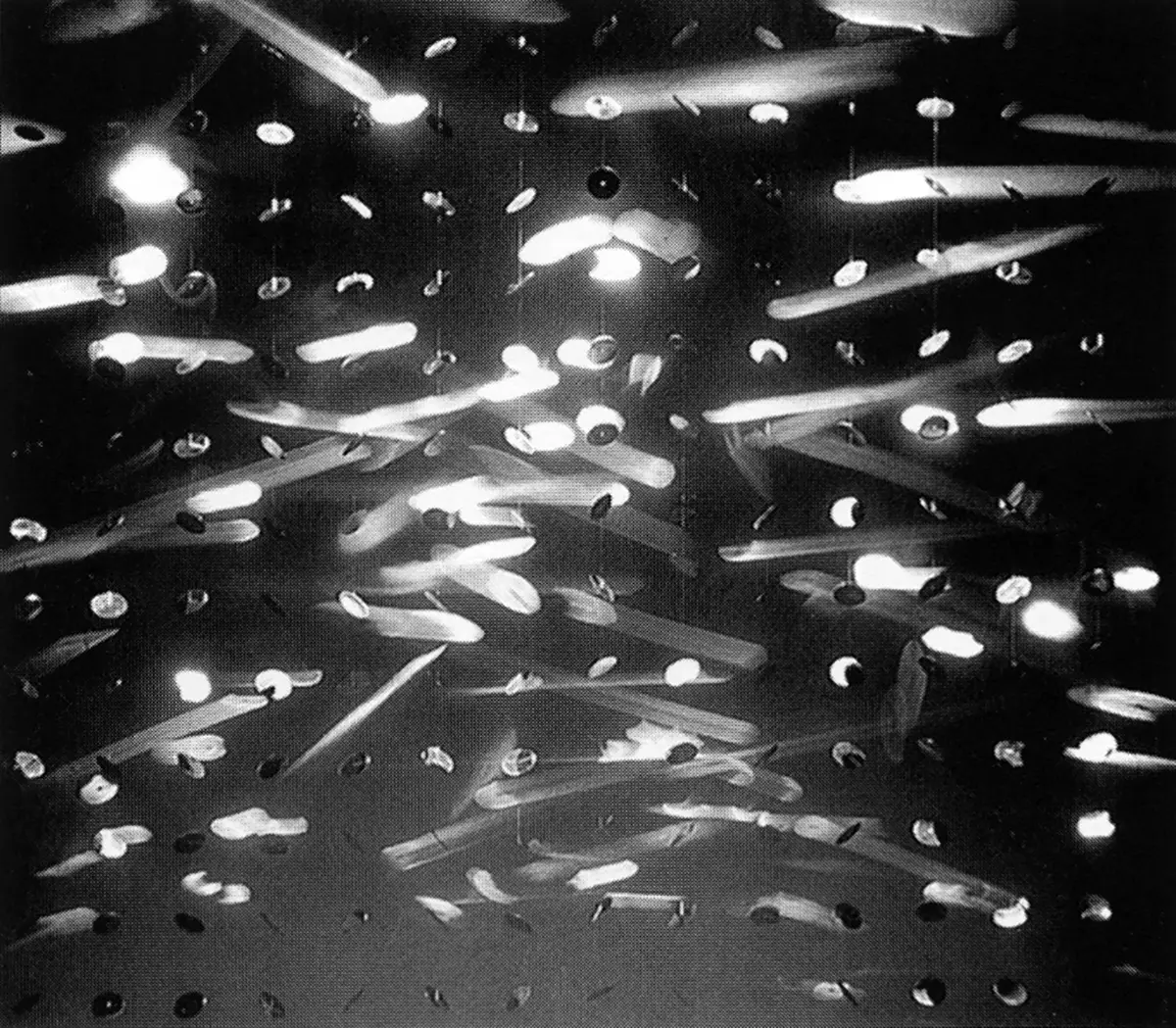
Rejecting any supposed history of kinetic art, exhibition curator Guy Brett begins with a historical center made up of the first works of Calder and the last works of Vantongerloo. To the wire constructions that Calder made in the thirties and the objects that Vantongerloo made between 1945 and 1965 (the year of his death), Brett adds the first Gabo sculptures with motors. This nucleus is the point of departure for a sort of essay that confronts works that simply assumptions of opening, the indefinable, unfinished open works, differing from the rigorous historicist paradigms. Or, as Manuel BorjaVillel, the director of the museum, explains in the catalog, the show outlines "a discourse that does not remain subject to the established canon but rather explores relationships that deviate from it and that generate tensions between the formal vocabulary and rhetoric of a period and the meanings proposed by the different artists."
In the thirties, Alexander Calder effectively considered art as an image and model of the universe when he stated: "From the beginning of my abstract work, I thought that there was no better model than the universe . . . spheres of different sizes, densities, colors, and volumes floating in space. He added that his abstract wire constructions derived from his underlying sense of the form of the system of the universe, or part of it. If in those first abstract structures of Calder that stem from mechanics, we can see a prelude to his later work, we must consider the last paintings and sculptures of Vantongerloo, which stem from mathematics, as a culmination of an entire life of creative work. In this sense, Vantongerloo’s sentence seems revealing: My works represent a conception of creation and they have nothing in common with art that is called 'modern.'"
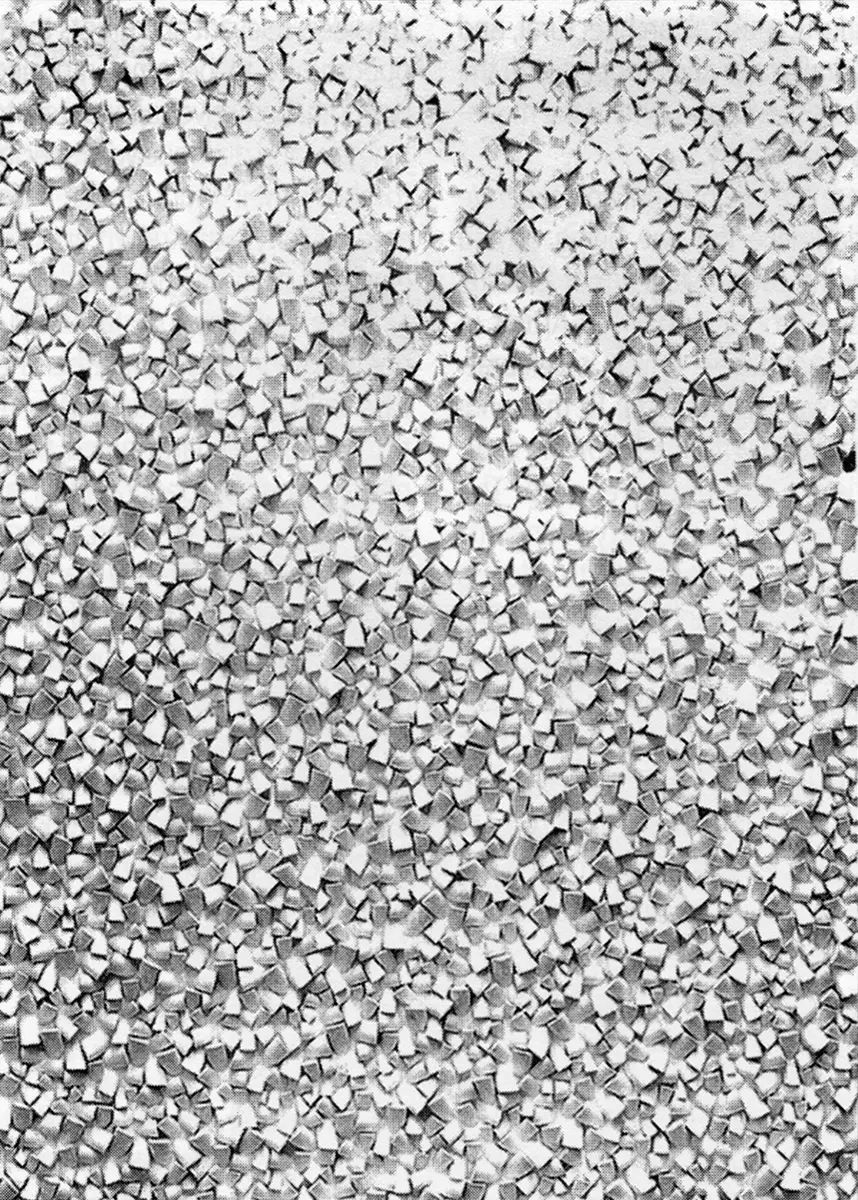
The exhibition gathers classics like the aforementioned Calder and Vantongerloo, with others like Duchamp and Moholy-Nagy, as well as works of certain artists whose names rarely appear together, like Wols and Lucio Fontana, Henri Michaux and Sol LeWitt, and it includes nearly fifty creators.
It is surprising to note that such diverse artists share a similar conception of art as a possible model of the universe. Thus Brancusi, who made ovoid objects that evoke the cosmic egg and speculated on the free form of gravitation. Thus the binomial DuchamplMan Ray, who created those Rotative plaque-verre (optique de précision) in 1920. Thus Naum Gabo, in the same period presented his Kinetic sculpture. Nor should we forget Moholy-Nagy and his Light-space modulator, which is not exactly an object, but a medium of reflecting, diverting, and mixing the rays of light that fall on it.
One of the most interesting aspects is that the essay is able to fit, into one single search, a series of artists of enormous renown, generally considered dispersed individuals with no apparent relationship to the problems of their time, but who in reality were deeply involved with it. Also, instead of limiting themselves to the mainstream, as is customary, the show gives preferential consideration to Latin American contributions, with substantial presentations reserved for creators like Lucio Fontana, Hélio Oiticica and Lygia Clark, Le Parc and Rafael Soto, Gego and Sergio Camargo.
Chronologically, the exhibition demonstrates Latin America’s contribution through a theoretical proclamation, the Manifiesto Blanco of 1946, which articulated a new relationship between the forces of nature and artistic creation ... It defined an art capable of generating itself in accord with natural forces, an art that is free of all aesthetic artifice, something that confirmed the contradiction between man, protagonist endowed with will, and the needs of material and of nature. Written in Buenos Aires by Fontana and some of his followers, it suggested a broader perception of space and time, building a bridge between tradition and innovation that offered new parameters to the phenomenon of abstract art. The famous perforations of the canvas that Fontana proposed were not accidental. Instead, he considered them his highest achievement because, as he said, they satisfied his belief that art should make thought advance. In the hole, he sought the transgression of the material, and in his final works he clarified once and for all: I did not make holes in order to destroy the material; I made them to find something more.
The Brazilian Sérgio Camargo (1930-1990), who had studied at the Altamira Academy in Buenos Aires with Fontana, went on to create in the sixties white wooden reliefs that incorporated movement through light; that is, through the vibration of light in a static structure, whether a source of real light or the changes of intensity of the light produced during the day, or from one day to the next, from one season to the next.
If Rafael Soto’s work is typically associated with the concrete and constructivist tradition, we must keep in mind that around 1960, after a rigorous period of investigation, he began to work on a space separated from reality, theoretically separated by being physically interactive. In this way, “the forces of nature” in the form of air currents tended to produce in the viewer’s vision a sort of dissolution of solid elements, without it being possible to say what was more real: the solid object or the immaterial vibration. His Penetrables were brilliant visual inventions in which the optical play between dissolution and solidity established such an easy communication that they became a genuine social experience.
The Cilindro de luz continua (Cylinder of continuous light) which Julio Le Parc created in 1962 is another of the interesting models that the exhibition reveals. It consists of a spotlight and a motor that simply spins. The ray of light penetrates a circular arena surrounded by a mirror and is placed vertically before the viewer. Only making use of the two blades of a fan that move slowly, intermittently, and irregularly, le Parc created an intricate composition of lines of light with great communicative impact that astonished and fascinated the public.
Gego (a contraction of Gertrud Goldschmidt), an Israeli exile who at 27 years of age, fled Nazi Germany for Caracas, was able to develop her work in the modernizing boom of the postwar. Gego’s work is based on repetitive geometric elements that she arranged in parallel configurations with no hierarchy, thus formulating a very intricate system of unions and links through rings, ties, tubular joints, and clamps. This system was considered a visual equivalent of the universal node or principle of physical and biological structures, achieved by playing, in a very personal way, with the relationship that the artist established between a structural model and an aesthetic object.
The work of Lygia Clark questions the limits between interior and exterior, the individual and the rest of the world. At the same time, blocking each one of the senses through very simple means incites us to become aware of our own senses and our own body. Her Máscaras sensoriales (Sensorial masks, 1967) produce a group of sensations in eyes, ears, and nose, and her Máscaras abismo (Abyss masks) that hang over the head prompts the knowledge of our own volume or of the abyss that surrounds it, believing that "contemporary man . . . learns to float in the cosmic reality within his own internal reality . . . He feels like a child who must learn to stand upright in order to survive." The work of Lygia Clark, by stressing speculations based on the body in space, is one of the most representative of the premises of the show, especially when she said that "I began with geometry, but I sought out an organic space in which painting could enter . . . What I wanted to express was space itself, and not to compose inside of it."
In Bólide (which in Portuguese means a ball of fire” or “meteor”), Hélio Oiticica suggests a source of dazzling energy by simply making use of any container, from a bottle, a box, or a feasible bag that must be opened in order to see what is inside or that seems inaccessible, as in the case of a light that is only seen through a reflection. His conception of World Shelter, a poetic imitation of the Earth made inhabitable, meant for him a sort of uprooting, wandering through the world in order to open onto the World and to experience it as a Lair. Like Clark, Oiticica also defined the notion of the inner cosmos through its link with the notion of lived bodily experience. And both Oiticica and Clark incorporated a ludic component and would have been able to state along with Hans Richter that "if homo sapiens never acquired wisdom, why not give homo ludens a chance?"
From Fontana to the last of the aforementioned Latin American creators, all accepted the principle of relativity of all things as a premise, and with that principle, they believed that "an eternal art that only lasts one minute is as valid as art that lasts a millennium."
MARÍA LLUÏSA BORRÁS