
The setting for Carlos Garaicoa’s (1967) work is today’s Havana, the city where he was born. A city with buildings in ruins because of the long-standing economic embargo; amidst the buildings, people come and go about in their daily lives. Garaicoa’s work has been widely studied because of its importance within Latin American art, but its importance has increased since his work was exhibited in Colombia. Why? Comparing a city crumbling before the spectator’s eyes with some Colombian cities with their misleading degree of development, allows us to draw certain conclusions regarding the meaning of ruin and the importance of holding an aesthetic position before it.
Let’s explain the comparison with traveling. If a few years ago a traveler with time restraints let’s say he or she had about a week visited certain Colombian cities such as Barranquilla or Bogotá, and certain middle-sized towns such as Neiva, Pereira, Santa Marta or Manizales, he or she could perceive the particularities of the central plaza and quickly find the small stores, pool halls or the place where the richest coffee could be found. Today, years later, if the traveler decides to visit the same cities, the plazas will seem uniform because they have been covered, literally buried by the huge signs advertising banks and financial institutions. He or she will find the same loud signs in every city, green yellow, and red. The sign of money has become important in the context of the plaza, maybe because the rent of local property is no longer paid by small businesses but by big companies. A very publicized money, farther and farther detached from the common people. The appearance of development goes hand in hand with all sorts of news about violence.
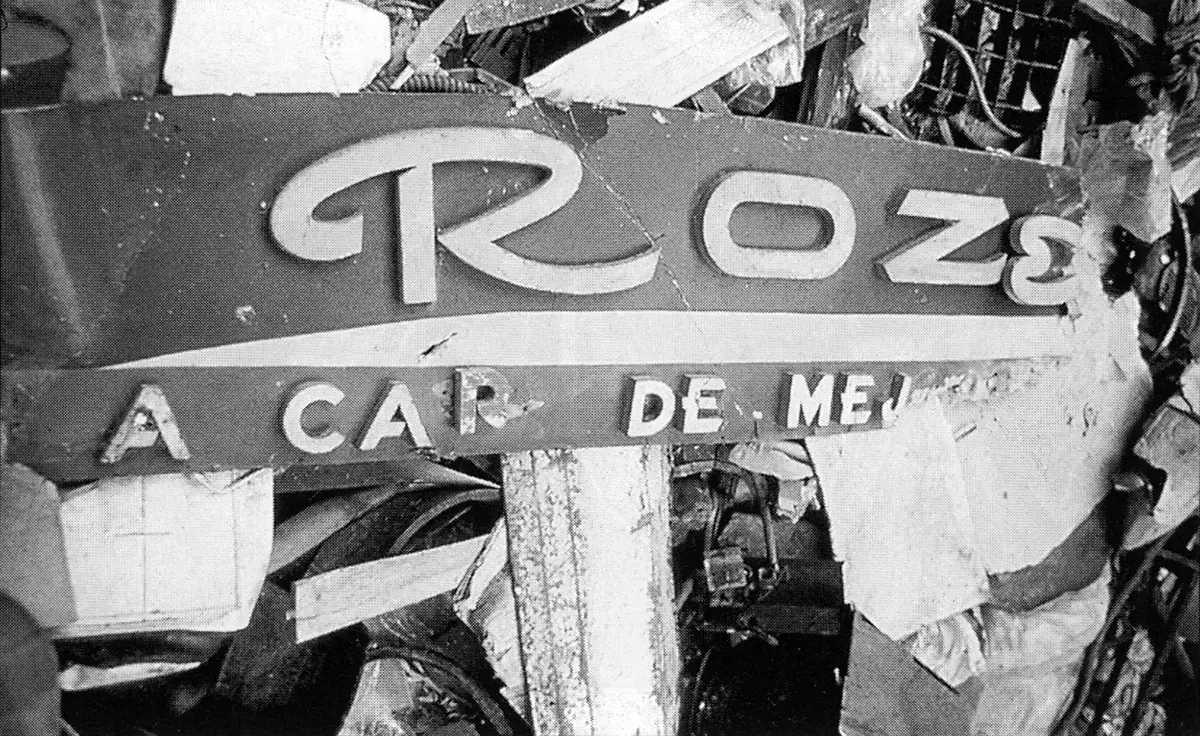
In an interview with Coco Fusco, Garaicoa says that in his work he finds it necessary “to suspect that at a certain point we have been deceived.” And, in reality, when comparing his installations of ruins to a city with a misleading degree of development such as the ones we described above, we have to think that we’ve been deceived at the same point. A ruin can be, on the one hand, deterioration but, on the other, it is the burial of certain cultural characteristics that have been literally interred by an economic situation capable of infiltrating, invading, and changing a city’s physiognomy and its inhabitants’ behavior. To compare the show with our cities also allows us to question people’s attitudes toward the concept or ruin, because despite the problems it might create, city dwellers have to continuously seek their possibilities of affection and creation in order to survive. In spaces with a deceitful sense of development, their inhabitants are accustomed to “being” only when surrounded by “trinkets.”
In the show’s photographs, passersby are very important because they walk in front of the ruins of buildings that still have emblems of their old splendor; they walk erect and show no interest; they seem in a hurry to get to where they’re going. The photos are well constructed because in them we find the spirit to confront signs. As a photographer he isn’t looking for fragmentary references; from what he sees in the streets, he chooses unlikely signs that are like parallel stories in the same image, but that together they synthesize life in the city. For example, the citizen’s impassive gesture when he walks by a fallen wall allowing us to see the interior of a public building, or a decapitated angel with the word “Fidel” scribbled beside it as graffiti. Conceptually, they are works akin to John Heartfield’s collages, in which a single image and only that one is counterpoised to another to create a conscience.
The confrontation of signs makes Garaicoa a master of ambiguity, especially in the way in which he presents utopia. In his drawings, the crumbling buildings are either suspended by mythical props or reconstructed as futurist or postmodern structures. But these projects are on the threshold of unbelief; they are proposals where an impossible constructive dream wants to move the present to another place as a sign of liberation, which is the beginning of all utopic projects. But, would that golden construction rising skyward over a pa Iisade and a historic building be a liberation? The spectator is not so sure. The images are placed in the utopia’s real limit, which very well can be the end of the story or its beginning. One never knows and that’s their beauty whether those proposals of spectacular buildings are the beginning of a marvelous story transcending the present, or icons representing its demise.
To find fragments amidst the rubble is an important role that the artist plays in today’s world, a role akin to the historian’s but with a different method because the artist does not insert the facts in a general discourse; instead, he or she distills every day from the past and takes it to the gallery. The objects making up the setting in Sloppy Joe’s Bar-Dream which for the consumerist society can appear as garbage recreate the context of a given time through a space where conversations, dances, and affections take place. The artist-historian’s act is to highlight that type of ruin. The photographs in La casa del brillante (Tbe House of The Jewel) work the same way: Garaicoa polishes and shines a rusted bronze plaque inside an old jewelry store. His installations, then, have an ideological anchor consisting of the clarity with which he assumes his double role as archeologist and witness.
Of all the show’s aspects, a last one should be highlighted, the fact that working with ruins has to do with affection; the object is in the process of disappearing, and sometimes feelings toward it are quite clear. Some of his pieces give the sensation that the artist is capable of capturing fleeting sensations such as desire and anxiety, and materializing them into precise objects. We can give two concrete examples. The first one is the sun made from coins, with a religious image in the center, from his piece Lincoln y Juan Bosco (Lincoln and Juan Bosco). Money is the point where everybody’s illusions of beggars or immigrants meet, and more so in a city like New York. The artist turns those illusions into a blinding sun, reconstructing, like in all desires, its words; they are islands patiently constructed to create a distance from reality. The second one is the photographs of Bogotá at night. They could be the lights of any city because ultimately they constitute a dark space dotted with anonymous sparkles, which Garaicoa is able to bring close to us by mounting them in small paper lamps on a table. La Ciudad sobre Ia mesa (City Atop a Table) is a piece with such an unsettling sense of space, so difficult to grasp at the intimate level, that it is the only place where we could recognize it.
NATALIA GUTIÉRREZ