
Recently exhibited at Caracas’ Saha Alternativa, Chemencia Labin’s Mamaosa 2000 show is a kind of inventory of the family memories and customs that root this Venezuelan artist, though she traded long ago the tropics of Maracaibo for the cold, gray winters of Hamburg, Germany.
Labin was born in Maracaibo, in the state of Zulia, one of Venezuela’s richest regions thanks to its livestock, agriculture, and oil fields. Zulia’s geography is among the most radical of Venezuela, with hot and humid weather and temperatures that often rise above 36 degrees centigrade. Zulia’s hand is rich and fertile, and the state’s architecture encompasses an astounding chromatic variety. Labin emerged from this region almost twenty years ago, leaving behind the sun’s reverberations and Zulia’s striking natural contrasts. But this wealth of images, sounds, and smells remained in her memory. From her first works to her most recent, Labin’s art shows an emotional charge marked by remembrances and experiences.
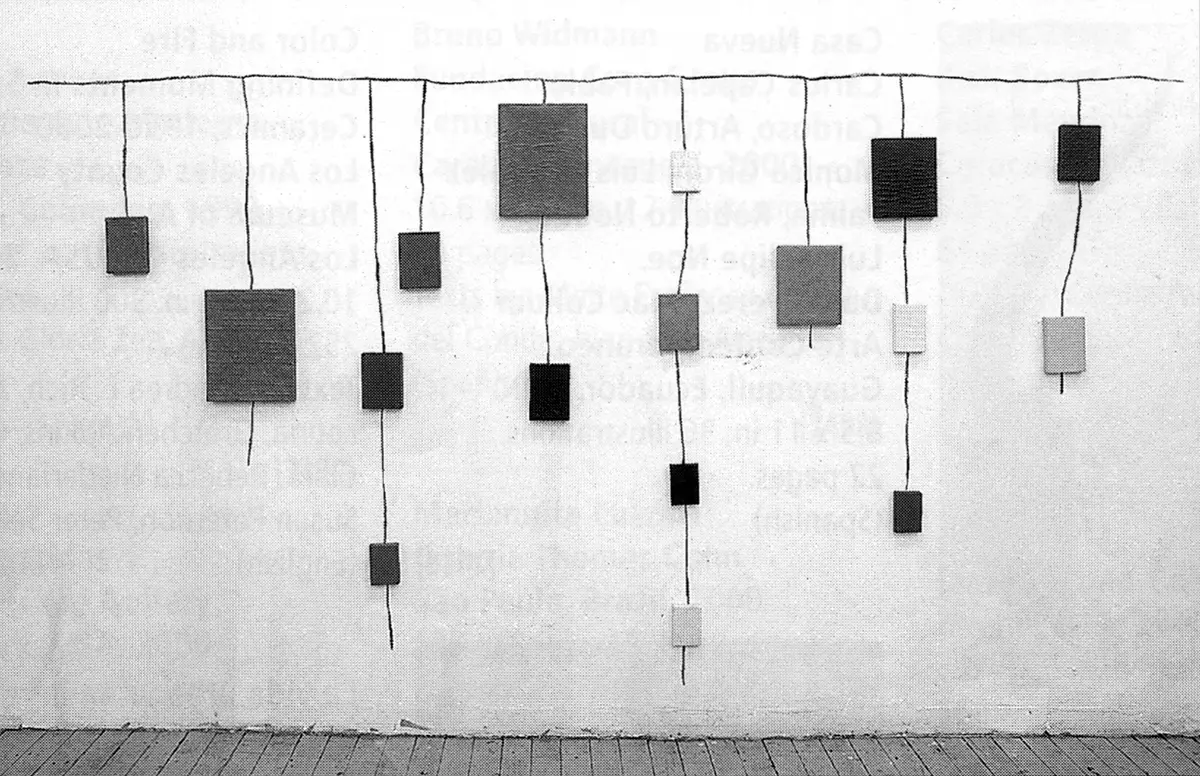
The exhibition, understood as a single installation divided into several moments, gathers Labin’s childhood and early youth memories when she was still immersed in family life. Family life is in Latin America an ample concept that includes not only parents and siblings but also grandparents, uncles and aunts, cousins, nieces and nephews, godparents, and friends. Labin appeals to her memory and reconstructs spaces whose significance has endured the passage of time. From the living room’s coffee table to the clothesline, everything has left a mark on the artist. The exhibition is built on the basis of past situations. The plastic resources Labin uses to build her objects are distant from formal representation. More than anything, she is a painter though her pieces differ from more traditional two-dimensional works. Her paintings often are realized in small formats, some of them square in shape, some rectangular some round; at times she breaks with the framed format and carries a line beyond the pictorial surface. This net narrates intimate situations, and in this way the work gains independence, becoming an open book full of form- and color-rich images.
Some of this and more we find in Mamaosa 2000. Once more the narrative element comes into play. Labin tells a story in several chapters that nonetheless form a totality within the galleries’ space. To arrive at this in/se-en-scene, she painted the exhibit areas of a tropical pink hue, to which she applied a fluorescent base, thus producing a luminescence that transports us to Zulia’s scenery.
The journey began with a hanger on which Labin had placed some kitchen clothes, these were treated with a plastic material, richly painted. From there we got to the living room. There, tables, plants, and other objects recreated the traditional family-gathering space. Another space, ingeniously resolved, is that of the clothesline. There we could see the pattern formed by suspending small wooden clothes of irregular shapes and varied formats. The artists successfully took us to the house’s backyard, where the wash was done and clothes were hung to dry in the sun. We seem to perceive the sun’s warmth beginning to fill the space, falling perpendicularly on objects and things.
The passion Labin puts into her work translates into the sensations she shares with the public. This facilitates our perception of the atmosphere suggested by each one of her recreated rooms, and it generates a totality of color, form, temperature, and sensation. Abstraction as a concept, from which Labin takes minimal references that are then adapted to the artistic act, is the vessel that connects the discourse suggested by this work, along with the de-contextualization of references to the past and how they are adapted to new spaces and situations.
Anita Tapiass and situations.
ANITA TAPIAS