
An exhibition that is formulated as a reflection on drawing gathered five artists who, through installations, projections, videos, signs, and live animals, came together to try to modify the traditional idea about the ingredients that make up the line.
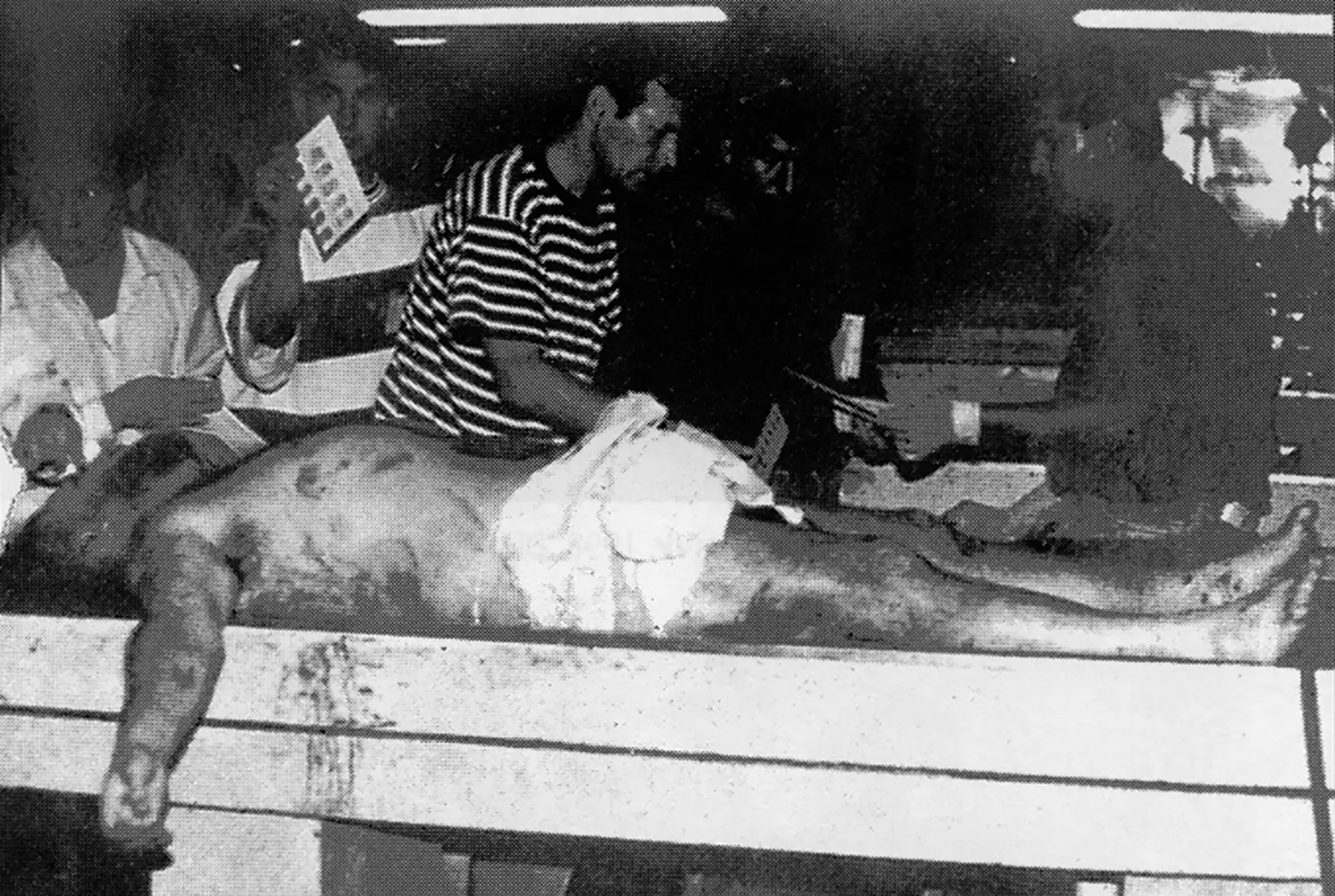
Leonardo Herrera (1976) reconstructed warning signs about the museum entrance, declaring it a sports area. Likewise, he constructed out of coffee grounds the inert image of a hierarchy of the mafia on the dissection table of the morgue. Coffee and cocaine, are processed powders of an agricultural origin that are emblematic of Colombia and of its international definition. Herrera, who uses diverse media, such as photography, video, and installation, concentrates his work as a critical instrument in the violent society that surrounds him.
Diana Lasso (1975) proposes mural enlargements on oilcloth of instructions on how to treat menstruation. The preventive measure of hemorrhage that does violence to daily life is also a didactic scheme that foresees its proper use. This appropriation of design in order to be subverted into a scale is also an exercise in stage direction and commentary on women and hen inevitable rites. The intimate and the secret as large display signs, animated by a will as sarcastic as it is essentialist.
For her part, Ana María Millán (1975) makes use of the projection of slides and videos in order to present her own image, telling a personal story. Obeying Banthes’s thought on the anecdote as a configuration for the opening of meaning. The apparently banal and random anecdote is exalted through the projected images which do not cease to be light occasions for provoking smiles. Millán refers hen gestures and descriptive treatment to soap operas, newscasts, and indicators of film and television work, all of which link hen aim to the document. She records musical actions and criminal acts, basing herself on banality as an eloquent symptom of a rhetorical society.
Claudia Patricia Sanria (1975) comes to the characteristics of place in order to prove her work. The architectural area becomes the protagonist, and the museum-container relationship is invented. The viewer sees his route underlined, and this is what makes the work exist in his visit. Regarding her work, experience, and realization, the artist has stated: "The project consists of taking the space designed to exhibit a determined number of works, of delineating it, representing it, taking as points of union each one of its vertices, taking it out of (apparent) anonymity, and making its structure stand out through drawing, turning the space into the work itself and, at the same time, monumentalizing and integrating the presence of the persons (the public) into the same, making use of self-adhesive strips of black covering in order to delineate the exterior space leading into the hall, keeping in mind the qualities of the line with respect to the structure, the idea of entering into a drawing."
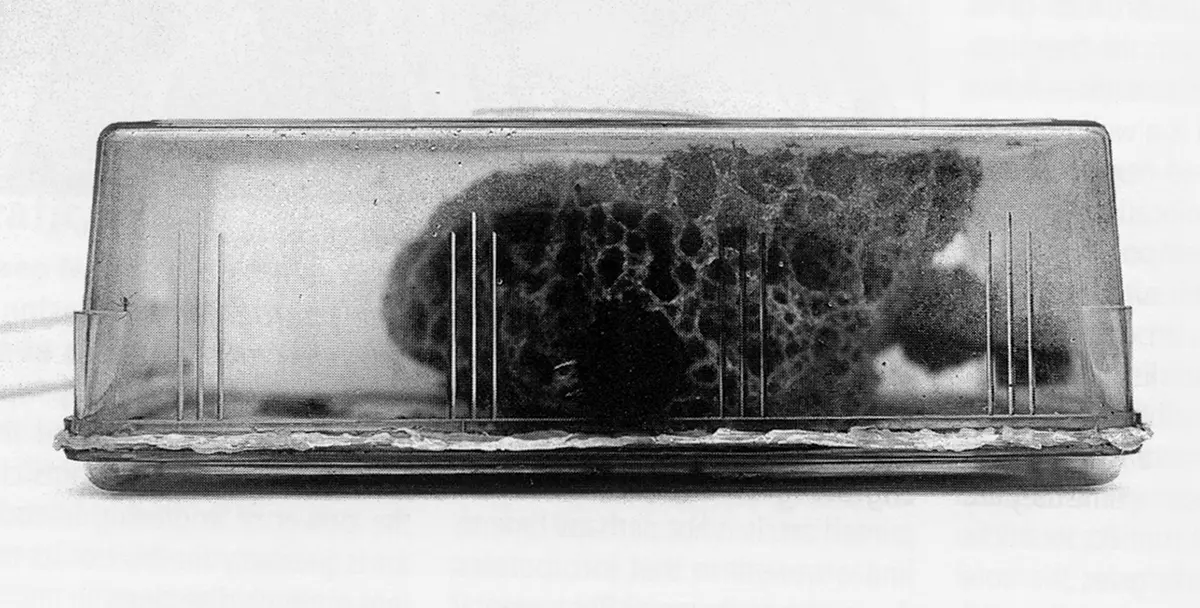
The brief video inlaid on the wall, the blackboard measuring 1.5 x 2.4 meters painted on the wall and written on entirely with colored chalk demonstrating a theory, and the anthill divided into three connected plastic compartments, formulates a work that presents the passing of time, fragility as a category, instinct as an element, and the eye-witness document as a point of emotional intonation. These are the interests that stirred Giovanni Vangas (1976) to produce this installation with diverse expressive vehicles. His work is visited by distinct motivations that include life and animal behavior, relating it to humanization, intelligence, and work. On another occasion, he had presented the life of his bitch, documented with the clothes, adornments, makeup, and evidence of anniversary panties. Now the center of his work offers the ordered, logical, sensible, and pacifist organization of ants diversified into three areas: the architectural construction in distinct behaviors, ranging from the room of the queen to the supply room, the place of the daily supplied food, and the sector where garbage accumulates, and which also serves as a cemetery The small city in prosperous growth is offered on a table, like a student experiment, alluding to didactic goals and somehow becoming a moralizing example.
The artists and works present at De-lineations come to discuss the discourse not only of drawing but also of the artistry of the creators and the production itself. Irony is a symptom, but so too is the distrust of generating questions, decoding attitudes, abiding by consequences, and designing particular forms of exorcism in the exercise.
MIGUEL GONZÁLEZ