
This first U.S. exhibition by deceased Argentine painter Esteban Lisa, demonstrated the artist’s unwavering fascination with abstraction. Spanish-born, Lisa came alone to Buenos Aires in 1907 at age twelve and by 1920 he began painting the small non-figurative oils on board and paper that he produced until 1978. Known in Argentina as an art teacher, who established a school touting his cosmological theories of art, Lisa never exhibited except to his students.
Overall, Lisa’s paintings from 1930 to 1964, convey rich and surprisingly fresh, abstract expressions. The earliest oils shown, such as Landscape, 1930, intimate the artist’s path toward a non-figurative language. Thick brushstrokes of earth-toned pigment loosely describe several buildings upon a hillside dotted with trees. Gently jutting mountain peaks and peach-toned, twilight skies loom behind, shedding light upon the softly rendered pastoral scene.
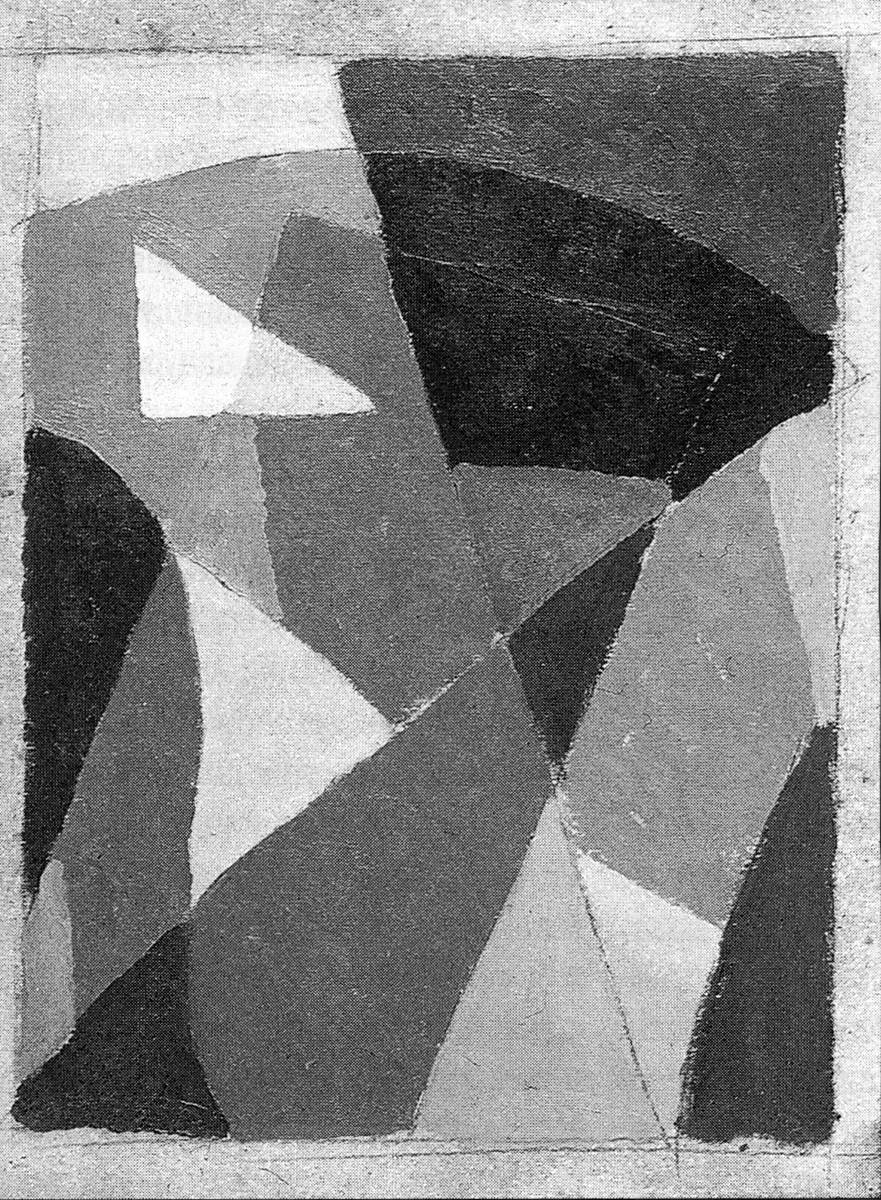
By 1935, Lisa began painting purely abstract paintings such as Composition, 1935-1940. Employing the earth-toned palette he preferred until the 1950s, this oil exemplifies the densely painted grid of shapes he explored throughout the 1940s. Arcs, triangles, and polygons fill the ground, placed side by side like puzzle pieces. Evident beneath the thick layers of paint, is the artist’s careful plot of lines, spaced and balanced with almost mathematical precision.
Most of Lisa’s 1940’s paintings divide the ground into shifting planes of geometric shapes, densely coated in opaque tones, with one notable exception, Composition, 1945-1950. This spare, evocative image is more richly rendered and despite its simple composition, appears as a more complicated and confident painting than most others in the show. The small board is divided into three sections, a deep olive right triangle fills the bottom and its complement, and a lichen green right triangle shaded with darker tones along the edges fills the top third of the ground. Between these triangles, the space is cut into three sections, a warm pistachio green shape at the left, beside a rich ruby section in the center, and a coral form at the right. Each shape is painted with short, precise brushstrokes in tones that darken along the edges, suggesting the shadows of a solid form. Unlike the flat triangles of his earlier paintings, Lisa modeled these shapes to convey their volumes, resulting in a painting less about the flat surface plane and more about the space within the picture.
In the 1950’s, Lisa freed his brushstrokes and pigments from his previous premeditated grid. Game with Lines and Colors, 1955, typifies both the title and effect of his new visual language. Colors, lines, and shapes dance upon the surface, presenting a lively panoply of semi-hieroglyphs. A dark line gently divides the ground in two, the right side defined by a half-blue, half-white lozenge shape, touches of yellow, black, white, blue, and a washy red form below. More anthropomorphic shapes in red, green, and gray highlighted with spots and curves, fill the surface, with patches of bare paper ground appearing throughout. The sheer exuberance of these later paintings suggests that by this stage in Lisa’s career, his abstract language aimed for an immediacy of expression, inconsequential to his earlier work.
MARY SCHNEIDER ENRÍQUEZ