
Sweden was unfolding into the new day. The night, a dark blanket that was now tired of covering the country during the winter, definitively retired and marked the beginning of the solar function. During the days surrounding the opening of Eventa, only a few timid indications of tenuous darkness peeked out between midnight and two in the morning, the hour of the dawn. June 10th, the date set for the opening, was preceded by fifteen days of preparation that, beyond the typical institutional bureaucracy, gave everyone present—more than fifty artists from all over the world, a handful of curators, a journalist or two, and all of the supporters from their different positions of duty—a goldmine of possible interactions on the real, artistic, and utopian plane.
This was already the fifth edition of an “alternative” international art biennial, the favorite daughter of Luciano Escanilla, creator and director of the Ekeby Quarn Artspace. Escanilla is a Chilean with a Swedish passport, a restorer of the most valuable jewels of art, a secret painter, and above all else the daring promoter of ideas with a cultural link.
Nearly thirty kilometers from Stockholm, Ekeby Quarn is the center, the heart, that gives life to Eventa. Throughout its existence, the Biennial has been growing and establishing guidelines. In its very beginning, it settled in the Ekeby Artspace, an old mill restored by Luciano. Recently, it has begun to break out of its boundaries by making use of exterior spaces, meadows, woods, and wheat fields. It has even arrived at the river, making its third edition a river voyage with five stops that disembarked in Uppsala, the city that today has been conquered and pierced by the symbolic invasion of Stockholm. There, on the ground floor of the Museum of Modern Art, Florencio Gelabert (Cuba-USA) this time unfurled the ecologist banner in order to revive five deforested countries of the continent, including the host country.
Utopia is the inspiration that the Biennial has named “PARADISE ZERO”—that instant that reviews the past, imagines the future, and makes proposals based on hope, nihilism, and apocalypse, according to each person’s vision.
It looks like gold, it’s not silver
To organize such a multicultural encounter inscribed in such an open, humanitarian, and harmonious society as Sweden, it would seem to be a good premise to give occasion to the proposed paradigm. Until you run into the reality and multiculturality within the “exemplary society,” it is nothing more than marginality in a decadent culture, which is the opposite of what it seeks to be. The conquest of space, the multicultural encounter, the de-conceptualized work, the gaze that rediscovers and reflects reality from another perspective: natural, social, political, cultural, anthropological, and metaphysical.
Cuco Suárez, an Asturian artist-performer who, among other merits, organized the project Diaspora: International and Interdisciplinary Art Encounter in the Spanish city of Oviedo last November, dares to bring together the faces that are repeated and added within a new world art movement without categories or manifestos —for the moment— and which travels across geographies beyond the commercial scope. This movement is promoted by key individuals like Orlando Brito Jinorio (Spain) who, having recently curated the Dakar Biennial, is the general curator of Eventa, in collaboration with Katya García-Antón (England), Ernesto Muñoz (Chile), and Luciano Escanilla (Sweden).
Ready, Set, Action
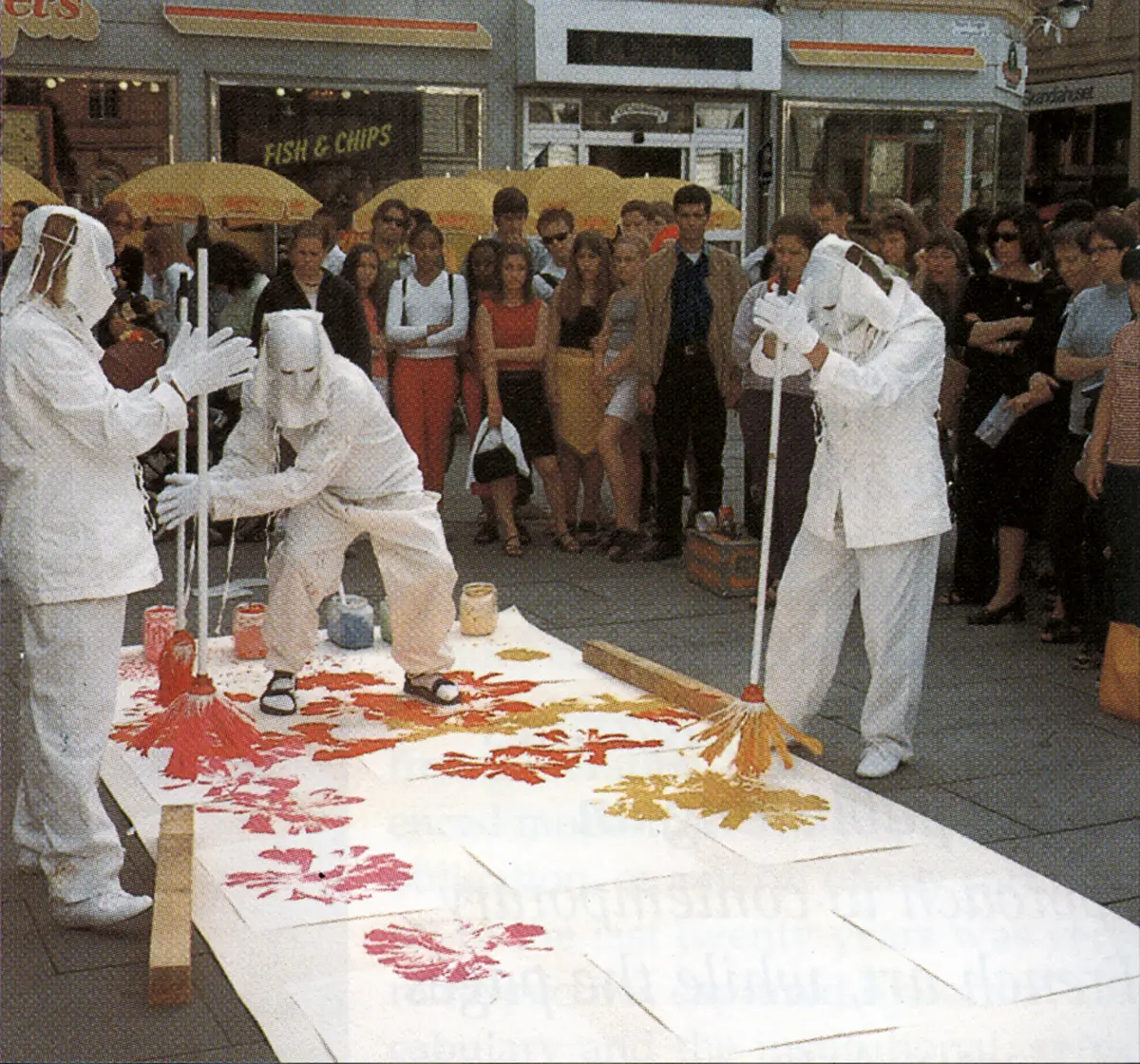
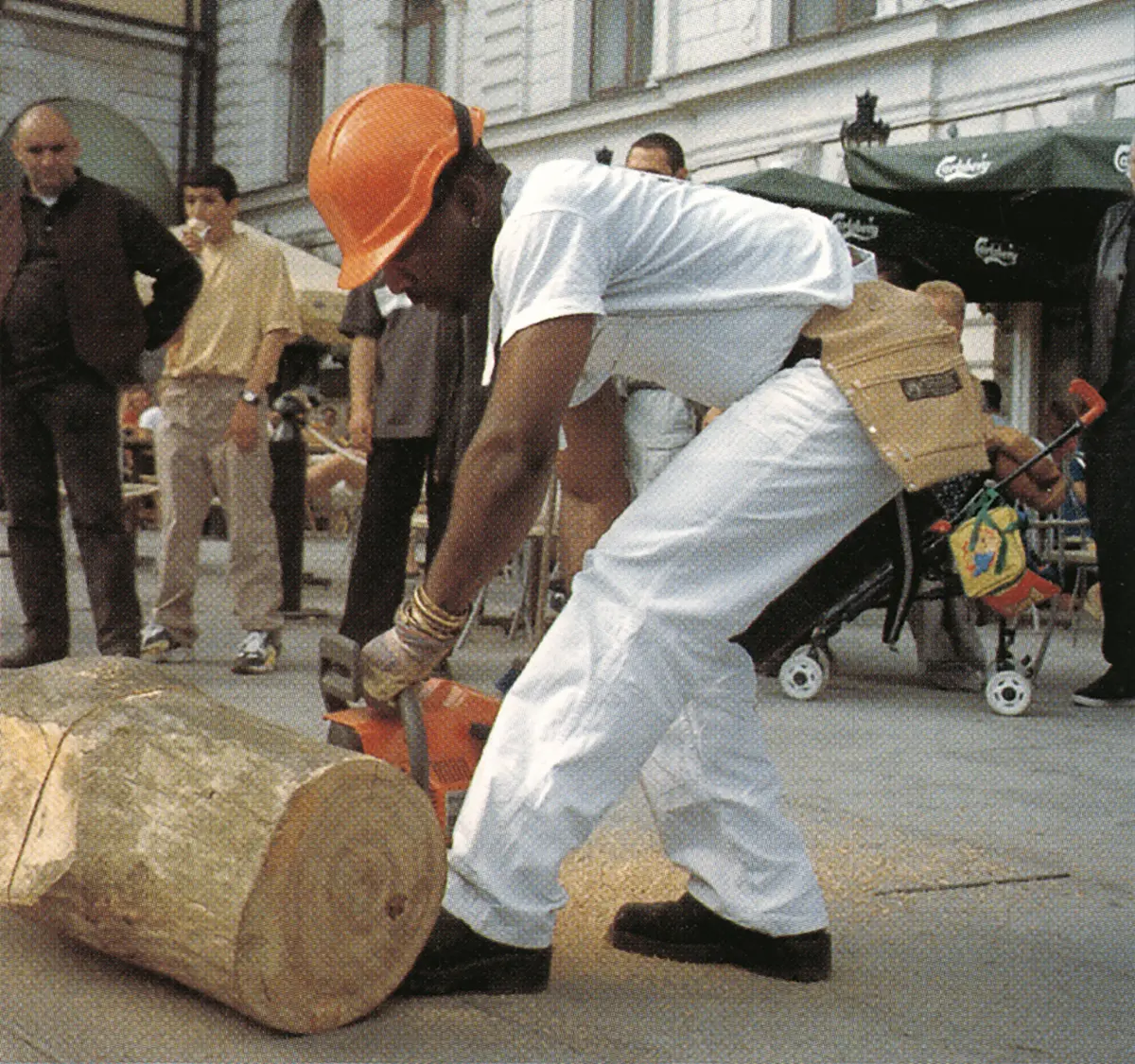
The days spent setting up coincided with the performances that opened the imaginary space in the city with the emblematic march of the King (Luis Sosa-Canary Islands), the Prince (Marc Latamie-Martinique), and the Prime Minister (Orlando Brito) from Butan World, a utopian place where everything is possible and blue (In Butan the blacks are blue, and so are the whites), accompanied by a troop of children who carried the message on pamphlets. Danilo Danziger (Argentina) dropped seven open black umbrellas into the river, Kjartan Slettemark (Sweden) and his domestic plastic dance printed color stars on a white street box, and Barthelemy Toguo (Cameroon), dressed like a laborer and with music on his shoulder, carried and sawed a wooden log in an extenuating cadence, thus making reference to the tough jobs typically performed by the community of immigrants.
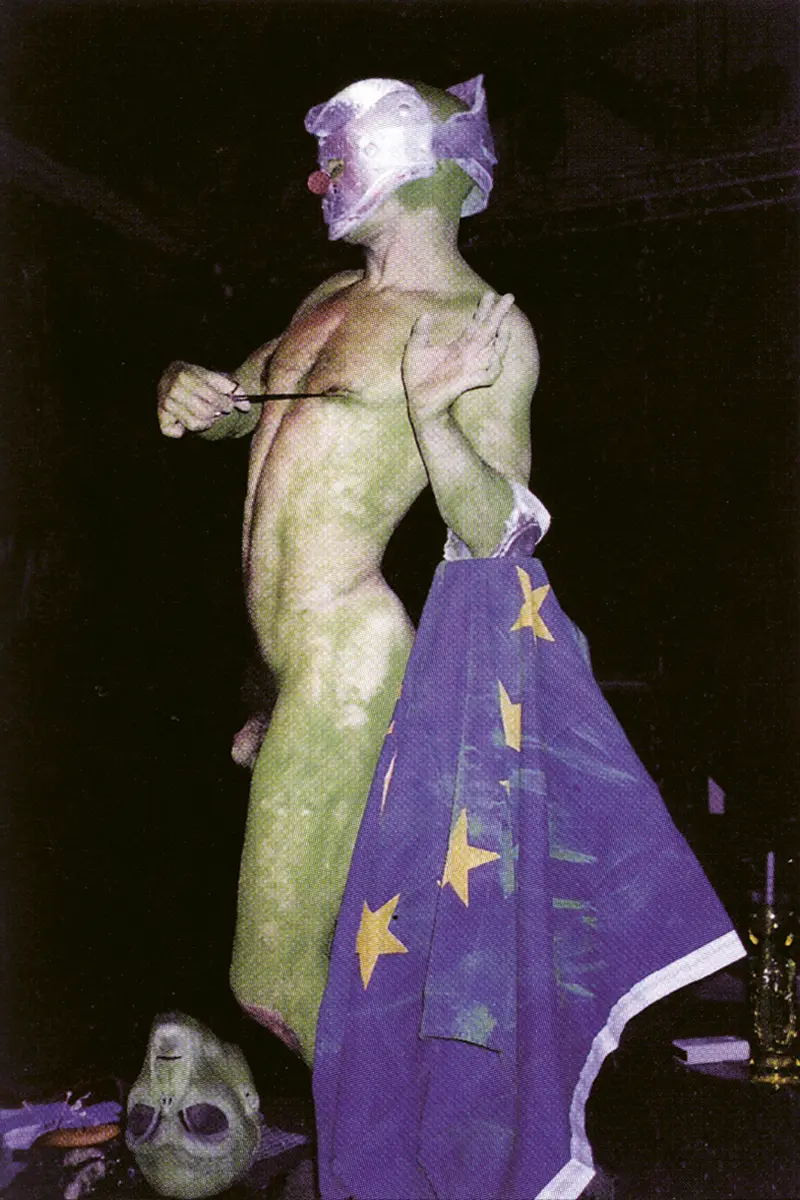
And to finish off the beginning of the paradise Eventa, the opening night showed for the first time on Scandinavian land the expectant Mexterminator Project (USA-Mexico) and the Interactive Museum of Experimental Ethnography and Apocalyptic Culture with three interactive specimens (The Apocalyptic Shic-Ano, The Cyber Vato, and The Generic Illegal Alien) incarnated by the renowned Mexican performers Guillermo Gómez-Peña, Roberto Sifuentes, and Juan Ibarra. They are culturally hybrid characters who, based on a provocative manipulation of elements—symbolic, ritual, bodily, theatrical, and technological—use and discard, construct and destroy, critical discourses on their vital realities and invite the public to take part in their needs and fantasies.
With the opening of the Biennial (in spite of budget cuts), the support and solidarity of David Elliot, director of the Museum of Modern Art of Stockholm, began to open unexpected doors that are seen as daring steps that place the Biennial in the jaws of fame, with the resulting danger of selling out or costing it its soul.
Right in the heart
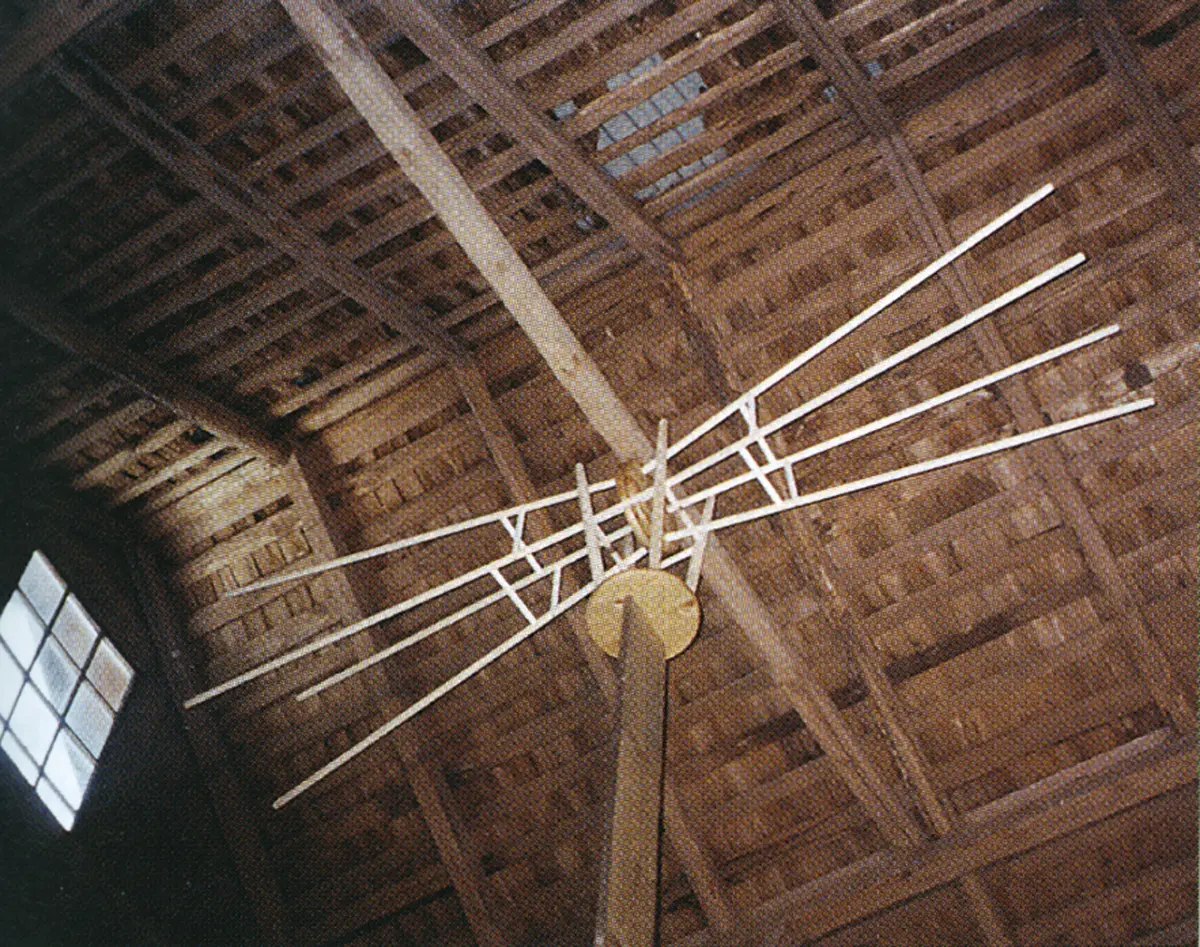
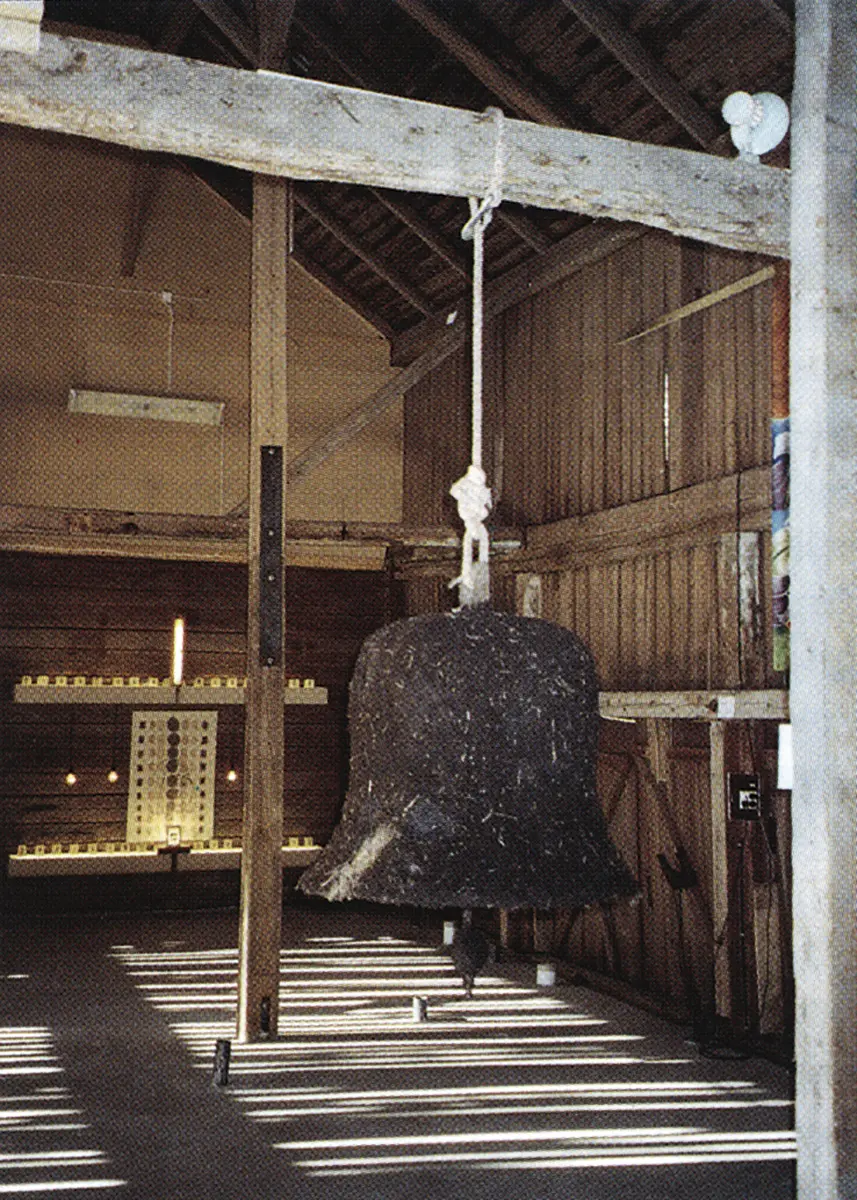
This year, the penetration and acceptance of Eventa were very fruitful. At the Edeby Quarn Center, the exhibition made way for itself with a piece by Eduardo Cervantes (Mexico) who, in the same way as the one he showed outside, took possession of the entire place in which it was installed as it merged into the architectural space with surprise, humor, and irreverence. In the first case, a trio of pine stools, so universally Swedish, made up an absurd standard that not only rendered the object useless and turned it into art but also became beautifully integrated into the wooden carpentry framework fashioned by the planks of the old barn that lent itself as an art hall. This room also housed the large ethnic fabrics of the great Owusu Ankomh (Ghana) which, face to face as if one were the reflection of the hieroglyphic self-portrait of the other, hung from the top of the wall and covered the floor, touching one another. And Danilo Danziger’s (Argentina) great bell, made of clay and organic materials hung from the ceiling. An unedited video in which a bird repeatedly pecked at an apple in the air, Japanese-style audiovisual poetry by Marc Latamie, and, finally, a series of multiracial faces enclosed in well-cared-for boxes or in bars of soap, all joined Juan Castillo’s (Chile) self-lit, scenic installation which seemed to sing an emotive and aesthetic political claim.
Outside of the barn, and before entering the mill on a woodsy plane on the riverbanks, a group of installations camped out, literally. Latamie had raised a tent that philosophized apropos of Descartes (who died in Stockholm) and which, without being the same work, extended through the multicolor and the written word “Atlantic” that Latamie finally described within a sort of pyramidal henhouse as a common dividing and unifying axis of his world.
Jack Beng-Thi (Reunion Island) marked the traces of a path that linked the space of the house (where the thought is constructed) to outer space, specifically an image of a primitive wood that lies at the bottom of a hole dug in the earth.
Luis Sosa (Spain), with a little blue paint and some strips of fabric of the same color as those that were floating in the water, suggested his Butan delirium of wanting to dye the entire river blue.
Juan Castillo’s countenances once again faced the public, this time forming an impermeable sheet that hung over the entrance canal to the river energy that last year gave life to the mill.
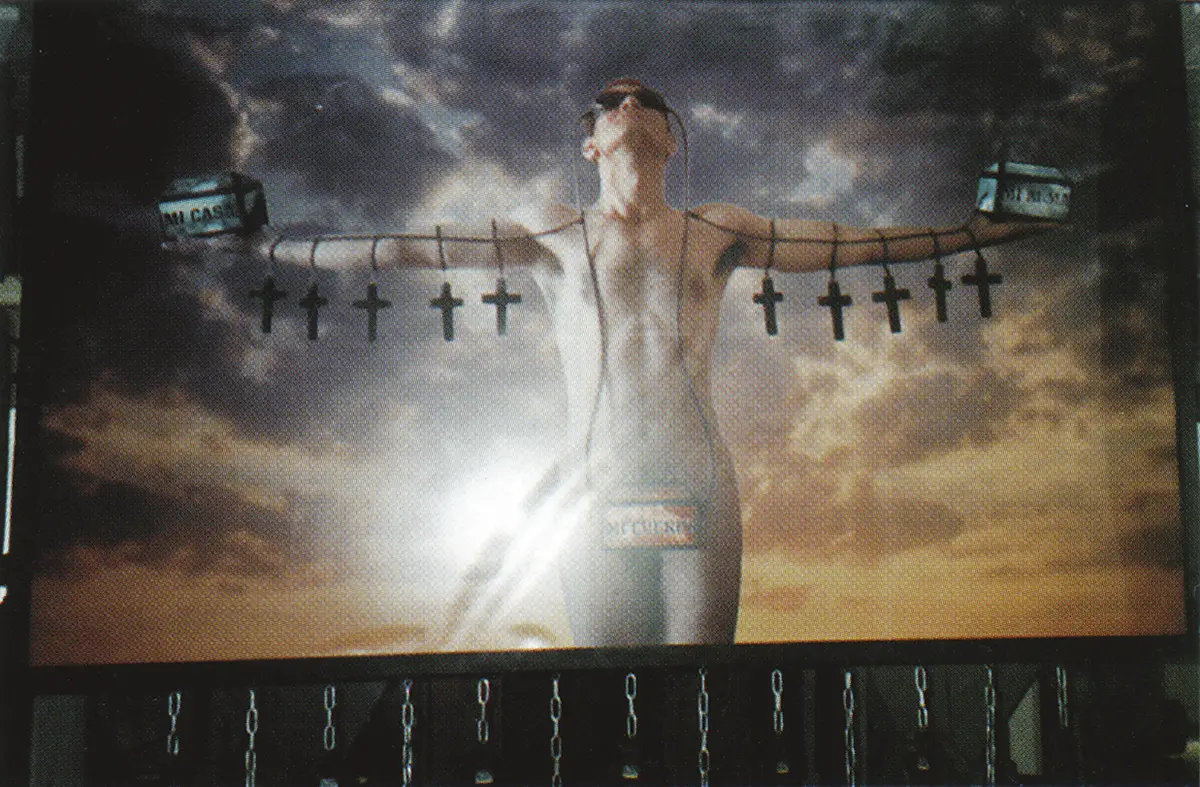
In a large-scale color photo, the crucified body of Pascal Meccariello (Dominican Republic) welcomed us with open arms, and with all his ideas of paradise hallucinating in a ruinous religious dementia.
Shanin Afrassiabi (Iran) alluded to another emblematic paradise, that of the insular oasis (like the little island with a palm tree) transmitted through a TV placed in a small corner decorated like the most inefficient hotel that had just been smashed up.
More Catholic recollection was repeated in the crucifixes that Ismael Frigerio (Chile) took from the cemeteries of the deserts of northern Chile where the artist carried out over a long period of time an exhaustive photographic-anthropological work on the salt mines, on the tracks in the earth and on bodies, on time, and on torture.

In the basement, Augusto Canedo (Portugal), through some spotlights stuck to the wall, projected the image of an open mouth that kept repeating itself as if a series of screams of light in the darkness, while on the floor level, the lights lit up a flower garden.
The refuge/house of artists had been appropriated by Cervantes (Mexico) with successful work that reached maximum results with minimum effort: a small doll’s face filled the cavity of a small hole in one of the outer walls, not only achieving a really disquieting effect, but also converting the wall, and therefore the entire house, into a concave and deformed body of expression of the little mask. Throughout the entire show, Sosa’s Butan spirit of inundating the world with blue continuously trickled down.
In a small, cold crypt, Fatma Charfi M’Seddi (Tunisia) wove an impenetrable framework secretly charged with so many memories. Above, in the loft, Natalia Pastor Suárez (Spain) mounted a small and sensitive show of her work (drawings, paintings, boxes, video). Within the theme of insects that she has recently tackled, this time the tireless ant appeared eternally traversing the symbol of the infinite, apropos of utopia. This concept, like a puzzle, was as if the artist were wondering if she could arm herself with pieces of reality.
Now, before heading toward the city of Uppsala, we recall the enormous multimedia garden/mandala carefully sowed by Ro Rai (Nepal), the English collective Antidote, and María Causa’s (Argentina) installation which re-created a bedroom made up entirely of white, emptiness, solidarity, and absence, and which opened the way among the underbrush of a wheat field.
Prolongations
Outside of Ekeby, the artists of Eventa let their participation be viewed from countless facets of the city. Just before arriving at Uppsala, in a picturesque church next to the Viking cemetery, Oswaldo Macia (Colombia) made his symphony of birds ring out. His investigation took up the tortuous resource of the repetition of sounds that, because melodious, can become unbearable. In the Botanical Garden, Armando Mariño (Cuba) placed a hyperrealist mulatto carved in wood and looking through a long view from the ceiling of his precarious hovel. In the park, Britt-Marie Larsson (Sweden) created a circle made of marble and mirrors in the center of which lay a mask that looked like a Pharaoh’s jewel. In the Museum of Modern Art, Jacqueline Fraser (New Zealand) reflected her personal delicateness in her scenographic work, and Mark Waller (England) projected a group of videos somewhere between documentary and cinematographic. Gilberto & Jorge (Spain), in their version taken from their Saxon namesakes, showed books of photos of all kinds of doors at the library. These doors were very casually accompanied by sentences/thoughts that reinforced even further the desolating and existentialist feeling of the work.
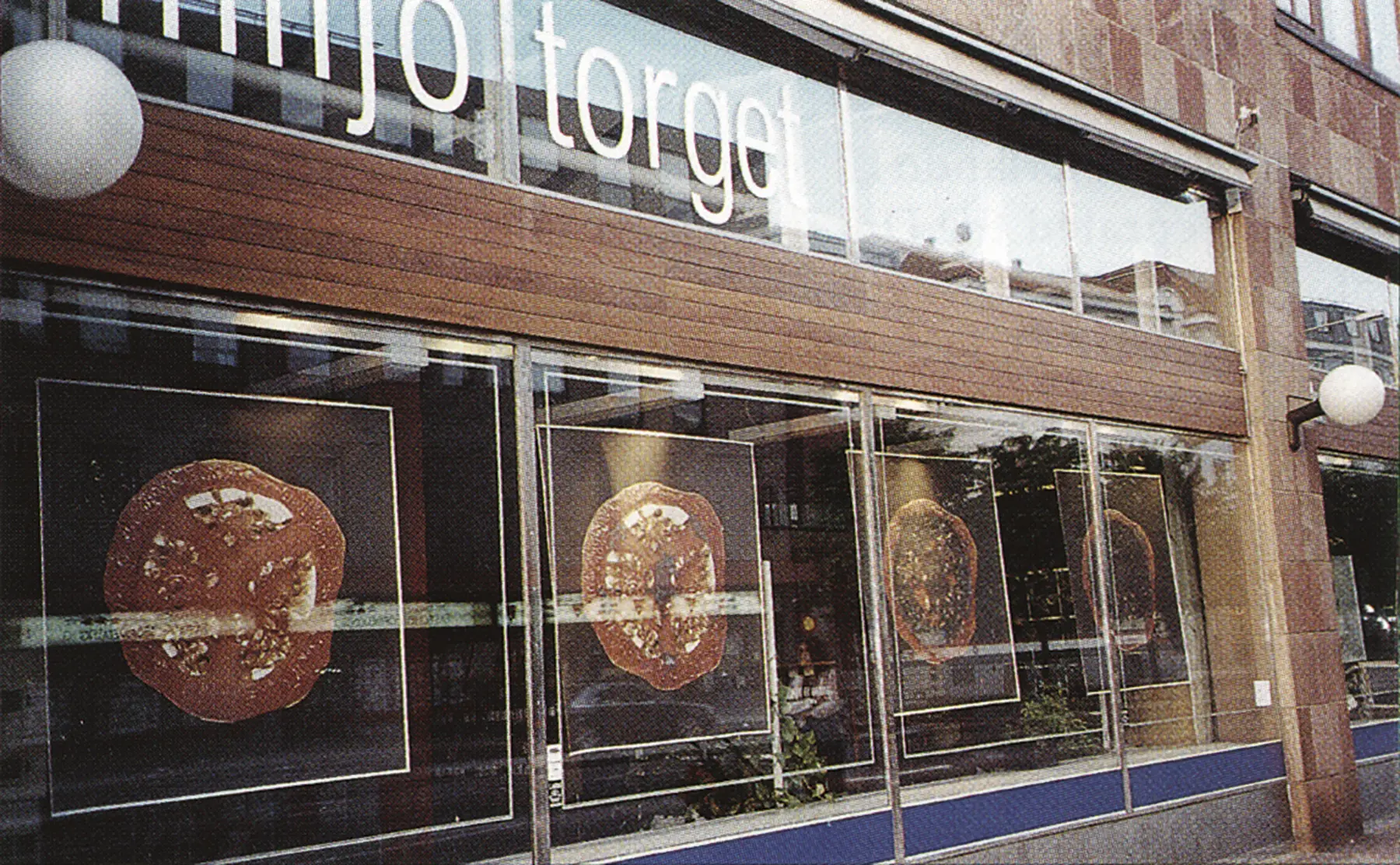
Three consecutive windows were reserved for Héctor Siluchi (Chile), Janet Escanilla (Chile-Sweden), and Luis Sosa (Spain), all with large photographic formats whose sequences alluded to childhood in the case of the first two. The Canary Islander, on the other hand, detailed with a precise objective the rotting process through time of a tomato/island/cell. Carlos Matallana (Spain) occupied a gallery with his murals of fire and air constructed out of hundreds of photos around his shadow of ash drawn on the wall.
In addition, there were works in cafés, bars, streets, and in the station, in such a way that Eventa did not go unnoticed. Although its dispersion proposed an effort at times like detective work for the viewer who wished to find all the clues, as a cultural phenomenon of social penetration it achieved more than accurate results that consolidated its success with the closing festival which, with complete freedom and in conjunction with performance, took over the cathedral as a center of participation and divine reflection during the month of September.
* Photos by Carolina Pascual
ALEJANDRA POZO
Journalist and member of the research group Artística ART-01; from a Venezuelan origin, based in the Canary Islands, where she works as an art correspondent, specializing in Latin American Art, for several publications.