
It would be impossible to bring Francisco Narváez (Venezuela 1905-1982) down from the place where his work has situated him in the history of Venezuelan and Latin American sculpture. A talented carver of forms, a master in the magic of capturing matter and space, the essence of sculpture, dexterous in the tridimensional projection of drawings, Narváez moved through XXth-Century sculpture hike an explorer who already knows his terrain, and knows it well. Beginning with his figurative work, he inaugurated a fundamental era in Venezuelan sculpture, when, under the influence of Maillol, Rodin, and Bourdelle, he joined the search for a visual preceptive for the nation as understood by the landscape painters of Caracas’ Círculo de Bellas Artes. In 1928, Narváez traveled to Paris; on his return in 1931, he encountered a changing culture in Venezuela, particularly within the visual arts. The artist’s immense work began then with commissions for large-size, monumental public pieces. To analyze the early periods of Narváez sculpture (labeled criollista due to the human type he represented, such as the black woman with bananas or the young, full-lipped mulatto, representatives of the sensual and mestizo nature of the artist’s work), it cannot be forgotten that he Venezuelan discovered in Europe his Latin American roots.
The retrospective show Narváez, the Great Latin American Sculptor, gathered a selection of works dating from the early 1930s to 1982, the year of the artist’s death, and it allows us to appreciate the different periods in Narváez’s development. The female figures of the 1930s show an artist immersed in the problems of figurative, volumetric sculpture, while by the 1940s there begin to appear more stylized forms resolved in organic configurations.
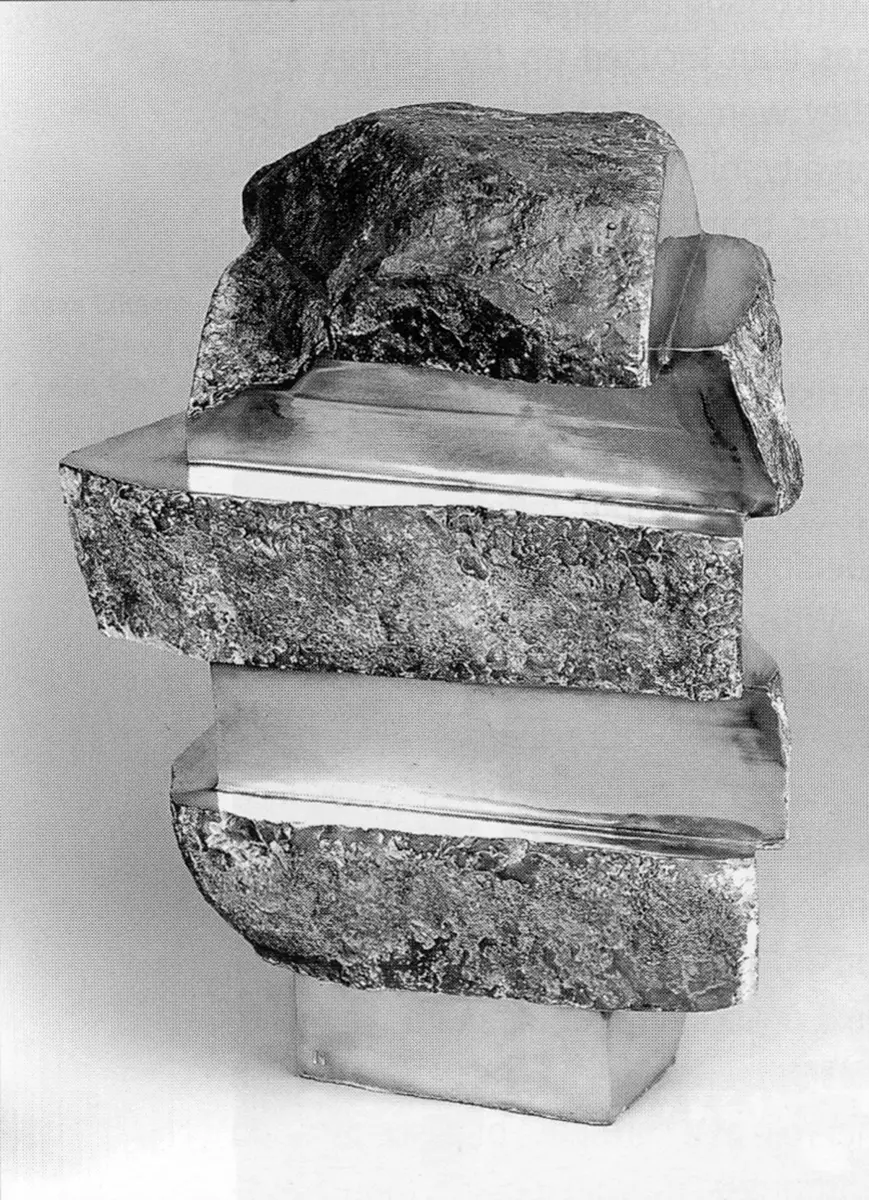
Narváez’s sculpture follows a cohesive path of development from figurative representation to abstract works, from representational forms to geometrical abstraction beginning in the early 1970s and hasting until the time of his death.
Analyzing his work under the light of world sculpture, we realize that it can’t be categorized following the traditional, sometimes banal criteria often used to describe it according to his creative periods. This Venezuelan artist justifies his work within the real space where his pictorial values are made concrete, and turned into objects, according to a Latin American reality. Within the context of Venezuela’s art world at the time, he certainly opened the doors of modernity for a tradition of tridimensional works and closed, bulky, volumetric sculpture. And he did so with an oeuvre that is charged with meaning in tridimensional configuration. In each one of his periods, the artist reached the outer limits of figurative representation and got chosen to the essence of abstract interpretation. As for the structure containing these two codes, representation (figurative forms) and interpretations (geometric forms), it was always rectangular volume in a vertical position for him. Both of these codes can also be seen as two geometries working to produce unitary metrics of material and temporal values in space. In essence, Narváez was a figurative sculptor whose geometric works during the last decade and a half of his life can be considered precisely as his geometrization. A diagram could show how this process comes to be in plastic terms. In his case, we could speak of block sculpture, of closed and timeless volumetric space that brings him close to the creative and human attitude of the American continent’s great pre-Hispanic carvers. The certitude of durability, his fidelity to the materials, be it real or induced (it’d be necessary to speak of his bronze works with the texture of wood), and his timelessness, are all included in the very cubic block that in itself contains the sculpture. It is on its surface that both figurative representation and geometric interpretation occur. A comparison between emblematic pieces from his different periods should suffice to support this conclusion; for instance, his Figuras femeninas (Feminine Figures) of 1932; Mujer con paño (Woman with a Cloth) of 1937; Alcatraz of 1940; the 1945 Torsos; and the whole decade of the 1960s all the way to his Cabezas ochavadas (Octagonal Heads) and Volúmenes (Volumes)of the 1970s and his work in the early 1980s.
Narváez was a thematically limited artist. He experimented with the insertion of his themes into the cubic volume: simple forms that forcefully express tridimensional volumetrics. Inhabiting a closed space, his sculpture is not primarily interested in letting form express its character as an object. He was a sculptor for architectonic spaces, at once real and essential. It wasn’t by coincidence that he became an important artistic collaborator of architect Carlos Raúl Villanueva’s arts integration project. Narváez’s civic works confirm this observation. Vigorous, hermetic both in its external configuration and its thematic essence. An heir to the great works of art of the world, Narváez’s sculpture hives alongside that of Constantin Brancusi or Henry Moore.
BÉLGICA RODRÍGUEZ