
The engaged and collaborative spirit of Francisco Toledo (Juchitán, Mexico, 1940) is renowned both inside and outside of Oaxaca. Beyond the richness and profusion of his plastic work that embraces all genres and supports, the social and cultural labor that Toledo has carried out in his native Qaxaca has made the artist a living legend. Add to that and even in spite of it the ghostly aura that his non-presence provokes in all events related to him. Toledo is more present the less he goes to his openings and, for those who follow his work, this summer it happened in Madrid. Barely a few weeks before the opening at the Reina Sofia, watercolors with which he illustrated Borges’s fantastic bestiary in the ‘80s were presented at the Casa de América.
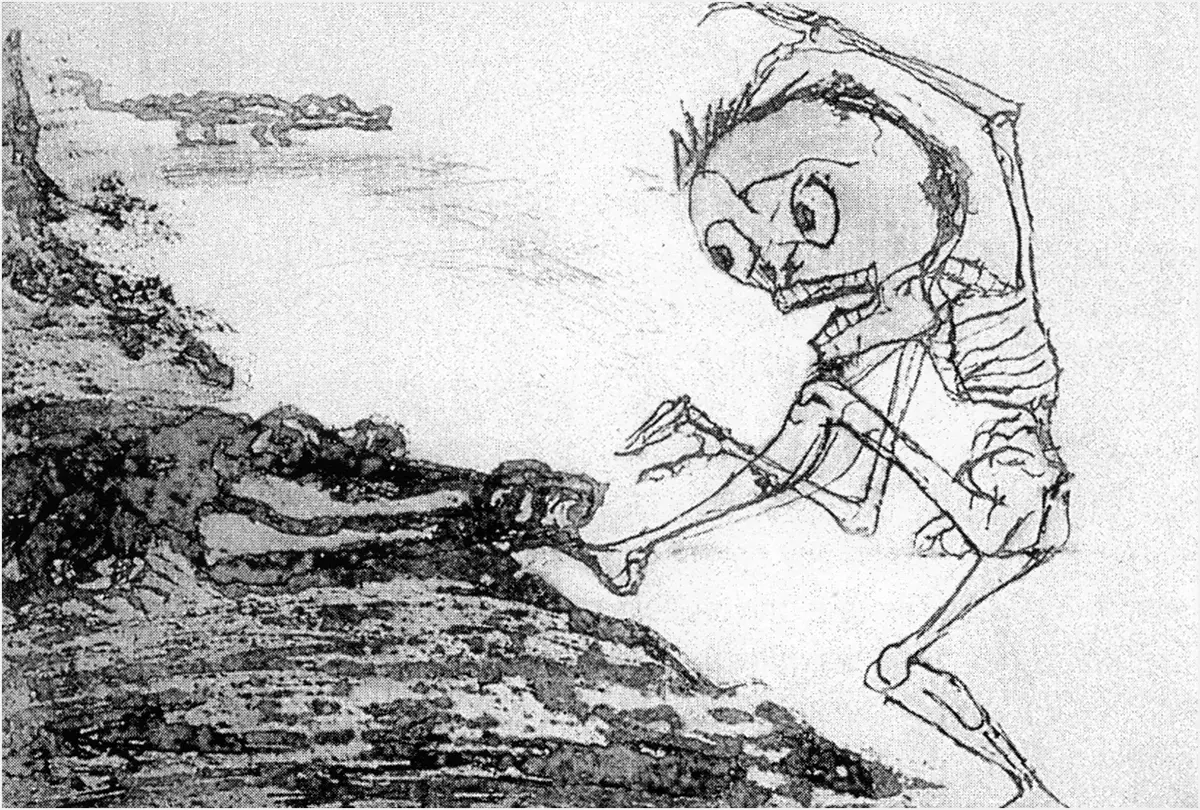
This brief but rich exhibition of inks and watercolors on paper already whetted the appetite for what seemed to be Toledo’s great presentation on Spanish soil and within a medium that, although it opens onto foreign proposals with difficulty when it does so constructs true mediatic myths whose later presence in galleries, museums, and institutions becomes obligatory. Thus, in the middle of July, the show brought directly from the Whitechapel Gallery in London and curated by Catherine Lampert was opened in Madrid. Very much in tune with Toledo’s solidaristic personality, both the exhibition and the catalog were co-produced by the English gallery and the Reina Sofia. The result, however, at least as it was seen in Madrid, does more honor to the teamwork than to the work of the artist.
Outlining a general vision of the work of such a prolific creator may seem complicated: the variety of his formats, his supports, and his stylistic experimentations complicates any attempt at a historical reading of a development a list, or evolutionist cut. His iconographic richness (which is not limited to indigenous imagery), his varied influences and dialogues (that include Tamayo as well as Italian futurism and Goya), and his high productivity, could put any curatorial team in a jam. In this case, the museographical arrangement was ideal for the presentation of the graphic series that were found in small, separate rooms, but it proved to be counterproductive for the pictorial medium- and large-format work and for the sculptural objects. Among such quantity and variety of distinct and concentrated work in a relatively reduced space, it was difficult to articulate any discourse that did not end in pure aesthetic judgment. This is something that Toledo’s work cries out for and promotes, and it is even one of its principal virtues. There will always be doubt as to whether this is the best way to introduce his work into a context as given to taking pleasure in Latin American themes as is Europe.
The selection of the work was, in effect, impeccable. We saw some of the best things that Toledo has produced in graphic work (the latest etchings of insects and self-portraits) as well as sculptural objects the Nabigu (figuras jorobadas) (Nabigu [hunchbacked figures], 1970), and in painting El coyote y el conejo (The coyote and the rabbit, 1974) and the Mujer atacada por peces, (Woman attacked by fish, 1972) as well as some photography and book illustrations. Perhaps the best part of the show, and where the artistic and social discourse that the figure of Francisco Toledo represents was secured, was the video created by Cuahutémoc Medina and Rafael Ortega, and the catalog edited by the English and Spanish institutions in conjunction with the Turner publishing house. It is in these documents that a more comprehensive and reasoned vision is presented of a group of work that, at first glance, is uneven and eclectic. In any case, the best thing after visiting the exhibition is a great interest in delving into and investigating a universe of which we have barely glimpsed a microscopic fragment.
ISSA MARÍA BENÍTEZ DUEÑAS