
The concern of museums regarding their role and their future has been going through an overhaul during the last two decades by means of diverse theoretical and practical formats. The selection, presentation, and conservation of the past and recent artistic heritage is a worn and doubtless important path, but there are other parallel destinies that many museums, if not all, can and should travel Why? In order to be in tune with the pace of history (read: in order not to become mummified pachyderms). In the specific situation of institutions dedicated to current art, the function should be even more active in various directions. Not only so that the public may perceive and absorb the changes that reveal social modifications through the works of artists, but also in the sense of a “multi-use building.” The cost of space and buildings represents large investments; the expansion of the education area that has been carried out is a basic social mission for children, adults, and especially adolescents. The areas of diffusion, publishing presentations, musical, architectural, and other similar activities cooperate in social prosperity and extend the meaning to each entity.
There are few original and concrete situations like the one being carried out by the Bronx Museum of the Arts with the program AIM —Artists in the Marketplace— which is celebrating its twentieth edition. To that end, an exhibition with the following characteristics is being prepared: The AIM program helps very young artists by showing them how to address both the market and aesthetics. How can I develop work and survive? How can I get a gallery owner to notice what I am doing? How do I approach critics? How do I present my work to a museum? Of all those who present themselves for each program cycle, the museum selects those whose work it considers relevant and grants them the opportunity to become informed, to promote themselves adequately, to get to know and dialogue with specialists, to show their work, to be “discovered.” Many well-known artists have emerged from this program.
There must be no mistake: AIM does not make the artist, but rather the artist is able to grow through AlM. Among those who have participated, there are people from all geographical areas. With that same criterion, twenty of those who had already participated were invited to form part of this anniversary exhibition that fulfills its obligation to “reload the page,” to celebrate and expand the reflection on the themes pointed out above. Each artist is present both in a work and on a CD-ROM, on which he or she talks about a key moment in his or her career, about a decision, a change, or an opportunity. At the same time, specialists —gallery owners, dealers, and critics— who have participated in the program speak about why they have given certain artists the right to participate. Fabián Marcaccic, Ernesto Pujol, and Valeska Soares, three Latin Americans who have lived in New York for years, born respectively in Argentina, Cuba, and Brazil, are three of the twenty that are participating in the present show.
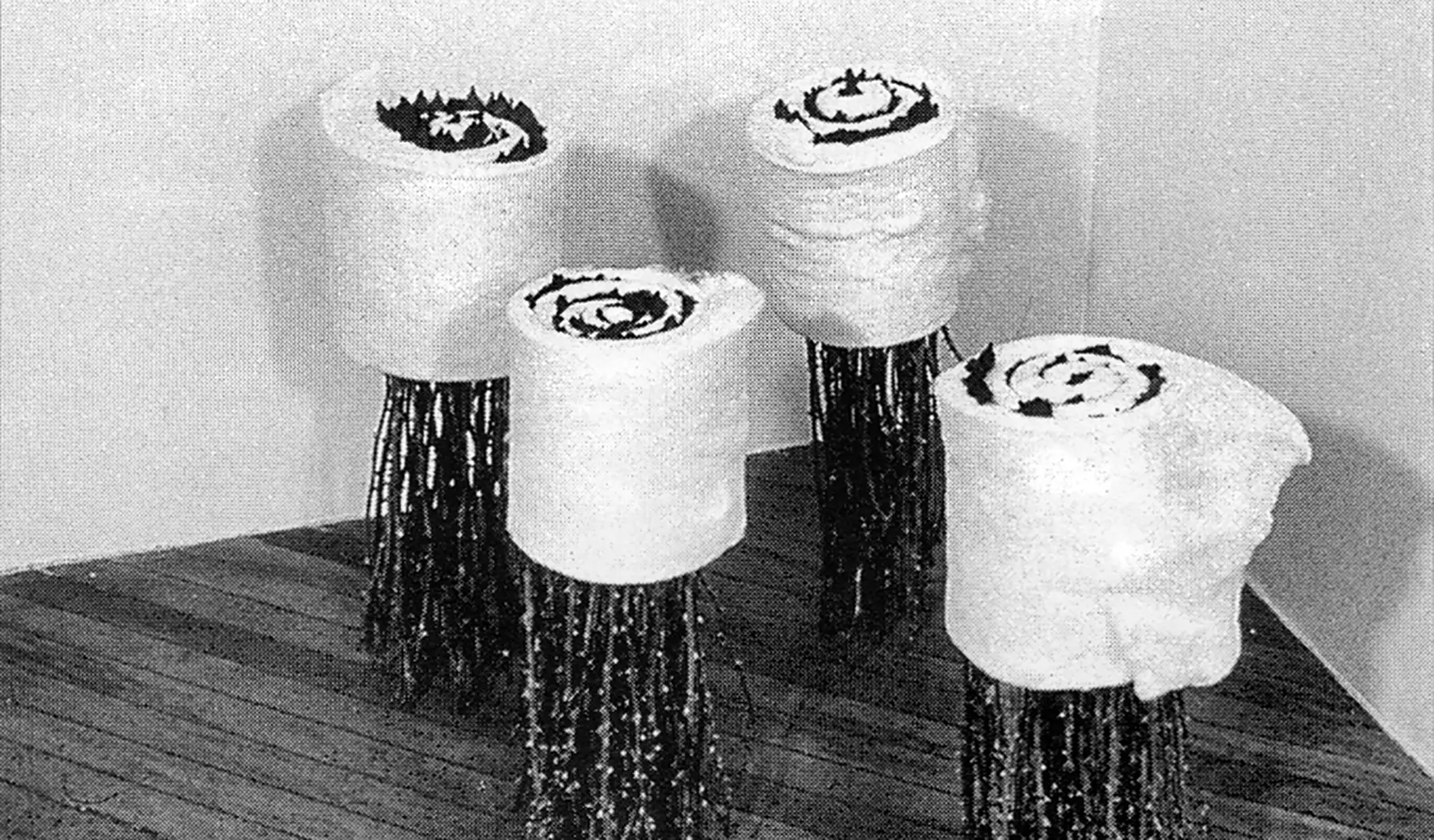
Valeska Soares (Belo Horizonte, Minas Gerais, 1957) presented an untitled installation from 199112000, made up of 1,500 red roses and cotton, in variable sizes, that belongs to the Bruno Musatti Collection of São Paulo. Scares make a worthwhile homage to the missing and much-appreciated gallery owner Camargo Vilaça. They worked together over the last eight years, and she recalls how much he helped her to professionalize Brazil’s art and art market, and to internationalize what the artists were creating. The counterpart in the electronic dialogue was headed up by Liebman-Magnan, who explained that they are showing it because, for them, as gallery owners and art historians, Scare’s work fulfills one of the precepts of art today: it expands the aesthetic borders from the sensible and visceral perspectives.
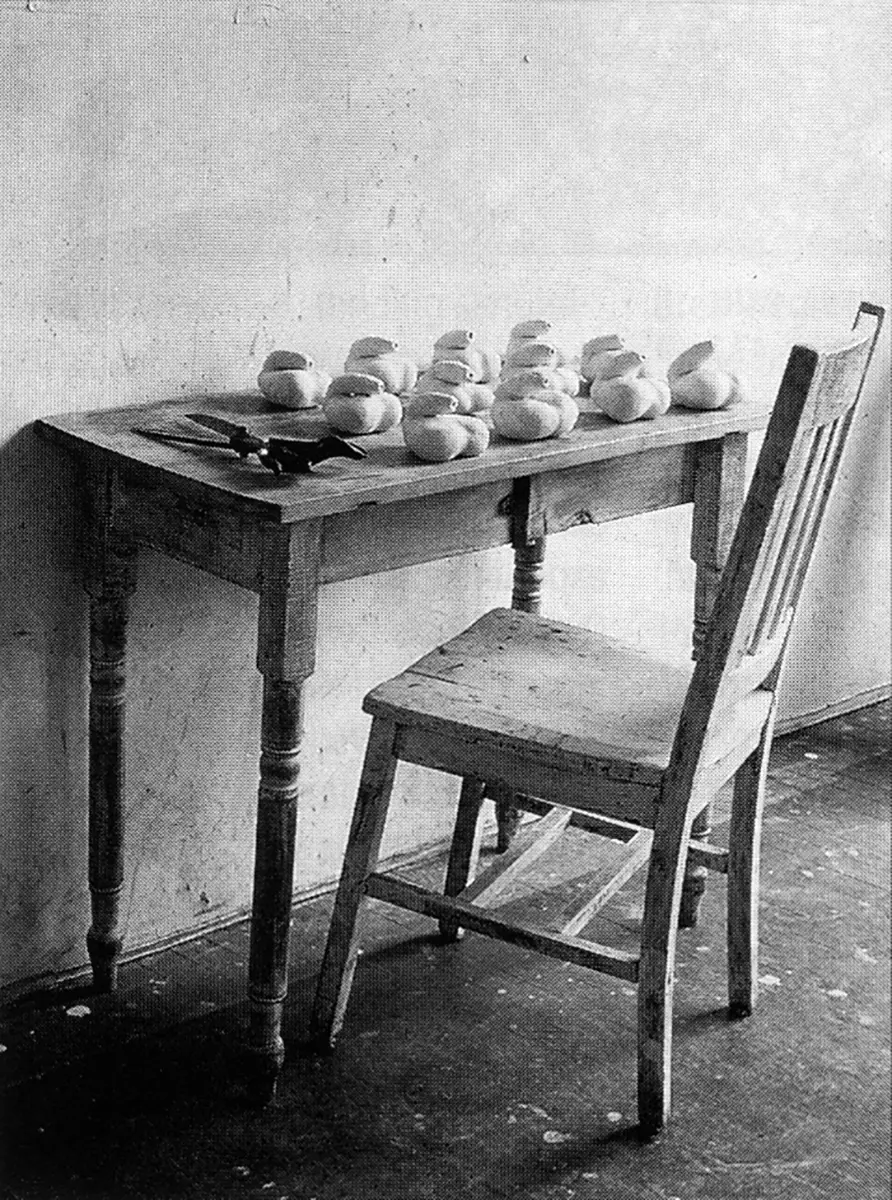
On the CD-ROM, the participation of these two is among the most consistent. Fabian Marcaccic (1963) was born and studied in Rosario, Santa Fe; he is participating with Genéticas alteradas # 1 and # 3, works in mixed media. In the recording he tells how, already forming part of an established gallery, he decided to “leave” because he was not comfortable. He has no regrets about the decision because, in time, he met John Lee, who represents him today and who Marcaccic believes best understands his work. Ernesto Pujol was born in Cuba in 1957 and studied in Spain, Puerto Rico, and the United States. He presented the installation La mesa de Peter Pan (Peter Pan’s table), an installation articulated with a chair and a table on which twelve unique trios are found, each one made up of a pair of testicles joined to a penis, and on one side, a pair of scissors. The work was originally created in 1994, a year he considers decisive. He explains that in 1994 he was invited by the then director of INTAR to participate in an exhibition of installations, and that that was not only a challenge for him as an artist, but also a challenge for the public and the critics who were used to seeing his paintings. When they found out that he was making small objects that jutted out from the wall, there were people who wondered where he was going, and the critics responded to the work with great interest. He believed that it was very important to take risks, and afterward, his proposals began to increase in size.
It is worth noting that Pujol participated in the AlM program in 1991. The installation was articulated with a chair and a table. 12 sets of three singular objects were organized on top of it, each one composed of a pair of testicles and a penis joined together, and to one side, a pair of scissors.
Good business is the best art, and good art is the best business. This sentence is a dynamic band that runs on the CD-ROM, which also has a lot of data on the artists. It was designed and produced by Elvira Morán, with music by Elliot Sharp, video production and editing by Devorab Hill, produced with the economic support of Philip Morris and the collaboration of the Jerome Foundation. On the documentary side, the exhibition had a space with chests of drawers where the choice of the twenty participants was spread out. Specialists could thus review the works of the artists whose work was not in the rooms and decide if other ex-AIM members had potential, would be invited, selected, or excluded. Also, slide images and documentation of all who had passed through the program were available for review. This ratifies the coherence of the entire project tightly curated by Marysol Nieves, with Lydia Yee and Edwin Tangonan Ramoran.
Considering that the Bronx Museum has only a reduced space, it is necessary to underscore the program that offered numerous opportunities that benefited the community in general. A few weeks later, the exhibition of artists who carried out AIM this year was opened. We thus see the change of direction in this institution, with clear goals, such as the decision to be in the present. In that same sense, they reopened the museum store and opened a cafeteria. This review does not sing praises but instead acknowledges a show that puts into action the revision of a museum’s destiny that goes beyond the linear.
GRACIELA KARTOFEL