
José Bedia’s recent paintings mark a dramatic and laudable change in his work. This small exhibition of six canvases, three of monumental scale, (seventy-plus inches by around one hundred inches or more), and a triptych of smaller acrylics, confront the viewer with the Cuban artist’s typical figures but within turbulent settings rendered in fluid shrouds of smoky hues. By layering pigment that seeps and flows over the surface, Bedia creates a tactile and extraordinarily evocative impression. In Lo que hace falta (What is Missing), 2000, we are confronted by the nose of an aircraft carrier, narrow at the base, looming wide at the top like the spread of a whale’s tailfin. The palette is confined to gray and black tones highlighted by dabs of luminescent silver, glowing on the surface like metal in the light. Fighter jets dot the deck. Above the planes sits Bedia’s alter ego, a man with the head of a stag, grasping flags in either hand, as if directing air traffic. It is an impressive image made more so by the sheer monumentality of the ship emerging from the veils of charcoal pigment.
Tragedy marked Bedia’s life in 1999 with the sudden death of his wife and the artist’s pain is palpable in these brooding canvases. Following a theme similar to the previous canvas, El príncipe escorado a estribor (The Wedged Prince towards Starboard), 2000, portrays the sinking of a massive destroyer engulfed in flames, depicted in vivid, seemingly ash-filled clouds of deep gray pigment flecked with silver. The ship and its numerous cannons are thickly outlined. Amidst the chaos portrayed, sits Bedia’s stag-headed figure with knees bent, smoking nonchalantly upon the side of the sinking ship. He lingers as if resigned to the devastation reaped.
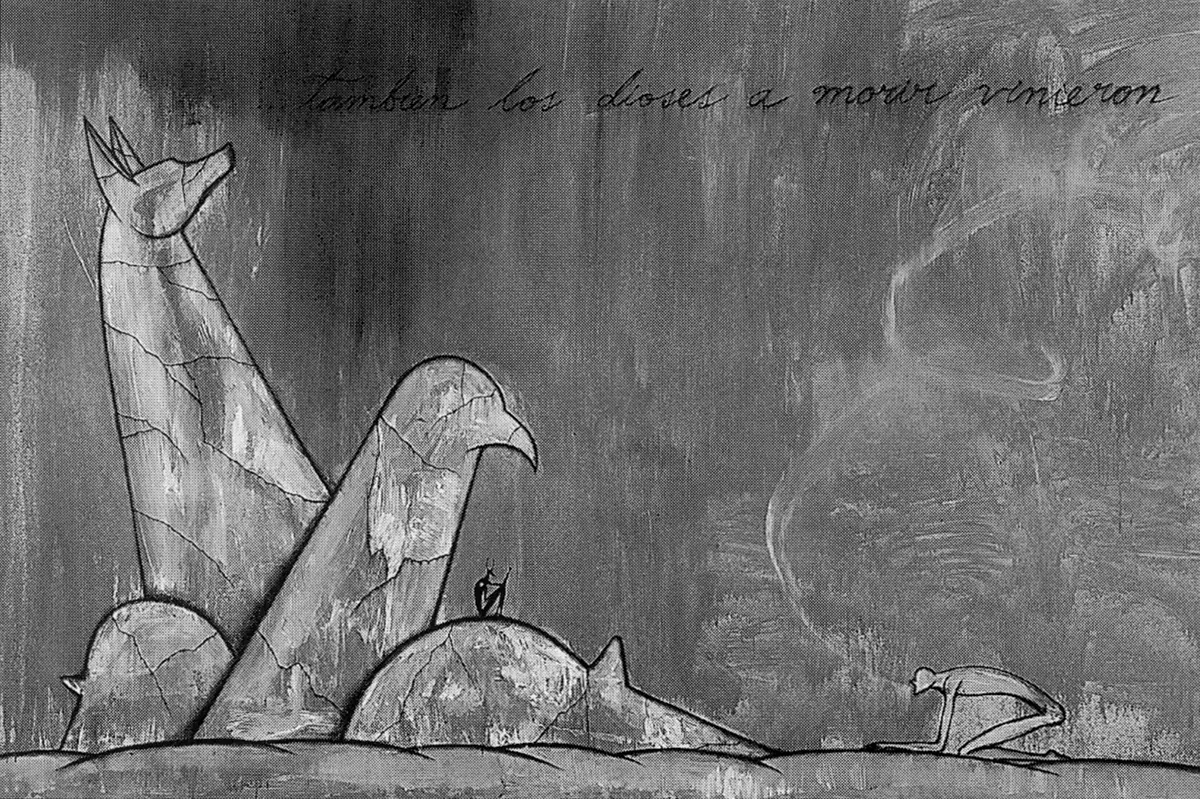
By far the most haunting, pain-drenched canvas in the exhibition is También los dioses a morir vinieron (Also the Gods Came to Die), 2000. Emerging from a ground of diffused veils of charcoal, poke the black outlined heads of Bedia’s classic animal and human characters, two male figures and a long-necked bird and beast, who appear God-like. Kneeling before them is the supplicant, whose beseeching words of prayer disappear like wisps of smoke blowing unheeded toward the horizon. Sitting atop a God’s head is a minute black, huddled, half man half deer figure, his finger raised, his mouth opened as if crying out. One all but hears his wails of sorrow echoing over this desolate landscape.
Less obviously seeped in emotion is Bedia’s triptych Los Aliados (The Allies), 2000, in which three small canvases are richly layered in burnished veils of gold acrylic. Upon the top canvas, Bedia’s hybrid man/stag figure supports a monolithic, black submarine. In the middle painting, a whale swims through the water, mirroring the sub, ridden by the same deer/man figure holding oars, as if rowing the enormous beast. The bottom painting presents a huge shark of similar size bearing Bedia’s alter ego figure upon its back. These works, like the other paintings in the exhibition, portray a ship or beast as the antagonist beside which Bedia’s figure appears as an overpowered, albeit persistent presence. It is as if in the end, there is little he can do, but go along for the ride within the seemingly churning waves of bleeding hues. There is little doubt, that the paintings in this show are some of Bedia’s most powerful yet, and they linger hauntingly in one’s mind well after seeing them.
MARY SCHNEIDER ENRÍQUEZ