
Among the white dunes in La mujer de arena (Tbe Sand Woman), a print by Hokusai (Japan, 1760-1849), you can see two legs barely distinguishable by a tenuous line separating them from one of the dunes. There are two silhouettes, soft, with a subtle texture, and evanescent shadows. In the background, a few green clouds replicate the sand’s smoothness. The dunes’ contours also make you think of the body on which the diminutive legs rest, lost in the voluptuousness of the hills and the horizon.
I thought of this print when I first saw Keiko Nelson in a presentation at the International Sculpture Symposium (“Harmony between nature and human beings at the threshold of the 21st century,” Tuxtla Gutiérrez, 1997): Dunes of dark sand occupying a chamber with walls painted with a pulsating pink color. Earth was accumulated in one of the corners spilling out and reaching our feet. On the slope were ceramic pieces interrupting the slope’s soft line with their round shapes.
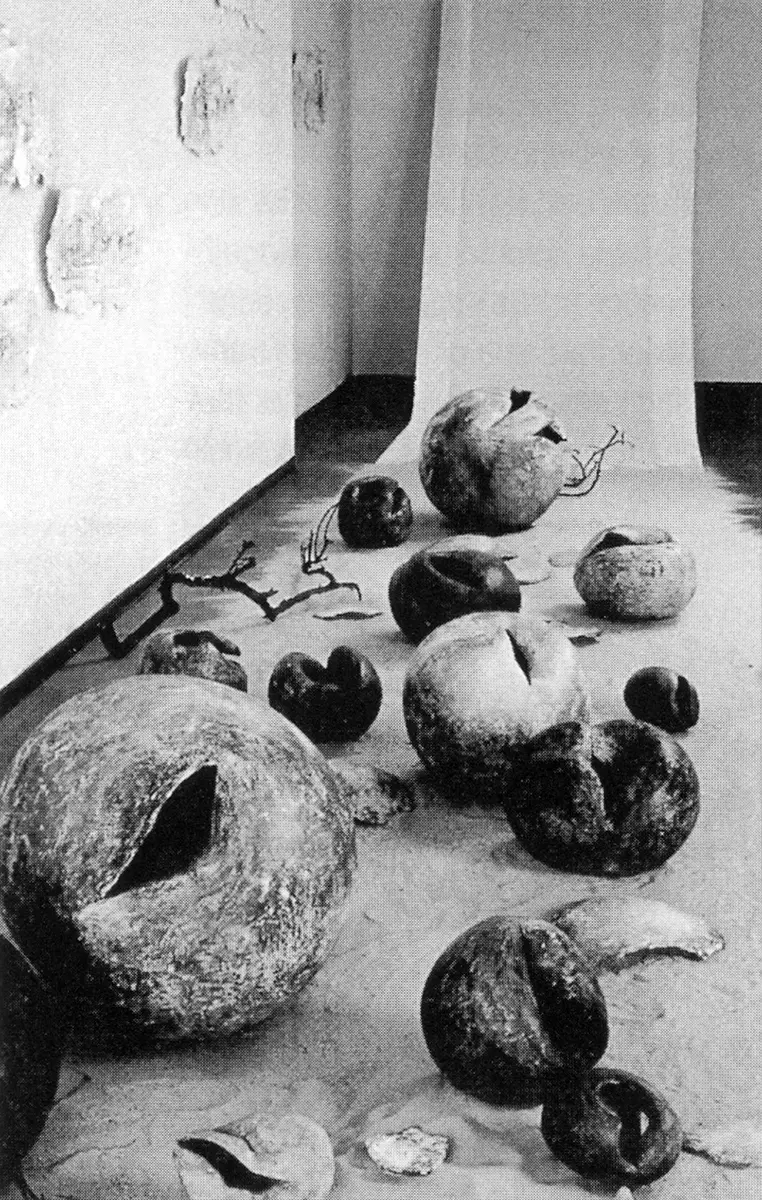
It was almost painful to walk over the sandy surface but at the same time, the need was almost unbearable to lie down on that humid earth and crawl to reach those objects almost human, almost animal, and slide a hand inside them and confirm their internal temperature. This would have been an intimate moment rarely seen in a gallery’s public space.
Keiko Nelson (Kyoto, 1948) entered sculpture guided perhaps by the love that during centuries Japanese art has had for the landscape. But her landscapes have something subjective, something of her own sensibility, they reflect the sensual surface of the female body.
The majority of her work consists of an exploration of texture and a reflection on nature. In previous exhibitions in Mexico, (Jala pa, 1993, and Tuxtla Gutiérrez, 1994), Nelson has worked with cotton pulp, tree branches, metal, feathers, and rocks. She wraps the objects in a medium that grants a poetic form to their physical characteristics. Every piece is a group of uneven textures and living surfaces. When I see them, I imagine those leafy spots on riverbanks where foam and vegetable matter swirl and form a lacework of sorts on the surface. They are garments covering the body, but also revealing it.
The installation exhibited at UAM’s Galería Metropolitano is a unique opportunity. It allows us to verify the consolidation of years of work into a total ambient. In previous installations, Nelson’s work showed isolated, encapsulated sides of nature We have a poetic and mimetic deployment of space. We can see it as a prolongation of our environment (not Mexico City’s, obviously), but also as an extension of our skin, and our body.
The work with the human body in fine arts has had a political twist for the last two decades The notion of the landscape as a theme and genre in contemporary art has been reevaluated. It isn’t that landscape is no longer done in the traditional sense, but that both versions have experienced a profound transformation. I think this renewal is all about the relationship between the author’s subjectivity let’s keep in mind that a landscape and the body are resources in our memory and memories and the otherness of nature and our own corporality.
Nelson’s work as with many other current female artists seeks to bring together the female body and the landscape, eliminating the traditional barrier between the nude and the landscape, creating a unity of the body seen as landscape or the landscape as part of a universal body.
In the installation Ondulación fecunda (Fertile Undulation) (Richmond Art Center, 1999), there is an artist’s statement that reveals Nelson’s aesthetic proposal: the variable dimension of the clay objects composing Ondulación fecunda, gives the impression of growing right out of the earth on the gallery. Birth and movement are implicit in the piece through the placement of the elements.
To this, we could add the oriental generative notion of ching and jing. The union between the essential energy (ching) found in earth and water and the generative energy (jing) represented by bodies made out of ceramic. The confrontation of these two elements of energy is similar to what Westerners know as the concept of harmony between nature and human beings.
On the other hand, there’s also a feeling of movement in the piece that makes us think of those creative undulations in nature that are water and lava that Robert Smithson (1938-1973) explored, becoming one of the first artists to take art out of the museum and into the natural landscape.
Smithson liked to erect stone and earth accumulations in the shape of spirals, mounds, or landslides. Interested in energy, synergy, and repose, he elaborated a discourse on non-sites, places that held no interest to human exploration, considered useless, non-representable, and impassable. In the Yucatán, Smithson worked on an installation consisting of mirrors placed at regular intervals in the desert. Of his actions are only photographic registries a fate to be shared by many artists in the Land Art movement. The clay shapes are what remain from Keiko’s installation.
The interaction between human beings and nature, and the use of real materials (some of them untouched by imagination), are the elements that Keiko uses to create a contemporary version of Hokusai’s print, in which feminine nature and earth’s natural corporality form the sand woman’s beautiful harmony. Jose Manuel Springer's beautiful harmony.
JOSÉ MANUEL SPRINGER