
Magdalena Fernández (Venezuela, 1964) placed her installation in a huge room, a huge ballroom of closed walls and a single door draped with a black curtain, on the second floor of a museum building that we could qualify as beautiful, in which the space used was not a banality in relationship to the spectator’s behavior. 4i000, espacio de luces (4i000, Space of Lights) was the tithe the young artist gave to her fourth installation. In the completely darkened room, cobalt-blue lights flashed through small transparent spheres. This color —an important emblem in kinetics— reached each sphere through a fiberglass thread suspended from the ceiling at a different height and distance from the others. Her proposal was clearly inserted in a reflection on space and the spectator’s reaction to it. An empty space, propitiator of only any given situation, inhabited by light and the spectator’s invisible presence; bordering on the abstract, it moved from the density of blackness, of total darkness, to the light of almost 300 glass spheres. One rough, the other fragile, they established an ambivalent relationship. The piece reaches its peak at the precise moment in which the spectator enters it and assumes it as a metaphysical reality.
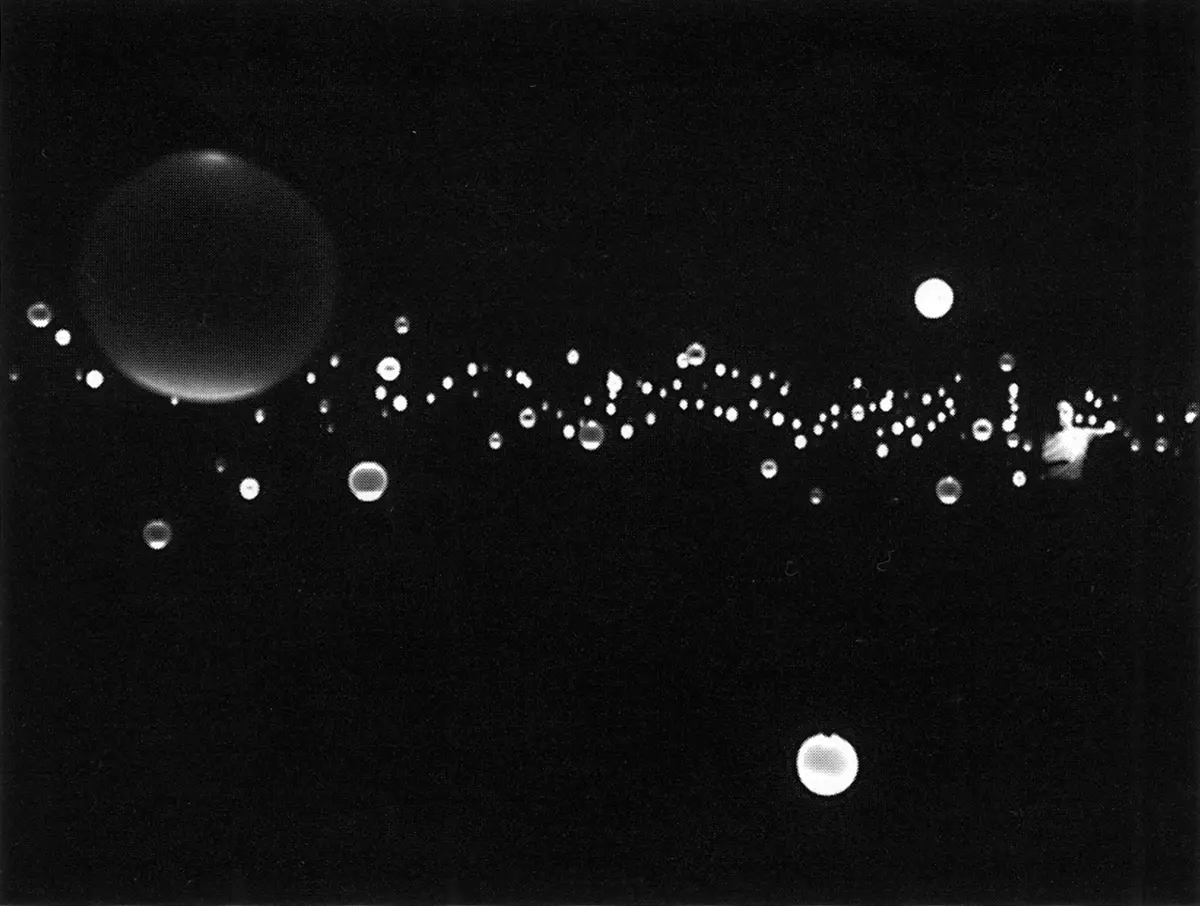
The problem of space and its axiomatic values constitute Magdalena Fernández’s theoretic, conceptual, and practical proposal, as it is also her main artistic preoccupation. In 4i000, the perception of an abstract place forks out in a double sense. Aesthetically, it corresponds to a previously unseen proposal in terms of the pictorial resolution on intangible support, physical and three-dimensional. When we enter the room we find a darkened landscape, with a night that has been painted with cobalt-blue circles; the artist herself speaks of a garden of flowers. The end of last century’s conceptual landscape belongs to her. The other sense corresponds to the spectator’s reaction to the aesthetically sensitive atmosphere created by the suspended spheres that swing when grazed by the body, producing physical undulations perceived only by the mind; they are hike emanations reaching the spirit.
A poetic-constructive proposal invites to modify behaviors through a blind movement around the room. For the artist, what’s important is the reaction of the person experiencing the installation as an event. She’s interested in "what happens to the piece, to the space, and how the public feels in the room." She questions herself about sensations and perception, "without making previous concrete questions or hypotheses." It’s evident she’s working with an important intuitive load.
With 4i000, Fernández, an inheritor of kinetic proposals, reminds us of the Argentine Hugo Demarco’s work, who at the end of the 60s presented some pieces with small courbaril spheres. Placed in a darkened room, his spheres turned cobalt-blue thanks to ultraviolet light moving through space triggered by electronic devices. By being individual pieces, they gave the impression of an installation. As Demarco did in his time, Fernández establishes an anthropological, philosophical approximation to human behavior under a given situation. In both their cases, it is an artistic situation.
Fernández’s installations modify space, always making it different each time it is experienced; it is the ontological penetrable. Almost hiking Heraclitu’s river, the space she proposes will never be the same. Her changes will depend on the intervention of those who visit the installations, favoring intuitive, personal experiences. The space-person-art relationship manifests itself in three flexible branches: the one vital, the one pragmatic, and the one cognoscitive. Consequently, the spectator’s orientation must be his or her own —the one placing him or her adequately in any situation according to the intelligent links established with the universe and with himself or herself.
Fernández has declared repeatedly that she works with geometric elements and simple forms such as the line, the dot, and the plane. In reality, she works with the basic formal elements of artistic structure and, in her case, is educated in the logic of physics and mathematics, with studies in graphic design, exploring the spatial references in relation to the person’s visual and corporal movement, suppressing his or her own and the work’s physical weight —which is the important part in terms of aesthetics. In this regard, it consciously analyzes what Laszho Mohohy-Nagy called in 1929 the “floating aesthetics.” Continuing the tradition (paradoxically new) of kinetic art’s unstable equilibria, Margarita Fernández’s work was an extraordinary example in the installation she presented at the l Bienal de Mercosur, in Porto Alegre, Brazil, where she effectively explores the visual and psychological perceptions of human beings. Always adapted to mobile, changing situations, and always based on the relativity of movement, this perception, according to Merheau-Ponty, "consists of our capacity to change the ambit within the world." The human capability to assume what is changeable is part of her proposal, but the most important one refers to the work of art itself as a self-sufficient, changing structure. It is not movement per se that interests her but the work of art as an aesthetic structure, as a distribution of forms, suspended or not, in which classical formal elements are used in a previously unseen format.
With the linear rhythms produced virtually by the tangible forms of the cobalt-blue spheres, with the constructive structure of empty space starting from the circle-spheres in non-real volumetric relationships, with the relativity of the full pace that at the same time is empty, and with the perceptual relationships of human shapes moving in that space, in 4i000 Fernández creates a dynamic system in which different factors of fine arts interact with one another with the spectator’s participation.
BÉLGICA RODRÍGUEZ