
Marcos Ramírez ERRE, a highly regarded artist of the Southern California and Baja regions, presented five large-scale sculptures along with selected preliminary sketches and gouaches at the Iturralde Gallery in Los Angeles. The exhibit, titled Oro Por Espejos (Gold for Mirrors), manifested his twined interests in art and politics. While earlier works such as Troyan Horse (1997) and Acorazado and Sing-Sing (1999) focused on the socio-political tensions of the Tijuana/San Diego border region, the new works instead explore the complexities of contemporary Mexican identity. Riffing with historical and contemporary consciousness, they probe the foibles, follies, and fallacies of human behavior across time and space. With postcolonial aplomb, Ramírez mingles references to Mayan, Aztec, and Colonial art, reassessing from a contemporary standpoint the lessons and consequences of history.
The opening room featured a large, unadorned chest, crafted of tropical woods from Chiapas and Yucatan. Set upon wooden construction horses adorned with small, cast-concrete pseudo-Aztec goddess figures, the work was layered with metaphor. Given its form, it suggests on one hand the gold-filled chests once shipped from Mesoamerica to Spain in the early colonial era. Simultaneously, the austere simplicity of its surfaces lends it sepulchral overtones reinforced by the female figurines read as funerary goddess effigies. The Spaniard's exchange of mirrors for gold with the Indians in the 1500s functions thus as the central leitmotif of the empty chest as well as of the exhibit.
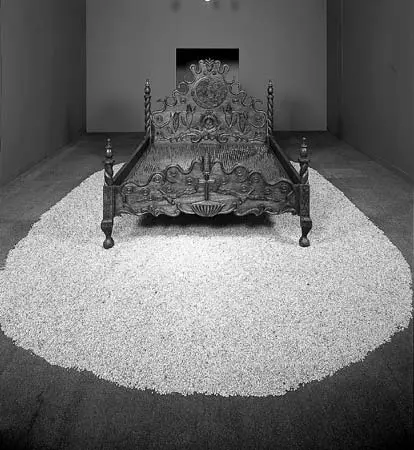
This work was conceptually complemented by the sumptuous, mahogany-carved Presidential Bed and Presidential Seat. Conflating colonial and postcolonial concepts, these pieces allude to the Aztec world through inscribed decorative embellishments. Fitted with a mattress of nails that profiles a map of Mexico, the Bed acknowledges Mexico’s cultural legacies. Its footboard features serpents, an Aztec symbol of life, symmetrically framing a central cross growing from a mound of earth. The cross, in turn, crowned with a “corn cob” headdress, sets ancient Mixtec/Aztec deity headdresses to new uses. Additionally, the filigreed edges of the head and footboards are edged with undulating snake motifs. Narrating a tale of Aztec civilization’s triumph and demise, a central headboard medallion ironically profiles an eagle standing on a cactus and biting a snake. Here the ancient Tenochtitlan legend that tells of the Aztecs founding their nation on a site where an eagle perched on a cactus is acridly conflated with the ravishment of the serpent life symbol. Mingling these signs with pseudo-Euro-baroque memories, Ramírez thus comments on the complexities of contemporary Mexican identity, particularly those that face the newly elected President.
With the swagger of a political satirist, he pushes those observations further in Presidential Seat, where an elaborately carved throne is fitted with a toilet seat. Contradicting the trappings of pompous grandeur traditionally associated with the head of state, Ramírez satirically equates its triumphs with mud. Suggesting a general cultural reluctance to face the image in the mirror exchanged for gold, Ramírez lampoons the political office for delusions of grandeur conducted upon a bed of nails or performed upon a throne set on the soil of merde.
COLLETTE CHATTOPADHYAY