Oh yes m the great pretender (oooh oooh)
Pretending I’m doing well (oooh oooh)
My need is such I pretend too much
I’m lonely but no one can tell
The Great Pretender, by Buck Ram/The Pretenders,
Venezuelan artist Meyer Vaisman has a peculiar body of work that reconceptualizes the historic and contemporary meanings of such categories as “Latin American art,” “global art,” “New York art,” and several others that have circulated in the last decade as the differences between the center and the periphery and multiculturalism took center stage in cultural debates.
From the beginning of the 1980s to the turn of the century, Vaisman was a founding partner in New York’s East Village alternative gallery, a whiz kid from the gallery complex at 420 West Broadway in SOHO, and from 1996 forward, a maker of a more openly accessible piece as a political and local artist, a miserly Caracas ranch house whose interior was the artist’s own privileged childhood room. The latter work brought him a series of disparaging remarks by the New York press and forced him into silence. It is to be noted that these events took place at a point in time when the United States' discovery of Latin America was already maturing. The idea of a New York artist who was also a Latin American artist, one who dared to politicize his discourse from a national perspective Venezuelan in this particular case wasn’t acceptable in the mid-90s. One could think that an artist who opened a gallery and created a series of works that pointed out and ironically glorified the commodification of art was essentially interested in the relationship between artistic practice and capitalism; one could think that such an interest is already political or politicized. Since Vaisman made these works within an eighties paradigm, the context forced their reading as above all strategic pieces, and his turn towards ranchismo was nothing more than another movement, reprehensible, within that same strategy. Vaisman’s recent production gives us then an opportunity to reassess his work in terms of continuities rather than breaks and to realize that the cyclical exaltation and writing-off of an artist according to fashion and/or tendencies should de-stabilize not only our perception of that artist’s work but our perception of the critical paradigms generated by each historical period. Plainly said, it should force us to give him the benefit of the doubt. Mayer Vaisman shows his most recent production at Gavin Brown Gallery, located in the newest “it” art industry locale, the border between Chelsea and the Meatpacking District in NewYork. This time around, the topic of his work is a therapeutic practice common to the middle and higher intellectual? classes throughout the world, from Canada to Argentina: psychoanalysis.
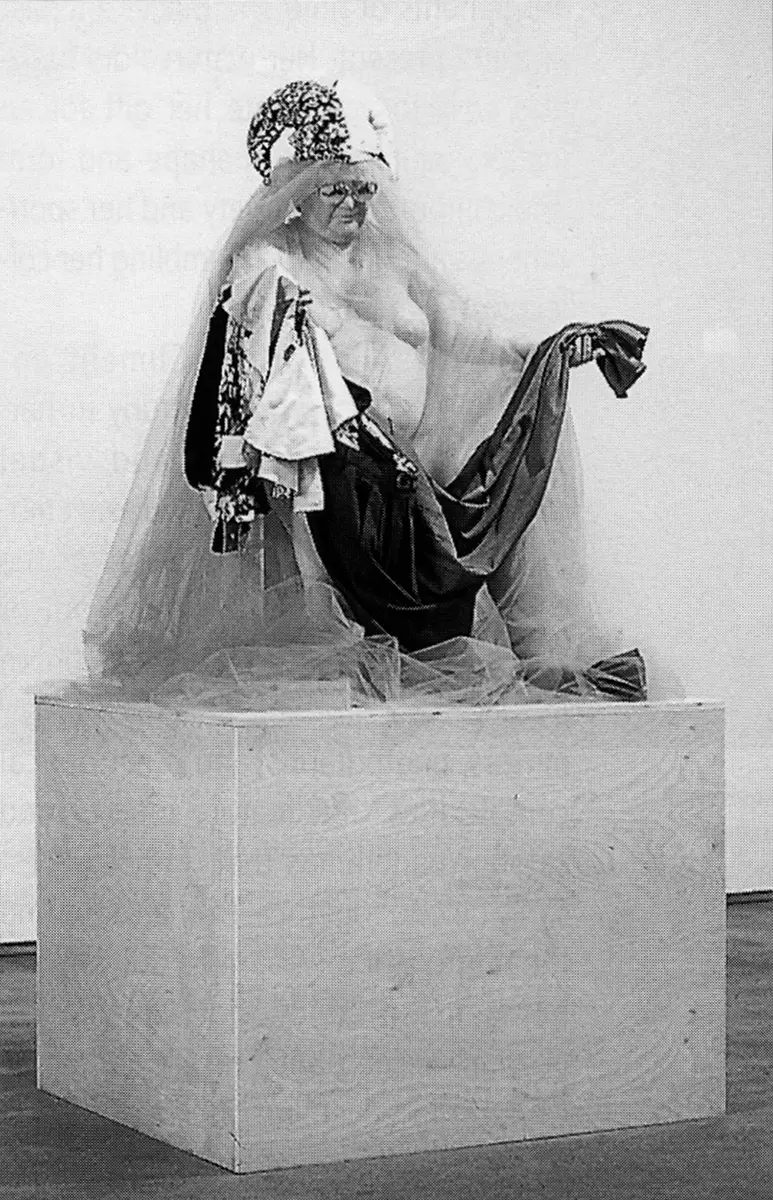
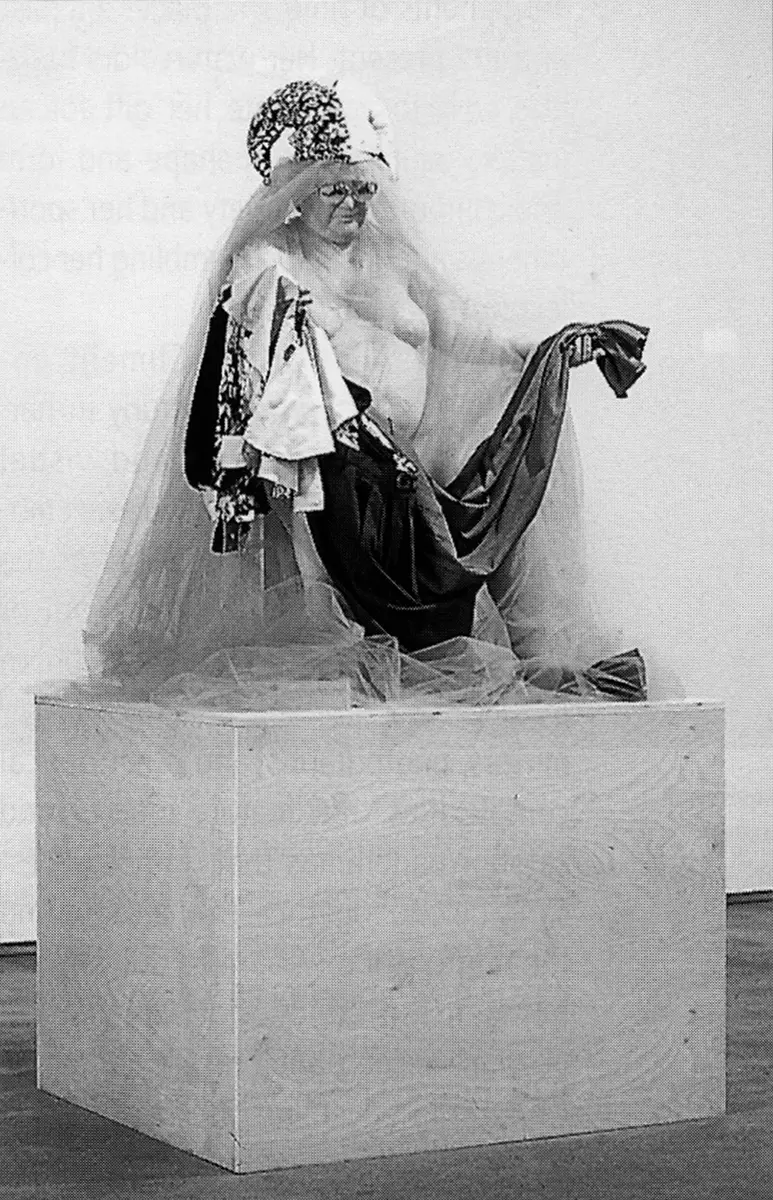
A life-size figure, slightly overweight, of a bothersome pink coloration, its head covered with gauze, its sexuality undetermined, sitting theatrically on a white cube in the middle of the gallery, offers, pious hands reaching out, some strange clothing. This clothing is, one realizes, a clown’s costume made with fragments and odd pieces, of a Frankenstein-ian lushness. In front of this figure, a group of lit candles printed with the image of a bearded man in prayer are offered on top of a platform attached to the wall. Outside the main space, on a bench, there is a souvenir in the form of a poster; it’s a photograph of Vaisman sitting with his head down on yet another bench, in a playground, wearing the clown costume and made up like a clown, smoking and drinking, obviously depressed. Inside the office or backroom, the interior of an armoire from one of Vaisman’s homes takes over a corner. Around it, a number of boxes are carefully packed and labeled as garbage.
The figure is Vaisman’s long-time New York psychotherapist. The clown costume has been made from fragments of clothing worn by the artist’s parents. The Catholic imagery that pietá with lit candles is jocular and obvious. Any conceptual operation’s cryptic elements, the superimposition of a code or system of meaning on another, is filtered through a neo-conceptualist irony materialized in objects. This is a tragicomic gesture, an autobiographical confession in the spirit of Jewish stand-up comedy. It would seem that the traditionally Freudian relationship between jokes and the subconscious has materialized at the level of the tangible and the immediate.
If we take the last paragraph and apply its analysis to Vaisman’s work of the last 15 years, it would still be valid. Tone, realization, media, and meaning-structuring mechanisms haven’t changed. With this show, they have simply become more effective.
My makeup is dry and it clogs my chin
I'm drowning my sorrows in whisky and gin
The lion tamer’s whip doesn’t crack anymore
The lions won’t fight
and the tigers won’t roar
La-la-la-la la-la-la la-la-la
So let's all drink to the death of a clown
Won’t someone help me break up this crown
Death of a Clown, by Ray Davies/The Kinks
NICOLÁS GUAGNINI