
The new millennium brings with it fragility in the possibilities of the invention of myths at the same time as it promotes reinterpretive strategies of the existents to “play” with History: the human need to shuffle fable and reality. The Cuban artist Rubén AlpÍzar seemingly took this premise into consideration in his latest exhibition, El vértigo de Ia libertad (Tbe dizziness of freedom), which exhibits a series that has been working on since 1998.
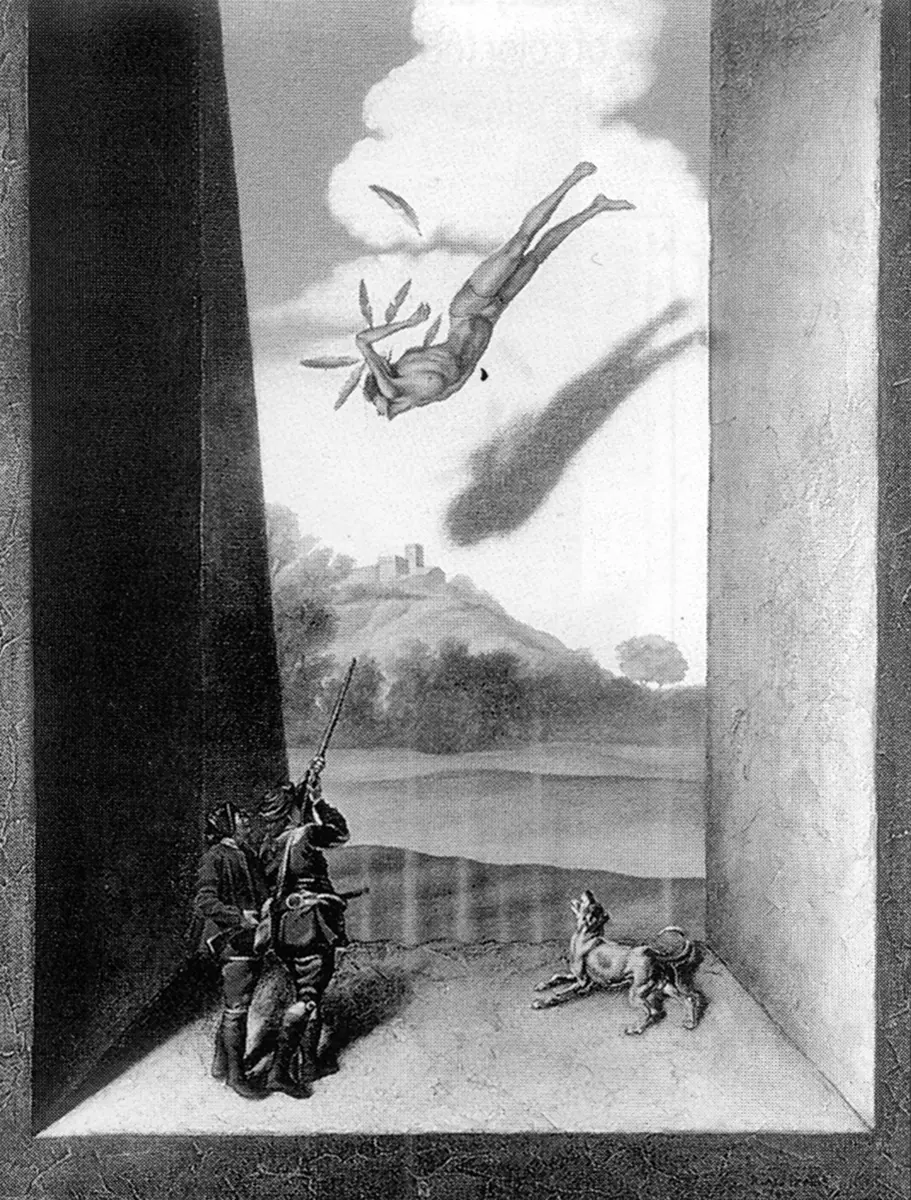
In it, an ironic version of the myth of Icarus leads us to a reflection on the destiny marked by our free will, in contrast to social contingencies. In the original legend the aforementioned character, in his attempt to save himself from his prison (labyrinth), decided to fly as high as the sun and thus burned his wings. For Alpízar’s characters, death is not the inevitable fate, though destiny bears within itself an implicit fall.
Throughout the history of civilization, the search for freedom has been a recurrent aspiration. On this occasion, through eleven medium-format canvases, the artist reworks the myth that alludes to this question of transcendent connotations through stories charged with humor, to a certain extent sarcastic and even absurd. With a refined skill placed at the disposal of symbolic painting, Alpízar appropriates elements, characters, and images of diverse moments of Art History in order to accredit the historical complicity in this universal aspiration.
Each scene alludes to a double enclosure: that of the habitual mark of the work and, another, corporalized into a sort of Magritte-like window, with a perspective that points toward the void, the unknown. In this environment, the implicated subjects share physicality proportional to their architectural frame; that is, they maintain a concordance with their habitat. However, many of the elements that surround them are greater in size, as a topological resource, which insinuates that situation in which circumstances from which we cannot escape sometimes place us. It happens, for example, with plates or kitchen containers, with foods, the toilet, the papaya, the gavetero, and other quotidian objects. Each possesses one or more meanings that empower a polysemy of discourse without proving to be allusive to a specific context; at first sight, they seem like guarantors of formal empathy.
The gallery of characters that participate in these compositions is diverse; they have as their common denominator a humble appearance. They prove to be beings that appear to be absorbed in routine, banal circumstances. The figure of Icarus momentarily transmutes into Jesus, thus approaching readings of social], or ambiguously religious, implications. The differentiation between the mythical character and those who surround it suggests a need for recognition of the other: otherness as an option, the right to venture, to elude the univocal.
The first piece of the show proves significant because it may just resume the thesis worked by Alpízar: four villagers hold a canvas where Icarus is to fall, while others observe from a spot a little off to the side. In the original version, the protagonist dies. Here, thanks to his fellow beings, he can be saved. This is the most altruistic interpretation offered by the author, who is generally optimistic in his approach, suggesting confidence in the perfectibility of human beings.
Alpízar questions the relativity of the concept of individual freedom by placing his creations in ambivalent situations. He allows us to catch a glimpse of the fact that this does not exist as an a priori condition, but only as a consequence of an effort to achieve it, an effort in which social aspects have specific importance. He seems to tell us that the individual must be aware that, in spite of the sacrifices required to obtain freedom, something or someone will always be able to manipulate him, belying the initial intention of the romantically motivated subject.
Also, the adventure of throwing oneself into the search for liberation may imply loneliness and uprooting, as can be appreciated in pictures where Alpizar makes use of surrealism, placing the protagonist descending into an opening full of orifices through which dream-like beings peep out. The principal figure turns out to be dissonant, anachronistic, and subject to the characteristic tribulations of a descent that may result traumatic.
In another of his allegories that perpetuates the myth in any context, the author stops in Cuba, letting us see through one of his windows the character falling to the sea, in a place as emblematic for Cubans as Castillo del Morro in the Bay of Havana. Sitting on the edge of the wall, engrossed in his task, a fisherman watches him. Next to him rests a large fish, which looks appetizing, sort of visceral, and essential, in the same way as the horizon could be, which can be made out in the distance, for some Cubans attracted by the idea of emigrating.
At times, the discourse acquires a dramatic aspect that augurs tragedy. Other times, such as when Icarus falls onto a plate or a toilet, or when he is trapped in the attractive and juicy mass of a papaya (with its implicit double meaning), humor is revealed in multiple connotations.
Alpízar trained at the academy (he is a graduate of the Instituto Superior de Arte), and has a broad knowledge of diverse secular and religious myths which allows him to achieve his aim efficiently, charged with cultural, political, artistic, and religious associations, and supported by a formal exquisiteness that confirms once again that he is an excellent artist. This also becomes apparent in the effects of baroque brightness, in the quality of the drawing, in the sober use of color (ochers and sepias dominate), which collaborates in the construction of the atmospheres and in the icononic homogeneity conferred upon his characters, beyond the differences of origin (quotes from Brueghel, Bosch, and others).
Alpízar’s ubiquitous Icarus is displayed in simultaneous appearances, apt for reaching proposals ranging from the most sublime to the most banal, with an undeniable seal of contemporaneity, because he chooses to be free, but with an emphasis on the practical side of the issue. Hence the ironic slant of the scenes. By falling alive, an image of continuity is established which parodies the original myth. It would seem that the author wished to warn us that freedom is where the dream reaches real limits, in that segment of space/time that can crash into failure if we fly in the wrong direction.
AMALINA BOMNIN