
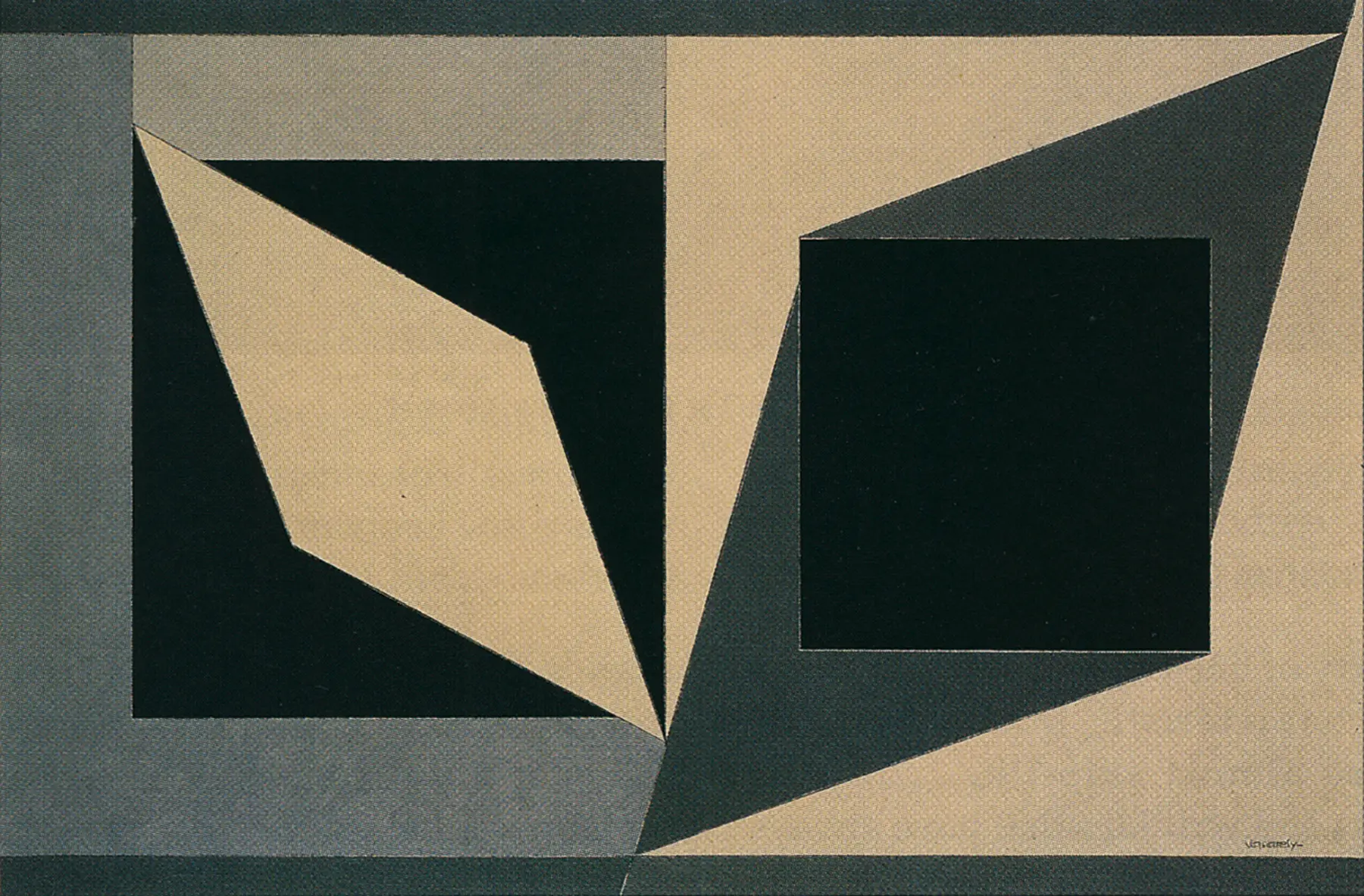
Given the omnipresent distribution of Vasarely’s work, one could be tempted to see it as a form of popular art. This could be an exaggeration, but it is a fact that the visual saturation created by his later years of silkscreen prints has both distorted and shifted the general judgment toward his work. To have a Vasarely on the wall seems to be one of the pre-conditions for existence required for the self-respect of any frame shop or interior decoration business. Today, as a consequence, Vasarely’s later work is often perceived as a form of semi-informed kitsch. Thus, the retrospective exhibition that recently opened at the Fundación Juan March in Madrid was welcomed as it allows for a reevaluation of the artist in a broader context.1 A modest show with around fifty works, it provides a fair synthesis of his trajectory.
The works exhibited were done between 1929 and 1988 and in total, give a balanced image of an artist whose importance had been somewhat forgotten in all the entanglements created by post-modernism. Even in Latin America, where his influence had been particularly strong during the decade of the fifties, Vasarely’s role was somewhat fogged in memory. During that time, Venezuelan architect Carlos Villanueva invited him to make a mural for the Ciudad Universitaria, the campus of the university in Caracas. An exhibit of his work then circulated throughout the continent. His art had emerged as an emblem of a new rigor, representing the revitalized extreme of constructivism that had started to show signs of fatigue. He had overcome formal composition on canvas to enter the brain via the eye and to work directly on perception. With him, the canvas ceased to be just a pictorial field. It became a sensorial stimulus in an attempt to have the artwork be realized within the perceptual setup of the viewer. It was this step away from what Vasarely and his followers considered romantic ponderings in normal art appreciation that became so appealing to a whole generation.
Vasarely was born in Hungary in 1906. His main teacher was Alexander Bortnyk, who during the decade of the 1920s created a modest Hungarian version of the Bauhaus in Budapest. Bortnyk had been in contact with Gropius and other teachers of the original Bauhaus. He returned to Hungary convinced that the ideas of the Germans in regard to the fusion of art, design, and life were not taken to their ultimate consequence. The basis for his pedagogy —a merger of art and objectivity— was closer to Mondrian and Van Doesburg than to Klee and Kandinsky. Bortnyk encouraged Vasarely to go into advertising as opposed to subjectivist art, and effectively, Vasarely did not seriously engage in painting until the mid-forties.2
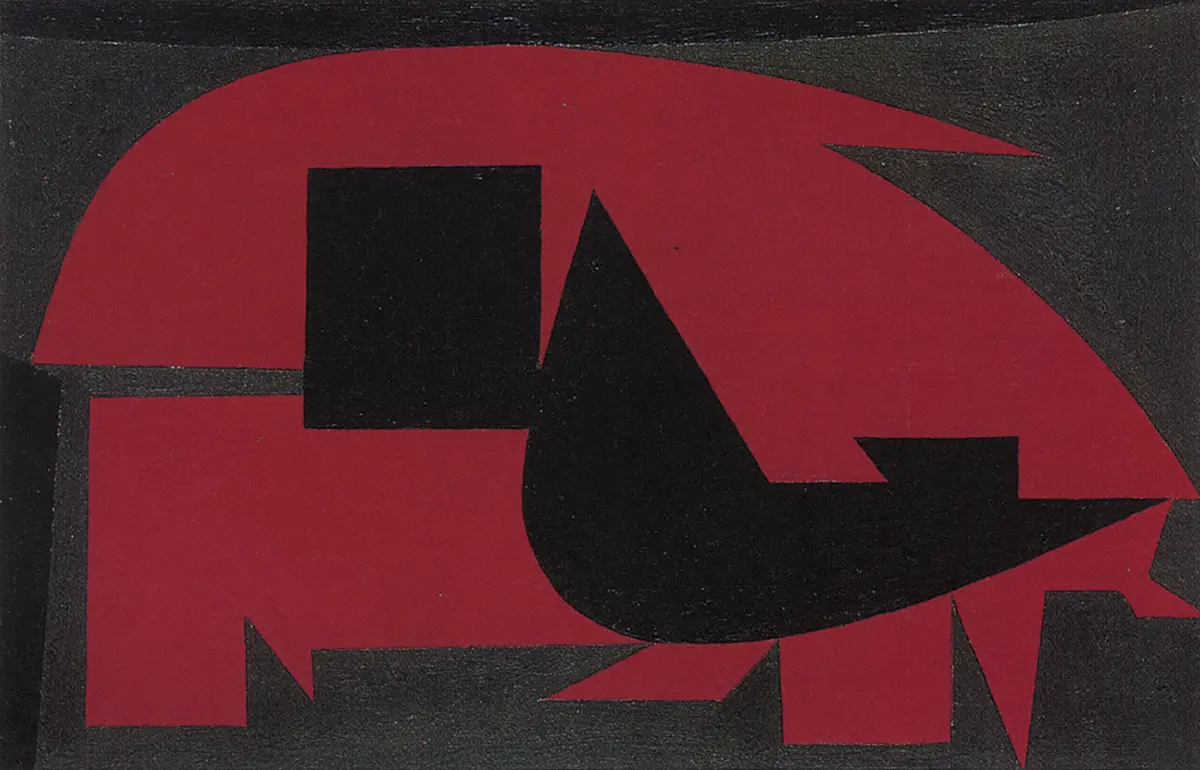
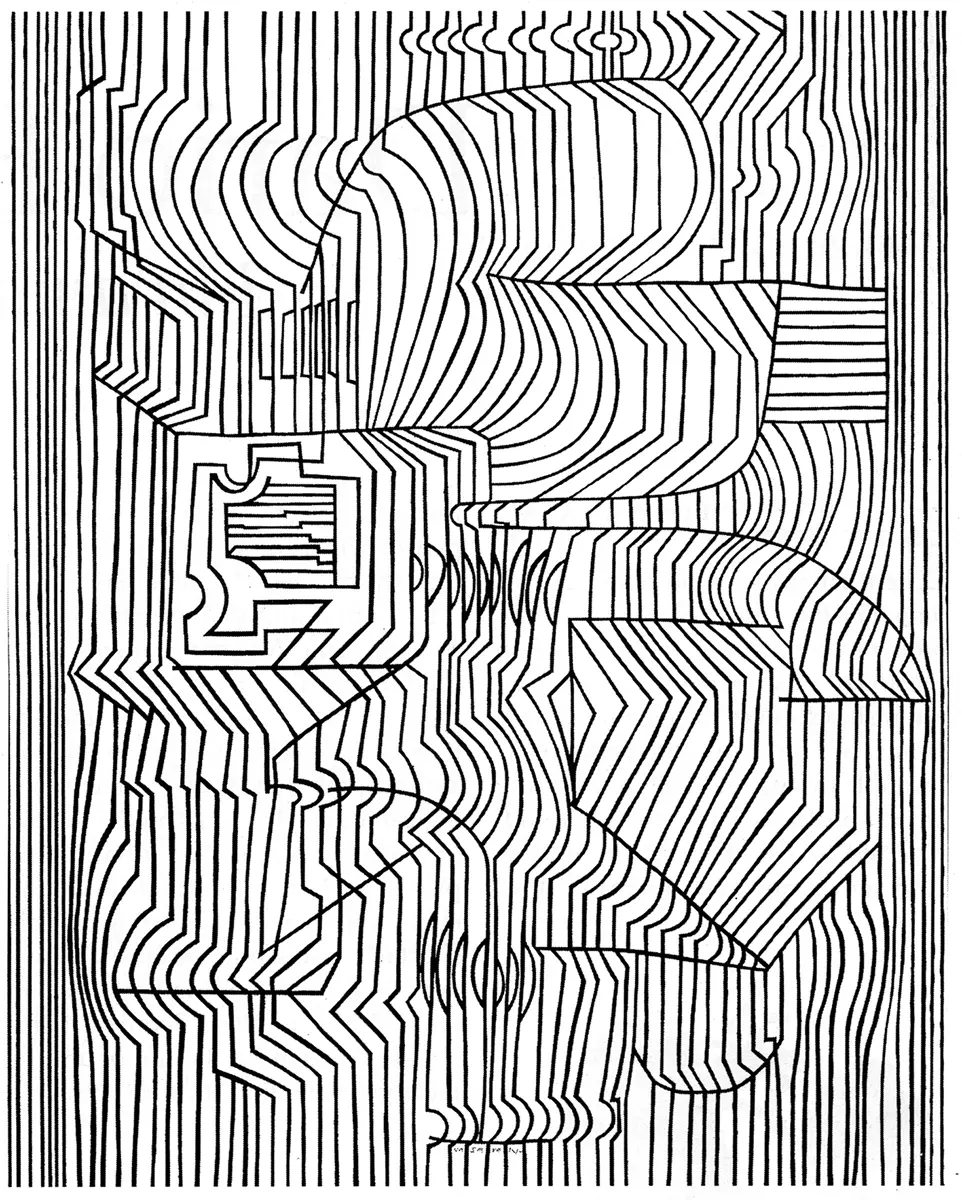
During this early period, Vasarely seemed more preoccupied with opening a Bortnyk-like school than with following a career as a painter. According to Werner Spies, director of the Centre Pompidou and organizer of the exhibition, Vasarely’s first works really were pedagogical sketches. In the exhibit, they appear as a rather eclectic group, but invariably interesting and containing the seed for the “serious” work to come. Harlequin (1935) is a figure of a clown camouflaged into a checkered table cloth, Étude (1936) is a surreal painting with a background full of optical texture, and his Étude de Perspective (1939) creates a space that clearly announces the effects he exploited later in his paintings. Though still focused on figuration, which here is used as a reference, his true search is about the perceptual interference created by stripes. Hence his choice of tigers and zebras, a subject matter that reappears sporadically in his work as late as 1950.
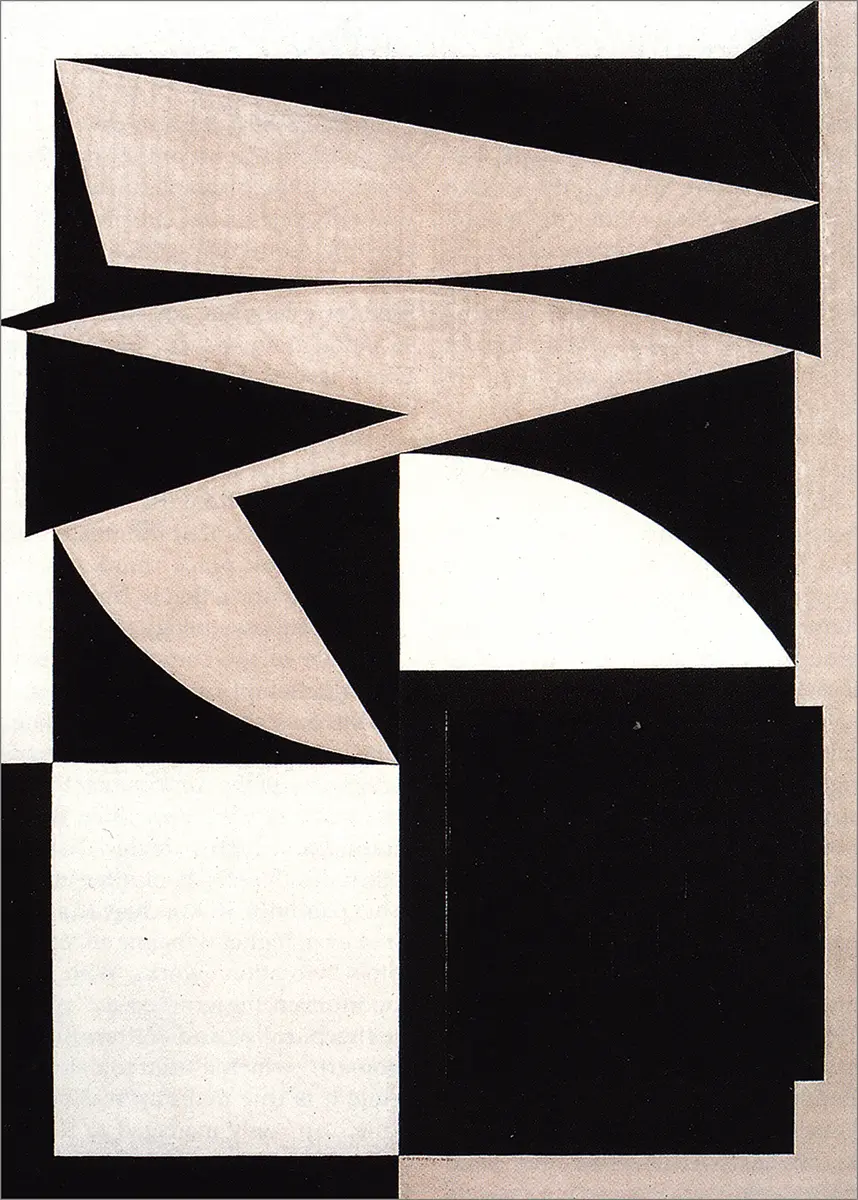
Vasarely affirmed himself as a painter around 1949. By then he developed what in fact are two stylistic streams. One is a form of constructivist abstraction, shown with Garam and Zante, both from that year. The other is more optically-oriented, exemplified by Gordium positif (1951). Although part of the first style, it is Homage to Malevich (1953) that synthesizes both these tendencies and announces the work to come. It is, very lucidly, the piece chosen to provide the cover for the catalog of the exhibition. One can see the painting as a double play on the derivations of the square and on the definition of the module that, with its rhomboidal changes, will multiply itself in his mosaic paintings. In the exhibition, it is Tunko 22 (1955) that illustrates the maturation of this mode.
With his shift from interpretive to sensorial painting, Vasarely set the precedent for the work of many of the luminaries working in optical and kinetic art. Yaakov Again, Carlos Cruz-Diez, Bridget Riley, Le Parc, and the GRAV (Groupe de Recherche d’Art Visuel), all have points of contact with his work. It is, of course, difficult to proclaim and prove influences, but it is probably Venezuelan artist Jesús Soto —with his Repetitions made in 1951— who can best declare his historical independence from Vasarely. Comparing the work produced during that year by both artists, it is in fact Soto who appears to produce more mature work. Again settled in Paris in 1951 and made his first “transformable” piece the following year. Le Parc arrived in 1958 (on a trip that probably was inspired by Vasarely’s work), Cruz-Diez traveled to Europe in 1956 and made his first Fisiocromos in 1959, while Bridget Riley started her optical paintings only in 1960, the same year in which GRAV was also started.
What most of these people have in common during the decade of the 1950s is that they were working in the orbit of the Parisian gallery Denis René. Vasarely began working there as an organizer during the late 1940s (he was accepted as an artist several years later). In 1955 the gallery gathered Again, Soto, and Vasarely (together with Bury, Calder, Duchamp, and Tinguely) in an exhibition organized by Pontus Hulten under the name of Le Mouvement. The gallery became a “movement” gallery and in time also represented the work of GRAV and its members.
When Le Parc and Sobrino —both from Argentina and co-founders of GRAV— arrived in Paris, it was through some divergences with Vasarely’s work that they developed their own visual language. The discussions, at some point, included the son of Vasarely (his brush name is Yvaral), who appears among the ten co-signers of the first document of the group.3
The discrepancies between GRAV and Vasarely illustrate the work of both. For GRAV, Vasarely lacked the necessary rigor since he made “subjective” decisions based on a sense of composition and harmony like any traditional artist would. According to the group, this was a sign of unacceptable individualism which had to be eliminated. Creation should be limited to a calculated change of variables within rigid systems set up by the artist. The change of parameters, not a personal evaluation, is what has to produce the resulting art piece.
The process of perceptualization, which with different degrees of rigor all these artists embarked on, had its highest international celebration in 1965 in an exhibit organized by the Museum of Modern Art in New York. Entitled The Responsive Art, that show launched what immediately would be known as Op Art. A rather short-lived movement, it was there where Vasarely was consecrated as the “father” of the tendency. Even though the importance of Vasarely is well laid out in the catalog’s text, it is ironic that on that occasion the oldest pieces shown were by Alexander Lieberman and Ad Reinhardt, both represented with paintings from 1952.4 Meanwhile, Vasarely’s earliest work is dated 1958 and Soto is inexplicably (and irresponsibly) excluded. If one had wanted to make a real history, his movement studies from 1939 (even if they include an odd cherry) and, on firmer ground, Gordium Positif (1951), should have been included. In any case, MoMA’s exhibition opened the U.S. market for him. A few months later he had one-man exhibits first at the Pace Gallery that same year and then, two months later in January of 1966, at the Sidney Janis Gallery.
MoMA’s show tried to cover all of the perceptualist art of the last fifteen years. Within this panorama optic art was only one of the streams. “Optic art” refers to that work attempting to become objectively resolved on the retina and avoiding any emotional association or any psychological evocation. That explains why so many of the examples in this section reminded me of psychology textbook illustrations. In fact, one of the art justifications at the time, borrowed from the then-still active pop art, was that the creative act partially took place thanks to the change of context, that is, transferring images from psychology to art.
In spite of the complex and overarching attempt of the exhibition, it was this optical part that appropriated the whole show within popular consensus. One of the contributing factors was the work of Bridget Riley. By exploiting to a higher degree than her colleagues the effects of after-images in her paintings, Riley achieved a similar or even higher dynamic effect than Soto’s “vibration” works. With some opportunism, the term “op-art” played on the parallel and alliteration of “pop art,” which it tried to dethrone. While it is true that Pop was on the wane, “op” only managed to temporarily displace it from its fashionable status without substituting for it in the market. The little movement’s life was so short that, had it not been for its ingenious nickname, it wouldn’t have survived but as a sophisticated extension of constructivism which brought with it kinetic art. Apparel designers, interior designers, and advertising agencies immediately picked up the decorative potential of the works in the exhibit, thus removing the aesthetic from the more elitist gallery field. Coincidentally, Vasarely’s piece in that show, dated 1965, is illustrative of that part of his style we can call 'decadent.'
Referring to Vasarely’s later period as decadent raises several questions. Did the artist corrupt his principles? Is the critical dismissal or downgrading of his work a symptom of an elitist reaction to the popularity of his work? It seems unfair to accuse Vasarely of having made concessions to the market. It is true that his more ascetic and economic work (in the present show exemplified by pieces done between 1949 and 1963) survives critical opinion better. But Vasarely, inspired by some Bauhaus ideas, always had a democratizing purpose and hoped for audience participation of some kind. He developed a form of typography (Spies in his catalog text refers to “Gutenberg” Vasarely)5 conducive to infinite formal permutations, which in certain ways anticipated computer-generated art. The system was sufficiently developed to allow him to seek a patent for it in 1959. He always worked with the conviction that ultimately his art should be fully integrated with architecture: “Why don’t we imagine facades with windows of different sizes, big or small, alternating and formed by rhomboidal shapes?"6 In that sense, popularization of his aesthetic was a goal.
However, it is undeniable that, throughout his development, Vasarely maintained the posture of an individualist artist. It is his aesthetic that would reflect in architecture, his vision to be multiplied for the viewer’s consumption. That position made him contradict the basis for his own beliefs. The openings created by GRAV (despite all their limitations) tried at least to incorporate the spectator into a playful activity within which the work is completed. With Vasarely, the work is presented in a completed form by the “master” for a consumption that wants to be democratic but never ceases to be consumption. In that sense, Vasarely never went beyond the premises set down by the formalist and more conservative sectors of the Bauhaus. His heirs tried, rather than just multiply consumption (here meant in a pedagogical rather than a market sense), to defy it and to involve the viewer in parts of the creative process. It was a limited affair also with them since the rules they established did not allow for the participant to ruin the piece either by mistake or by decision and action. But the GRAV artists were clearly collectivists, somehow evolving Vasarely’s premises, while he remained an individualist.7
After 1955, Vasarely reconnected with the different sub-styles that he had defined in his most fertile decade, the 1950s. Trusting the systems he had already created, he allowed them to generate his work. He intervened with his taste-based decisions, but he also forgot the possibility of inventing new systems. This fact, added to his belief in the multiple existences of his work favoring editions in silkscreen and multiples, is what led to the taste of fatigue that his later work produced. The integration of art with architecture and everyday perception did not happen the way he longed for. An integration did take place, but it was one created by mass merchandising. It ultimately affirmed the passive consumption of his work and did not achieve the activation of the creativity of the viewer the way he had hoped.
Vasarely, as much as the ideologues of the Bauhaus, believed that good design can improve people and elevate their ethical level. Today, unfortunately, it seems more accurate to say that good design is limited to making life a little more pleasant and no more. And even that modest achievement is fleeting. If Vasarely had the success he wanted, he would have been able to create a truly popular culture. That dream went unfulfilled. Vasarely was a designer of paintings who, like many others, had his ideology betrayed by history. Maybe that is the reason that the exhibition at the Fundacion Juan March elicits an unexpected feeling of tenderness.
NOTES
1. January 14 to April 23, 2000
2. Spies quotes his conversations with Bortnyk about his school, objectivity, and Mondrian in the catalog text. Werner Spies, Vasarely, Fundación Juan March, Madrid, 2000
3. The signatories of the document initiating GRAV were: Demarco, Garcia Miranda, Garcia Rossi, Le Parc, Molnar, Morellet, Moyano, Servanes, Sobrino, Stein, and Yvaral.
4. William C. Seitz, The Responsive Eye, The Museum of Modern Art, NY, 1965
5. Werner Spies,, p.60.
6. Werner Spies, p.62
7. In 1973 Le Parc wrote: "l seek collective work as a form to escape the individualism in which we are confined as artists.[...] Because I have faith in a society differently organized than ours. Because I believe in the potential for reflection, for action, and for creativity of the people." Reprinted in Le Parc, Modulaciones, Galería Latinoamericana, Casa de las Américas, Havana, 1981.
LUIS CAMNITZER