
This new show of works by Vik Muniz, a Brazilian artist long residing in the United States, is simplicity itself. As one enters the gallery, one encounters a series of framed surfaces of differing sizes; these contain, apparently, blown-up newspaper photographs, whose grainy weave, bunched here and there in dark planes, has become visible and dilutes the images (which were surely easy to perceive when smaller and on the page). Some images are still intelligible: in the gallery’s back wall, Abraham Lincoln’s visage can be seen; near him, somewhat more uncertain, the crash of a large dirigible airship (the Graf Spree?). But other pieces show only a random distribution of shadows and points (or is that image there a swan’s neck? A stretch of some pathway?). This is not altogether strange: these images resemble notably those offered some years ago (and occasionally still offered) by Sigmar Polke. There is a lot of Polke’s atmosphere in Muniz’s show. And not only through the use of blown-up news photos but also thanks to the choice of motifs, from the perfectly insignificant (which doesn’t seem to have ever been worthy of a photograph) to such anachronistic icons as Lincoln or the Graf Spree, whose showing is difficult to explain, so strongly do they resist any meaning other than the most banally conventional. As in Polke, there is in Muniz a will to project the image of a collector without a program, and in the end, without a collection, who shows strictly banal treasures.
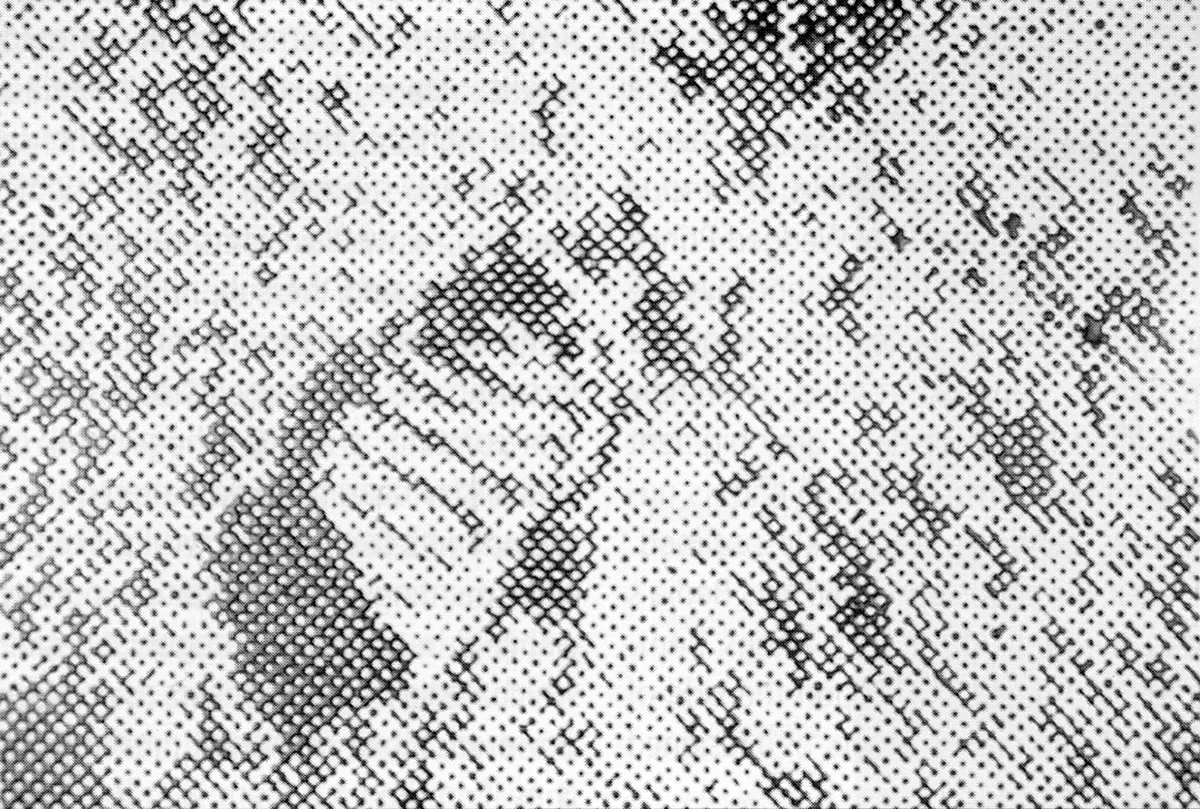
As in Polke, there is in Muniz the recourse to a somewhat pathetic, almost unfunny humor. But, is there anything else in these works by Muniz? l believe there is: there is an inflection. Because these are not just blown-up images, but something different: they have been created in ink and only then photographed. This work is almost absurdly difficult if one takes into account the banality of the effect. There is something Duchampian in the whole thing, of course: something of the Duchamp who insisted on minutely reproducing, in paper and wire, a meaningless urinal, as though art were the celebration of useless dedication to a task. (In this Muniz is close to, for example, Tom Friedman.) Or as though all this could connect the field of High Art with banal school projects, and the art gallery with the arts and crafts classroom.
In any case, the result is interesting: When attentively observed, the images show certain troubled areas of brightness that undermine the extended serenity of the figures (no violence here, however; not even in the figures of violence.) These images arise, the moment we see them, as if about to overflow, just emerged from a simple stain or an erasure, or about to devolve and fall into them. Such fragility is particularly suited to the nothingness the images show and invests Muniz’s work with a certain discreet, withdrawn power.
In the last room, there is a series of light boxes where one sees, painted on glass, the faces of television news anchors, more spectacular —even in their gaunt presence— but less effective.
REYNALDO LADDAGA