
This past April, the Bolivar Hall was the site of a solo show by Arturo de Narváez. The Paris-based Colombian artist brings his work to the British public at a time when the city of London is excited and enthused about contemporary art, after the opening of the Tate Modern designed by Herzog & Meuron on the banks of the Thames.
Just minutes after entering De Narváez’s studio, his solitude and the intimate battles fought within his mind are already evident. The tools of his exploration are fore-grounded: a big canvas, and aggressive mixtures of a thick oil pigment in his palette. The remnants of big stains on the furniture invest the scene with the character of a battleground.
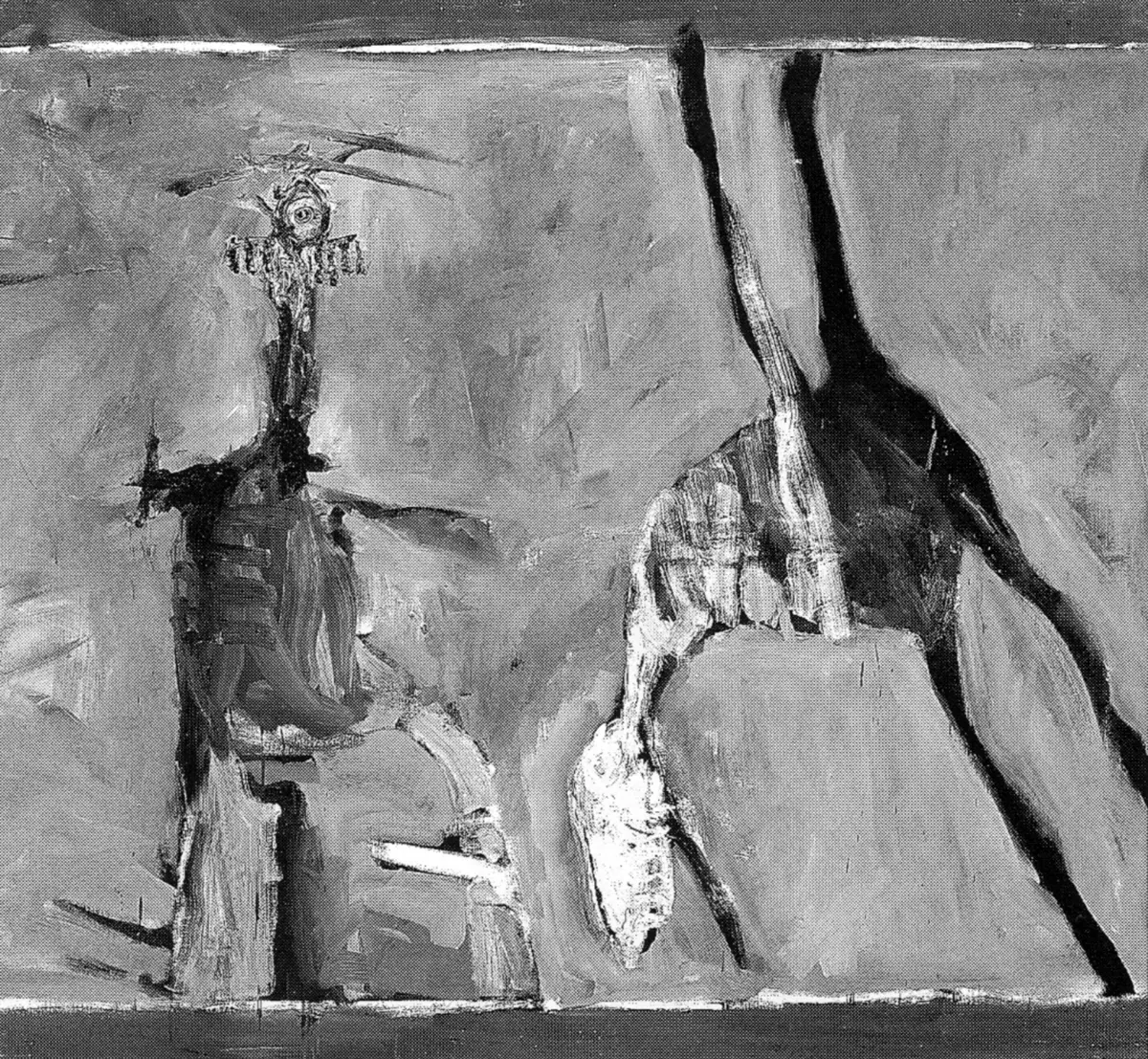
A first glance at his paintings puts the observer in the proper mood. In this period, De Narváez’s palette is predominantly ochre, focusing on hues that veer from the earthen to the blood-like. One is almost under the impression of having stumbled into Lascaux or Altamira for the first time and feels astounded by the encounter of pigmented animal representations upon the rough rocks. Their texture makes them inescapably present, forcing the gaze to lock in their direction and enveloping the observer, who struggles to identify diffuse characters that lack recognizable elements.
Two beings face each other in life’s perpetual confrontation. For birth, for love, or for death. Two male beings the instant before the clash that will grant only one of them the right to perpetuate the species; male and female before copulation, conscious of being at the origins of love’s path, of passion and the pain of existence; bull and bullfighter; man and beast taking each other’s measure in a ritual that invokes all the power needed for the hunt. Och re-colored figures speak of blood and life. Some of these savage beasts resemble prehistoric species familiar to our imagery, who in all certainty journeyed, like us, from birth to reproduction, and death.
De Narváez chooses to analyze human behavior through the representation of animals, thus avoiding the positioning of man in a higher plane (as was done with Christ). Animals are innocent. The artist uses emotional archetypes that are common to our collective memories to render on the canvas his personal frustration. Lacerated bodies reflect the constant violence of human life. Passionate relationships, infidelity, dissatisfaction, and suffering all of them reach the observer through the tension between those two beings; these are the demons De Narváez is trying to exorcise in his work. When asked about his palette, De Narváez likes to talk about his mental state as intuitive conduits. He describes it more like a form of pleasure than a language. There is no premeditation in the choice of colors. Consciousness is abolished here. For him, the sense of taste is to the vulgar as knowledge is to the aristocracy. Knowledge subscribes to ignorance. Taste cannot be an instrument of judgment. His intuition, however, meets the ancient meaning of some colors. Red is life, blues, and greens relate to shadows and death, and their interaction has to do with ancestral symbolism for the representation of glorious and incorruptible flesh, for which life is nothing more than a temporary state with intimations of death.
Showing in London has emotional significance for De Narváez, as this is the city of the London School, the place that determined Bacon’s, Freud’s, Auerbach’s, Kossoff’s (and his master Giacometti’s), commitment to figurativism.
TATIANA VILLEGAS ZAMORA