
The rhythmic movement of the sea shelters the secret depths of the ocean and reveals, at the same time, particles of all sorts of living species and remains of inert objects that are washed ashore at every repeated break of the waves against the sand or rocks. Deposited along the coast, these live and barren residues find a comfortable resting place and gradually begin to mingle with what surrounds them: precious and ordinary stones, sea shells and crabs, jellyfish and squid, sea horses, starfish, seaweed black and green, marine plants, and so many other species of things and creatures that beguile our imagination. As the sea sucks the waves on the coast back into the ocean a plethora of tiny pores opens up to breathe in the sand and reefs. Signs of amphibian life, invisible to the naked eye, manifest their existence for an instant, before being submerged by another wave again and again and again. This unfaltering intimacy of the waves’ repeated impact against the seashore slowly erodes and scrapes off layers from the rocks’ surface and continuously transforms the land’s topology. Like an endless, subtle mutation. Like the daily peeling of our skin. There is always another layer underneath. However, it is not a new uniform layer but an anachronous amalgam of yesterday’s, today’s and tomorrow’s that meets and intertwines inextricably.
Beatriz Milhazes’s painting seems to celebrate the transformation of life by focusing on a play of multi-layered meanings that fuses nature to an extensive repertoire of man’s iconic representation of it. Rising with the 80’s generation of artists that revived a return to painting, Milhazes developed a visual repertoire consisting of numerous floral and arabesque motifs that maintained their objective singularity despite forming part of an integrated pictorial composition. Thus the rose was clearly delineated as a rose whether in bloom or in decay; frills showed off their several layers of carefully detailed folds; cashews, oranges, lemons, cherries and the lily were shaded realistically with a painterly fading resembling ancient frescoes; arabesque swirls and curls added movement and transparency to superimposed layers of intricate lace patterns and jewel-like decorations reminiscent of chandeliers and native Islamic, Iberian, and Latin American ornament and embroidery.
The artist’s painting technique exemplifies the compositional process of her visual repertoire: akin to a type of frottaged collage, Milhazes paints cutout plastic motifs with acrylic paint which she then peels off and pastes onto the canvas, reducing the paint’s natural gloss and smooth finish.
In the five paintings exhibited in April at Galeria Camargo Vilaça, São Paulo, the collage elements of her previous works have given way to a more unifying dilution through which such motifs have lost much of their iconic detail and attributes. In O Buda (The Buddha), for example, the lily symbol of peace and innocence has become more stylized and coarse, gaining a sexual confidence that before was a mere innuendo. The bottom part of the painting is cut by thick horizontal lines that descend from near black to Mediterranean blue, adding a strength of abstraction that is echoed in the plain arabesques and concentric tree rings. Where have the lace patterns and embroidery gone? The blue rose in the center has lost the contour lines that define its petals and immediately classify it as a rose. Plain-colored stars humorously twinkle amidst a psychedelic sky inhabited by hearts and girlish daisies. In these new paintings, when a particular motif preserves its iconic identity, it appears as an isolated icon that seems to be lost in space. Such is the case with the red cashew nut encapsulated in a green circle, in A Conversa (The Conversation) and with the peace symbol in Jarro com limoes, laranjas e rosas (Jar with lemons, oranges, and roses). Replacing the perianth of a daisy, the peace symbol seems to have been dropped there by accident as its formal rigidity contrasts with the evanescent smoothness of the green and purple roundelay flowers underneath. A formal tension is created through the careful arrangement of each layer and sub. or inter-layer, which suggests points of greater chromatic concentration and plastic density while evoking a sense of circular expansion towards the edges of the canvas. This is especially clear in O Retrato (The Portrait). A purple daisy expands concentrically in circular layers that end on refractory blue and gray lines in an arrangement that brings to mind a kaleidoscopic image. Fantasy and geometry remit to 60s psychedelia in Moinho Vermelho (Red Mill) where the relation of color and line shows a greater concern with the formal qualities of painting.
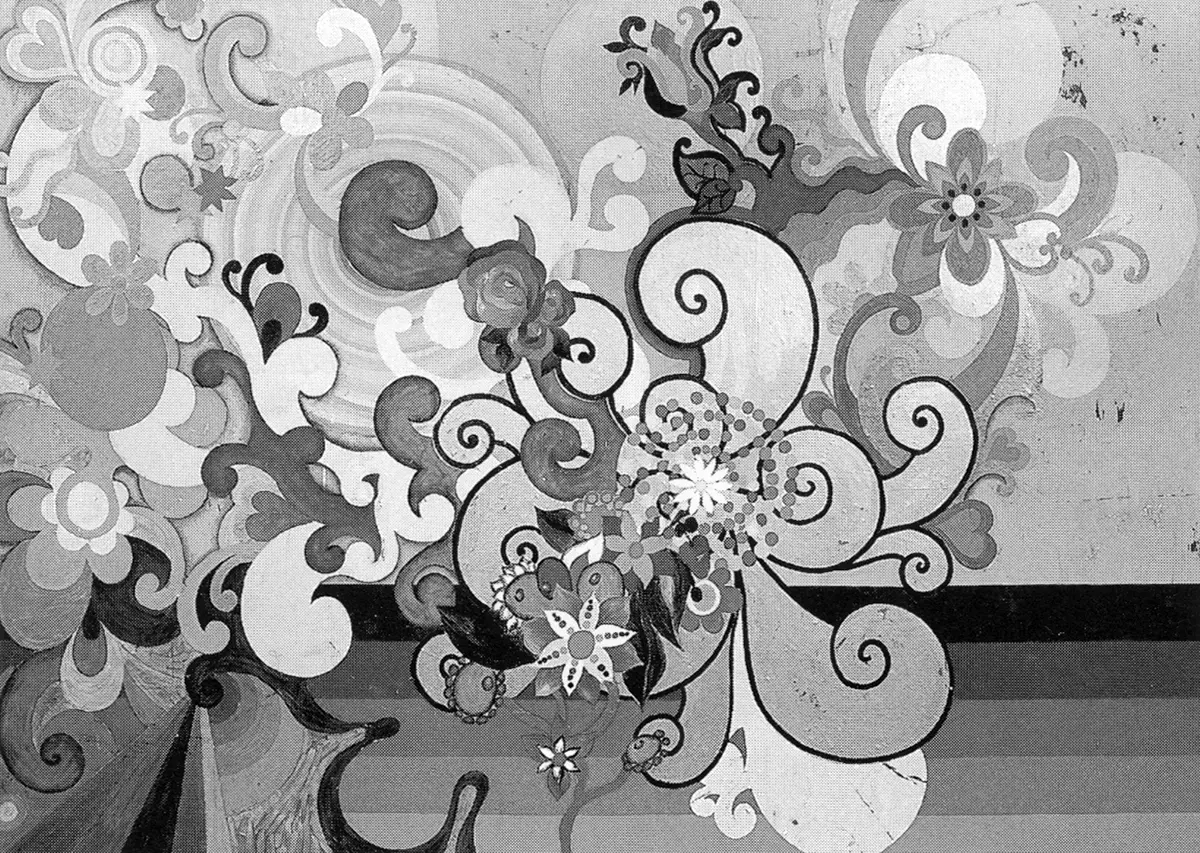
Straight lines and plain rings lose themselves under brushed green leaves, hearts, stars, colored dots, and fruity motifs while curls, hexagons, and arabesques meet on various layers to form "curlagons" and "curlabesques." In these works, Beatriz Milhazes portrays the transformative power of relations and explores different levels of associations in which no element maintains its singularity when coming in contact with the other. Like the shells deposited on the shore that crumble to form part of the sand or stick to rocks and coral reefs and are fossilized. Like two or more waves arriving separately towards the shore which suddenly hit against each other forming one big wave or breaking altogether.
VERÓNICA CORDEIRO