
The director of Aachen’s Ludwig Forum and the curator general of the exhibition, Continental Shift had as a goal the proposal of the first common project (in this region) among three countries linked by similar problems derived from their geographic proximity (a premise based on one of Wolfgang Becker’s ideas). These countries are faced with similar economic, social, and cultural problems. They also share problems raised by the idea of “border,” in spite of the reality (still somewhat “virtual”) of the Schengen Space which has come into force in Europe during the ‘90s. The show was carried out in four cities: Maastricht (symbol of European unity) and Heerlen, in the Netherlands, Aachen, Germany, and Liège, the capital of (French-speaking) Belgian Wallonia. This type of approach is already a reality in a region in which the Rhine River has for centuries been the federation of a common cultural crucible between Germany (Cologne), Switzerland (Basil), and France (Strasbourg) in order to limit us to the cities which are currently most representative due to their cultural and artistic dynamism. In the case of a typically European project such as Continental Shift, the beginning of a common cultural cooperation had as its goal to induce the idea of the disappearance of borders, erasing national separations. “To acquire an awareness of community and an identity endowed with meaning in the conglomerate of the European Rhine-Maas region” became one of the greatest goals of this multicultural and pluri-geographical show.
The European idea placed at the heart of the exhibition advocated at the same time the vanishing of borders and the disappearance of their effects on cultural and political nationalisms. On the other hand, it invoked the reconstitution of a larger space, at the same time symbolic and real, proposed by artists and their creations through exiles and migrations that serve as a metaphorical pedestal for their imagination. This cultural project had a double interest: in the first place, because of its artistic dimension (for Wolfgang Becker, Continental Shift “seeks a new iconography of continents developed by current artists”); and in the second place, because of its political dimension, expressed in the group discourse of the mayors of the four aforementioned cities. Its common declaration showed the desire to erase disparities in order to head more toward Europe and, in this way, to have more of a presence in the world.
The Ludwig Foundation was created in 1966 by the German businessman Peter Ludwig, who began his collection with pop art from the United States. Since the ‘80s, he has been interested in artists from Eastern Europe and Latin America, and he opened a branch in Havana in the early ‘90s. His permanent collection is in Aachen, especially in Cologne, making up one of the most important collections in Germany. In Continental Shift, the works (paintings, sculptures, and installations) of eighty artists are spread out in four geographically and nationally differentiated places but symbolically tied by the federating concept of the show. The artists, originally from three continents, work in capitals or cities like Berlin, London, Paris, Brussels, Barcelona, and Hamburg.
My goal is to comment on the Latin American representation, evoking the presence of artists from other countries, in particular that of the Asian artists, strongly represented in the space of the Ludwig Museum of Aachen. Curator Annette Lagler selected nineteen Latin American artists, while forty-one Asian selected by David Galloway (China, Taiwan, Japan, and Korea) formed a majority core compared to the group of artists hailing from Africa and the Middle East.
The exercise of such a confrontation is refreshing for the gaze and the intellect. On one hand, between national origin and the experimentation of the workplace; and on the other hand, between the artists from different continents and cultures. This idea allows us to report the concerns of the artists, which are not only personal questions, but also sociological and formal, situating their anchors and openings, and demonstrating their desire to find a place in the mobile and often uncertain terrain of contemporary art. This option prevented them from being close to their places of origin, at the same time as it situated them in the contextual space where the dialectic of cultural experiences can be fully developed. In the paintings, sculptures, and installations of the nineteen Latin American artists present at Aachen, we saw the expression of the desire to integrate into the modernity in force in Europe. However, the questioning of culture and the role that culture plays in its transplanted creation was not renounced. This double core of inspiration pointed to the conceptual and formal center of their art, in accord with a productive dialectic that allows them an opening toward a new distribution of their works.
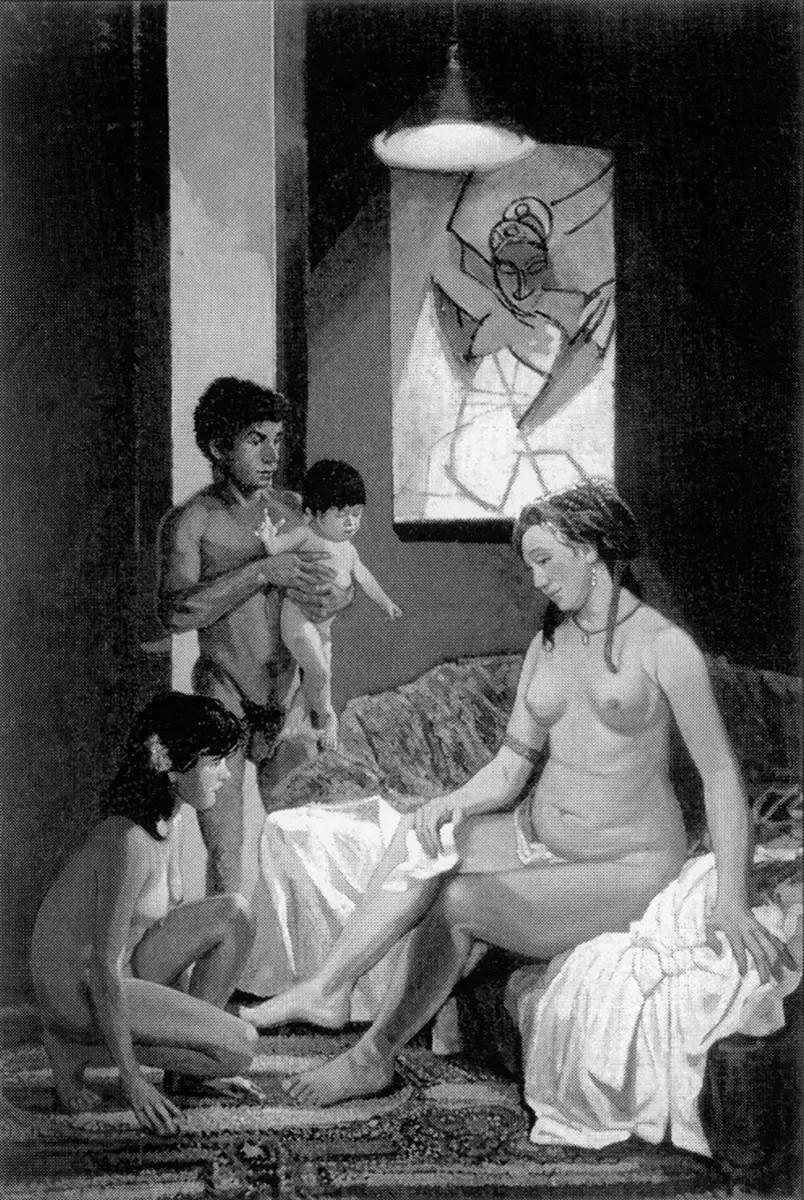
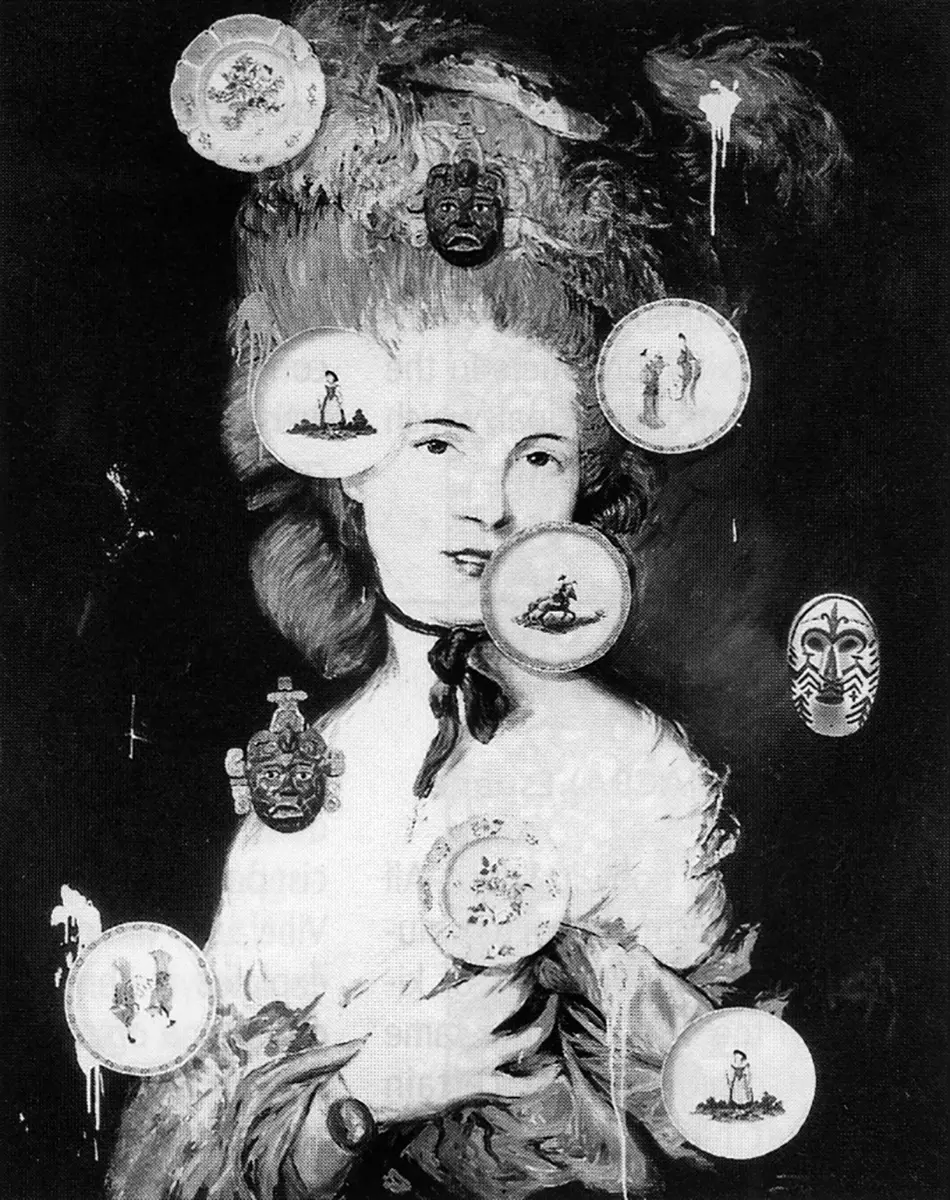
The conceptual and museographical construction chosen by the curator was based on a series of themes observed in Latin American art into which artists and their works were incorporated. Two emblematic artists serve as points of departure for the visit inasmuch as they are references of the history of the influences in the art of the continent throughout the twentieth century: Wifredo Lam, with three works on paper; and Lygia Clark, with the same work in two different versions. Their scant representation gives a somewhat reductionist taste to the “introduction,” although the goal of the exhibition was not to present a historical panorama of Latin American art. The general concept and the museography are articulated around four important themes: the first, called “The Archives of the Conscience,” refers both to art history, with paintings (from the ‘80s) by Peruvian artist Herman Braun-Vega and Mexican artist Alicia Paz, and to daily imagination through painted objects by Colombian artist Ofelia Rodriguez. Later, we approach a more provocative section called “Object Archive,” which shows paintings and objects realized by the Brazilian artists Julio Villani and Milton Machado, dealing both with the memory of personal identity and of cities, in this case, London. For her part, Betty Leirner throws us into a virtual space of sounds in which the recordings of her own voice in different languages cross the words of her texts presented on the walls.
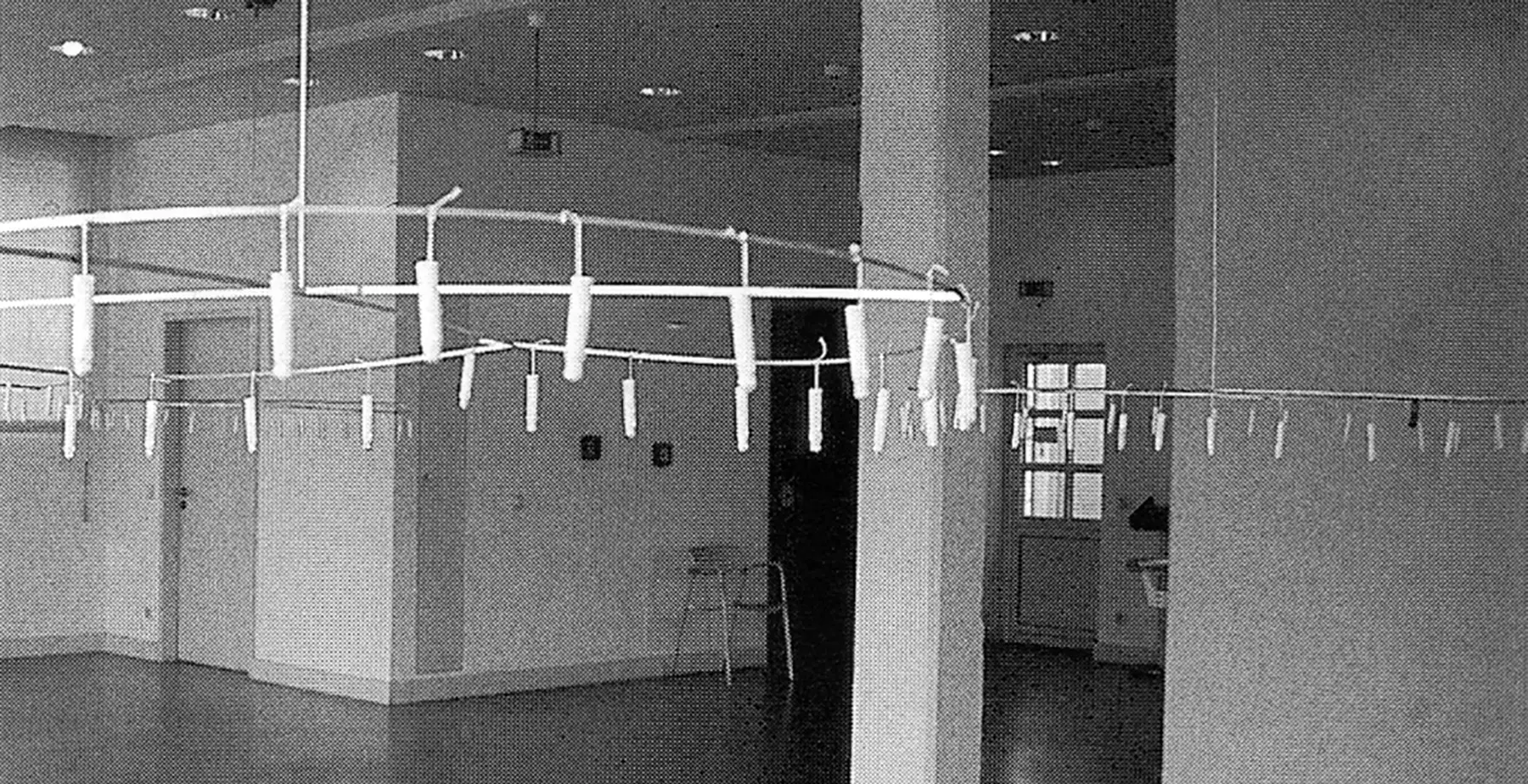
Above, a somewhat crude installation by Colombian artist Oswaldo Macia lets off an indefinable and rather repulsive odor. His goal was to evoke, through intermixed smells, the variety of cultures and their permanence in time. To illustrate his aim, he chose to exhibit various tampons suspended on a sort of rotating chandelier, impregnated by more than two hundred essences, just as the Buddhists install incense in their cultic places.
The second topic tackles “Body and Alienation” through breathing sculptures by Pablo Reinoso (two works, one of which is a variation of his Meninas, shown at the FIAC in 1999), animated objects by Jack Vanarsky, installations by Maritzu Otondo, the very interesting Lucia Nogueira (who unfortunately passed away in London in 1998), and Miguel Rothschild. This last artist proposes (in a work previously shown in Berlin) a meditation on pain and pleasure: his bed covered with Band-Aids suggests suffering and wound, while a sensual armchair with a thousand mouths invites an infinity of kisses. For her part, Frida Baranek created especially for this show a work in the form of a hammock, made of interlaced bronze and latex, called Tenor, sentimental, álbum, gala, fatal, veto, élite, moral, brutal. The space reserved for Argentine Jack Vanarsky had allowed him to present a series of works organized in an “installation,” under the theme of “The Geography Lesson”: animated books on school folders, butterflies hanging from the walls, or prisoners in bottles that wait to be thrown into the sea, a fake map of geography.. . a group of evocations that create an atmosphere at once nostalgic and poetic.
For the third topic, dedicated to “Games and Sarcasm,” the installation of Brazilian artist Daniel Chust Peters invites children to take possession of a wooden construction that allows them to play both inside and out. The gastronomic-cultural performance by the couple Vincent+Feria (Elohim Feria and his wife Françoise Vincent)—couples are definitely style—fluctuates between play and cultural references. The artists decided to distribute hallacas, a type of Venezuelan-filled pastry, in the course of an “evolving installation” (to use their terms) which is planned to last several weeks, constantly changing. In the two presentations of this section, we wonder where the sarcasm is hidden. To finish off, the fourth topic, under the title “Finale: The End of Nations,” attempts to introduce the idea of the disappearance of the beginning of political and artistic nationalities. This is illustrated by Argentine-Thai artist Rirkit Tiravanija and his popular motorcycle taxi, as well as by different works from Peruvian Jota Castro. This artist questions society in his series of transgenic products of consumption, at the same time as he attempts to make the public participate, proposing that they express their ideas on the meaning of Europe.
The project posits the idea of the disappearance of nationalities and the discovery of continents, which does not impede confirmation that the concern for national belonging is far from the artists’ conscious memory. However, the concern for a more or less absorbed (national) culture turns out to be an idea that contains values and resistance, as well as artistic imagination. The merit of this show is grounded in its will to place artists from continents alien to Europe face to face, which allows the visitor to decode his singularities and cultural common threads. The exhibition also helps to appreciate and discover artists who have chosen to live and work in the old continent. This is the case of the important Asian contingent, with installations by Japanese artist Chicharu Shiota, and the interwoven threads from the floor to the ceiling by Chinese artist Chen Zhen: boxes and pianos with stretched skins that were shown at Aperto, Venice Biennale (1999). The Japanese artists Takashi Murakami and Mariko Mori, marked by comic strips (manga), advertising, and pop art, also stand out, as does Tazro Niscino and his fake-authentic Hotel Continental, built with containers in the plaza of the Teatro Municipal, which is able to receive real clients.
A political as well as a cultural project, Continental Shift claimed itself, first and foremost, as a European project. An exhibition of this caliber and of this importance also constitutes evidence that grants its cards of nobility to a Europe that continues to be, through history, an artistic and cultural magnet for all creators. The show gives proof of the interest that Europe stirs up among plastic artists of diverse horizons, thirsty for encounters and mingling; but it also manifests a part of what the artists feel: finding here a freedom of creation and circulation in a different time and in relative autonomy regarding the demands and limitations of the North American market.
CHRISTINE FRÉROT