
Under the simple title of Obra reciente (Recent Works), the Galería Mendocal in Mexico City presented a sampling of Daniel Lezama’s (Mexico City, 1968) work. Before the spectators stood some of the most revealing pieces in what could be seen as an intense current within contemporary visual arts which aims at restoring the old recipes for the realization of a type of painting whose orthodoxy and academicism do not detach themselves from the most rigorous canons of fine arts in this discipline.
Although Lezama is not quite a voluntary rescuer of painting, it is true that, on the one hand, he has chosen it as his main expressive vehicle, and on the other, through it, he tells us some of the stories that delighted his imagination as a child. In adulthood, he reworks and proposes with contemporary eyes and old memories. That’s why in some of his canvases we find some of the most well-known myths in Mexican popular culture, recreated in an evocative manner and with a strong pictorial element rarely seen among his peers.
Let’s say that Lezama has chosen the difficult path, the one of telling clearly the stories that few wish to know. La Muerte Del Tigre De Santa Ana (The Death of the Tiger of Santa Ana), for example, is one of his capital works. There we see the reconstruction of the story of a man who, it is said, was a thief and rapist who extorted those who knew his whereabouts in order to keep them secret. One day he’s caught while defecating and the town lynches him in revenge.
Even though the story has other turns, Lezama’s painting rescues the moment in which a woman washes a naked boy’s bloody arms while a small girl, also naked, kneels before the body of the Tiger of Santa Ana fatally wounded on the chest, his pants pulled down to his thighs. It’s a new reading, hard and merciless, to one of the many stories populating Lezama’s memories, and seen and I think this is the essence of the issue stripped from ornamentation or scenery.
Lezama’s works go beyond the scenes he proposes in his pieces. In them, something’s always about to happen. The characters and their positioning in the pictorial plane tell us of environments in which everything is being, where the spectator witnesses the precise moment in which something is happening or about to happen.
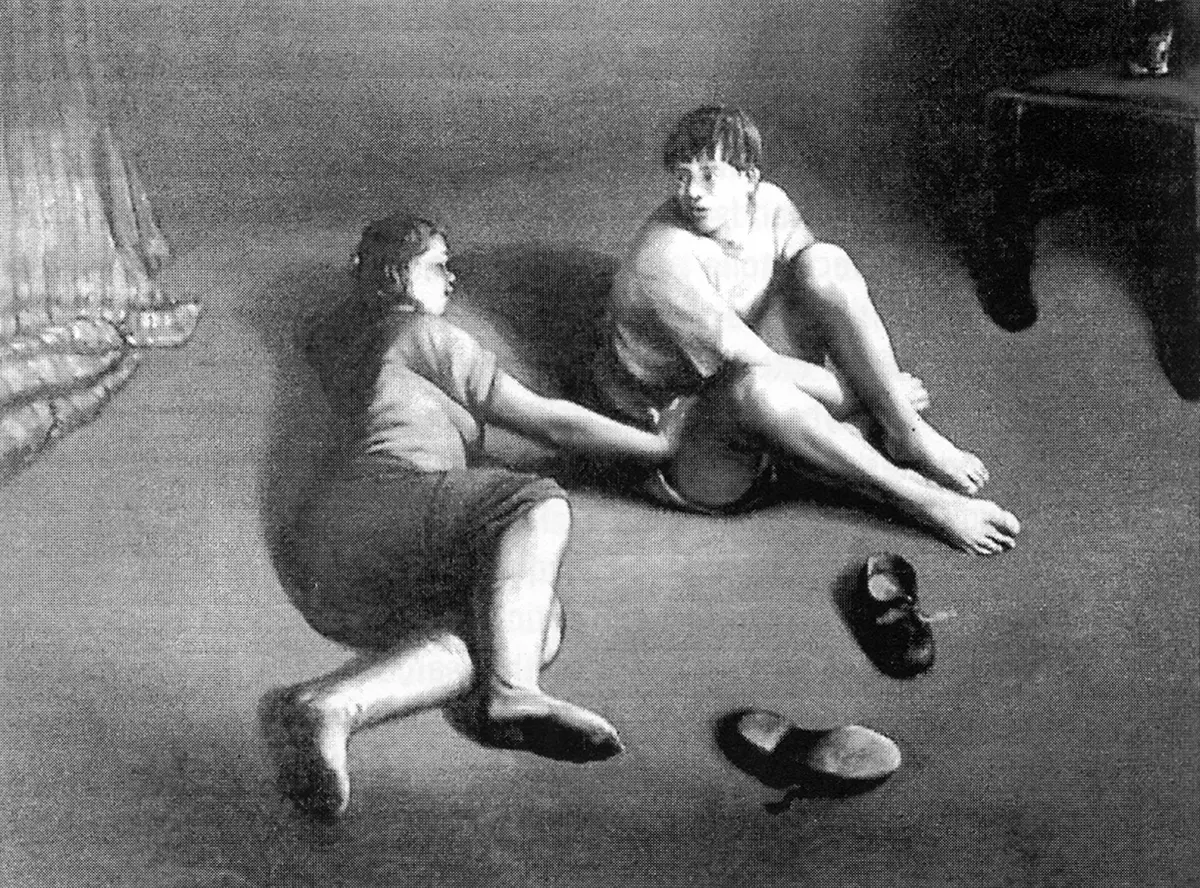
The protagonists’ sexuality is also a recurrent theme. In pieces such as La conversación (The Conversation), one of the most inciting pieces, two adolescents seated on the ground, inside the solitude of the space they inhabit, an encounter between a couple, where she delicately touches the boy’s thigh after he has taken off his shoes. The encounter, inevitably disquieting, leaves before us a situation in which we are privileged witnesses.
In the case of Baño (Bath), where among a group of people belonging apparently to the same family, we see, seated, a heavyset mature woman carrying a baby on her left arm; her right arm is extended, her hand touching a small boy’s pudenda. Although the boy has his back turned toward us, we can see his tense face reflected in the mirror in front of him. An older man to the right of the composition, accompanied by two youngsters in underwear, points to the other scene, his magnificent hand placed on the center of the canvas.
Among the virtues of this painter, we find the use of light, an element which readily identifies him. Almost all his compositions have an irradiation of light as the visual center. Aside from giving clarity to the cam positive display surrounding it, this center highlights the painting’s motif as it occupies the center of the scene.
As someone who’s very familiar with the paintings of Holbein, Mantegna, and Goya to mention just three who wink at us from the canvas Lezama has known how to take from them some way of storytelling, of speaking through the painting, even though the selected themes are byproducts of his personal imagery, which is not at all devoid of a fascinating perversity.
We are before a painter who has conceded little to those who want to see bucolic scenes or mere reconstructions of a contrived, complacent reality. That’s why he also paints what is supposed not to be seen, as in the case of Las tentaciones de San Antonio (The Temptations of Saint Anthony), where a group of ghostly figures inhabits the upper part of the painting, or in La pelota roja (The Red Ball), where a child’s fears and fantasies have materialized. The boy enters a room to get his ball back, without imagining that behind him are his nightmares and apprehensions.
Not only that: but surrounding Lezama’s characters are all those different ways of sexual initiation continuation or confrontation. All who have been seen by him have to go through the hard test of directly confronting his painting, which is hard and merciless and it presents everything, even the unimaginable, with absolute orthodoxy.
SANTIAGO ESPINOSA DE LOS MONTEROS