
It is evident that contextualizing the work of many Latin American artists in places like New York is particularly difficult, especially if we wish to create an appropriate frame, one free of arbitrariness and interpretation. Though this may be obvious, the effort of problematizing the context and trying to discern the roots of the question that a work can bring is not so common. Misunderstandings especially tend to take place when artists develop certain visual codes that, although easy to recognize for a public limited in its surroundings, lose their radical meaning when they are shown elsewhere or before a new public. As a commentary on this, and perhaps as a group exercise, curator José Roca brought to New York the work of six Colombian artists, presenting in the process pieces that challenge the viewer precisely when they lie outside their place of origin.
The dialectics of contextuality fluctuates between the excess of information and the absolute lack of it. And these two extremes make up the poles between which curators, critics, and historians try to situate the coordinates of a particular work.
While on one hand, the stubbornness to specify biographical and historical details of a work tends to be a recipe for a categorical, and somewhat rigid, interpretation, on the other hand, the misunderstanding of historical and social coordinates usually results in varied, but possibly disoriented, interpretations for an uninformed viewer, as this exhibition demonstrates. Define context gathers the work of Colombian artists who make comments intimately related to the political and social reality of their country. Perhaps the best-known member of this group is Colombian artist Antonio Caro who, for several decades, has created works that are characterized by a fascination with cultural symbols and whose re-creation turns out actions that are sometimes ironic, sometimes commemorative, but never sarcastic. In his work Colombia (1976), Caro simply wrote the name of his country with the Coca-Cola logo, skillfully linking the drug trafficking market with Yankee imperialism. A piece that the artist painted with achiote directly on one of the walls of the gallery—which had to be mounted after the opening since Caro was refused a visa and was not able to arrive at the inauguration on time—consisted of the recreation of the signature of a famous Indigenous leader, Manuel Quintín Lame. The re-creation of Lame’s signature, which in itself is elaborately visual is a direct and unequivocal gesture for recognizing the importance of an indigenous leader and the meaning of the indigenous movements in Latin America in pursuit of a voice and votes in their respective countries.
Caro’s strategy can be seen as an iconoclastic practice in the spirit of artists like Warhol, Rauschenberg, and Lichtenstein, who recognized widely identifiable icons in their environment that, when recontextualized, demand a critical re-evaluation of their meaning.
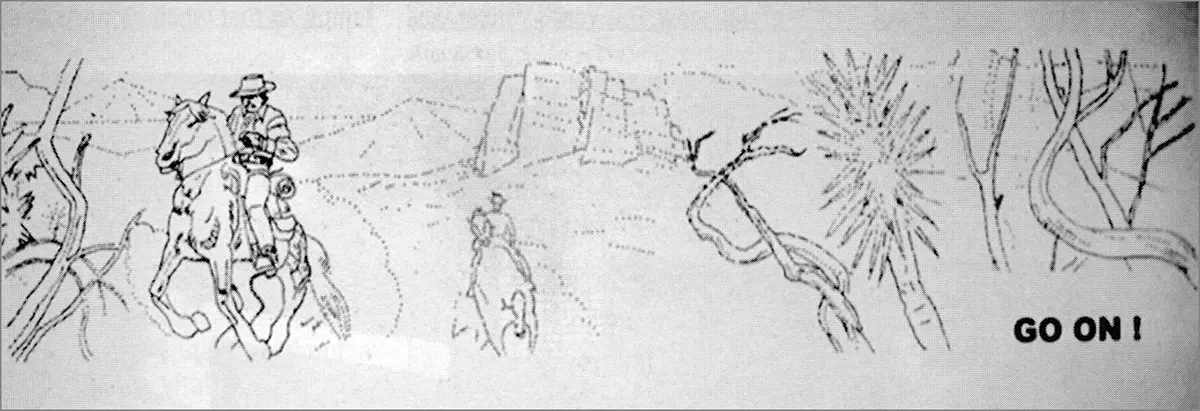
In the same discourse of playing with symbolism—both of materials and iconography—Miguel Ángel Rojas presented another piece mounted on the wall of the gallery titled Go On, a scene reminiscent of the American Far West, which could easily represent a cowboy taken out of the Marlboro ads. The drawing is made of a series of “points” that, when seen up close, turn out to be circles of coca leaves. Its references, as in the case of Cairo’s Colombia, are evident for anyone familiar with the delicate relations between the United States and Colombia in terms of the problem of drug trafficking.
For his part, Alejandro Restrepo raids the historical context of the foreign perception of Colombia in his work titled El cocodrilo de Humboldt no es el de Hegel (Humboldt’s crocodile is not Hegel’s crocodile). In this installation, the artist compares two commentaries of two German figures from the nineteenth century regarding nature as a metaphor for the “inferiority” of the American continent. While Hegel speaks of crocodiles and other animals as weaker beings than the Europeans, Humboldt mockingly refutes him, giving the dimensions of an Amazonian lizard that reaches 25 feet in length, a size that is marked in the installation. Restrepo alludes to the classical stereotypes of foreigners toward Latin America, and especially to the erroneous generalizations that have grounded much of European perception of what this continent and its history are.
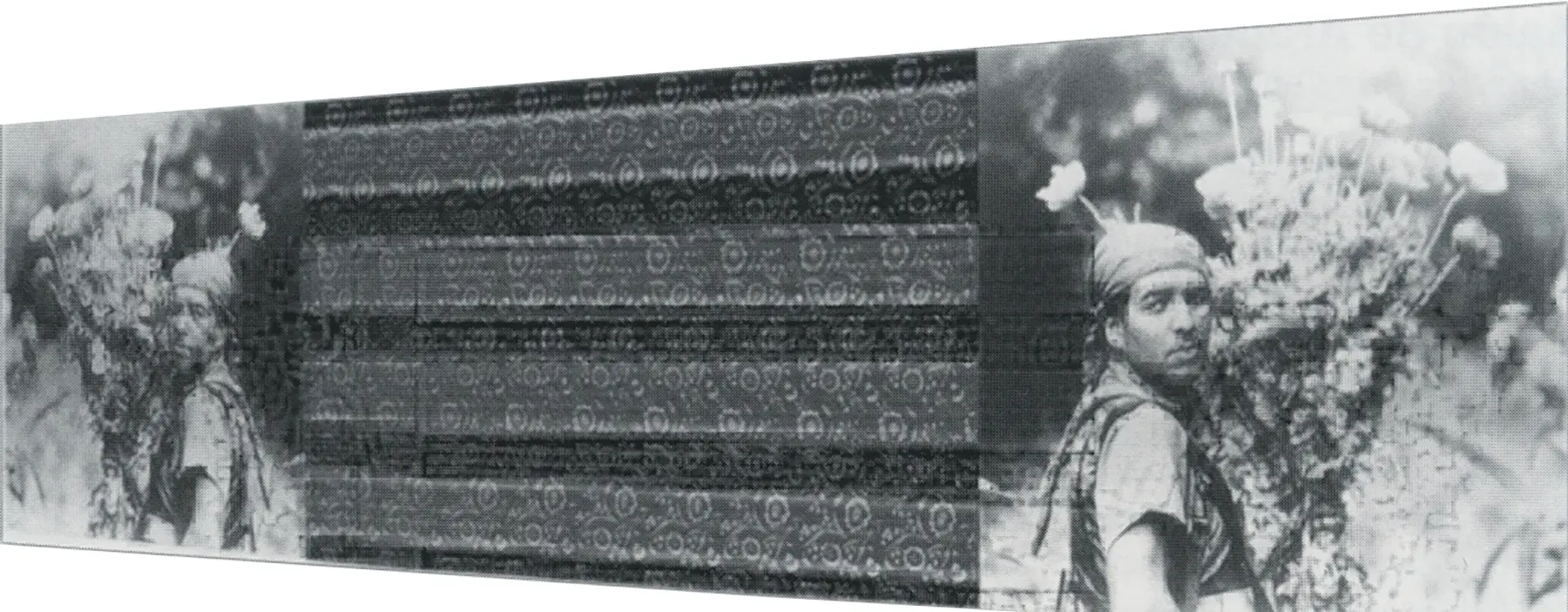
Delcy Morelos’s painting titled Rojos por naturaleza (Reds by nature) actually makes use of a reddish purple that, although attractive, makes direct references to blood, and therefore to violence, which is emphasized by the representation of a bucket that seems to explode on its surface, as if it had been shot. It is hard not to imagine this work as a philosophical representation of violence. Many works in the show give appearances that are usually peculiarly deceitful. The piece that Juan Fernando Herrán presents in this exhibition, for example, could well be confused with a romantic image of a Latin American indigenous movement, in the style of González Palma, so to speak: the work flaunts the photography of a mestizo with a bouquet of flowers in his hand, next to a piece of colored fabric. The subtle connotations emerge once we know that the image corresponds to that of a soldier in the process of uprooting a crop of poppies, prohibited by the government. The fabric included in the work, for its part, contains a half-hidden floral pattern that looks like poppies. The play with perception in this piece by Herrán is admirable, particularly because it proposes the idea (and at the same time it puts it into practice) that the struggle against drug trafficking is nothing more than a continual game of hide-and-seek between delinquents and the law. Finally, the body of work that operates like an effective contrast to the rest of the pieces in the exhibition is not that of an artist in the traditional sense of the word, but rather that of a photojournalist from Medellin, Jesús Abad Colorado, whom José Roca has included in the show. His direct and graphic images, which are seen by the entire country in various newspapers and publications, narrate the most tragic spheres of Colombian life and they demonstrate once and for all—if for some reason, this was not clear to the viewer by now— the works in this exhibition are attempts to analyze and understand a social reality that is too overwhelming to be ignored.
PABLO HELGUERA