
atom. [From the Lat. atomus] N. (...) All substances are formed by atoms, which can be grouped to form molecules or ions. (...) Brief space of time; moment, instant. cell.
cellula. [From the Lat. cellula] N. (...) Basic structural unit of living beings (...) The smallest unit of living matter that can exist and reproduce independently.
The consistency of Edgard de Souza’s production comes together at the small exhibition hall of the Galeria Luisa Strina. The installation evidences a complex web between the sculptures, photographs, and paintings. The same relationship works within each work: between identical bodies; between similar forms; between circles; between the human body and the sculptoric body.
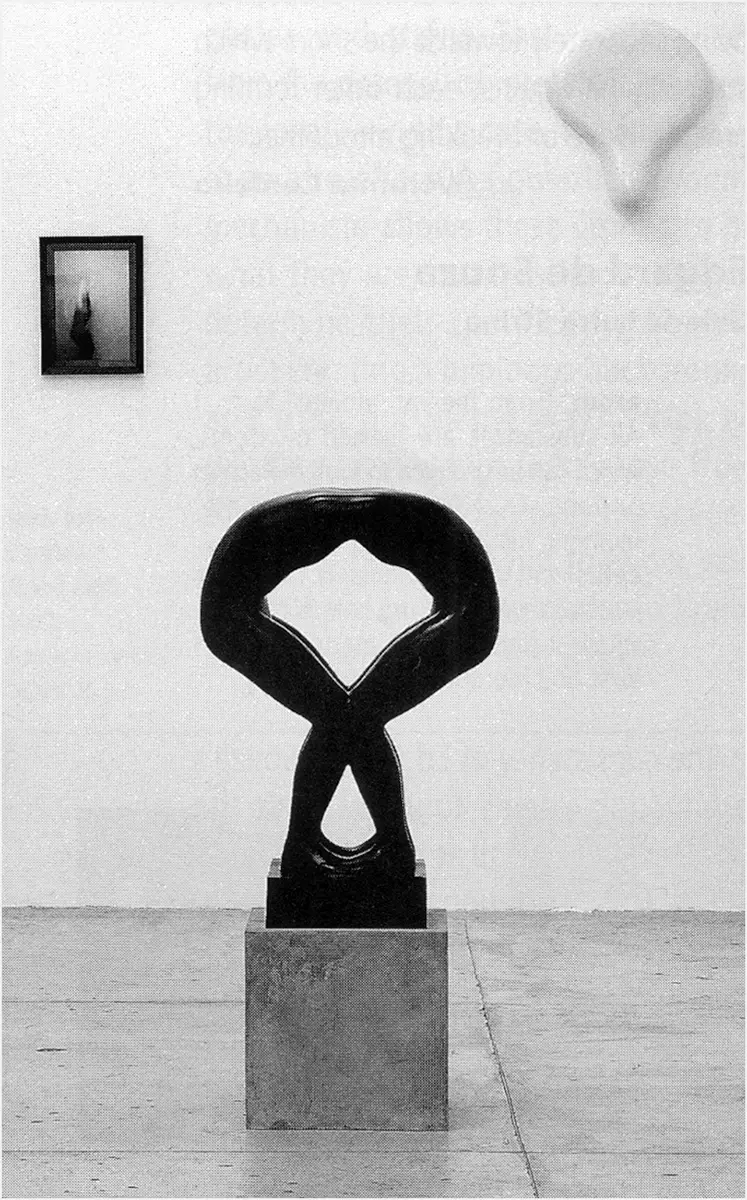
When we enter, we see a diversity of media and scales counterpoised in the environment. The four walls are covered, and in the middle of the room stand two sculptures. The first one depicts two identical male bodies, fused at the trunk, one reflecting the other, forming an arch. The idea of reflection, of the relationship between identical bodies, is recurrent in de Souza’s work. The duplicate body refers to the relationship between two people or between different aspects of an individual’s personality. In an apparent state of fusion, the sculpture also sparks the idea of a physical relationship between the bodies. But the solidification of a stage of fusion doesn’t let us foresee the next stage: we don’t know whether the bodies are in the process of duplicating or absorbing the other. The second sculpture, constructed by fusing together ten white spheres of approximately the same size, provides a reading that expands the understanding of the whole exhibition. The abstract shapes and the reduction to the minimum of formal elements take us directly to the structure: we don’t associate them to the shapes of the human body, which is a constant in de Souza’s work. Rather, we see a structure of identical pieces related to one another, similar to the representation of a molecular structure. From this piece, and in the relationship we find between it and the first figurative sculpture, we can understand each of the individual pieces as a system of relationships. And if we understand the sphere structure as an abstract scheme or plan, it’s possible to apply the system in different scales. We can think of any small part of a whole that, when repeated, forms a structure an atom, a molecule, a cell, a body.
In the exhibition, the relationship between the photographs and the fused male bodies is made quite clear. There’s a photo depicting the artist’s identical bodies placed in the same position as the sculpture, one reflecting the other, fused by the arms. While in the sculpture there’s no identification of a single subject, therefore there’s no guarantee that the repeated bodies are the same person’s, in the photographs we always recognize the same person in relationship to his identical. In the photos, we can read the repeated body as different aspects of a single person’s personality. Or, returning to the idea proposed by the sphere sculpture, we can associate the bodies as living elements splitting and generating identicals, as cells, together forming a larger structure, the body. A photograph placed behind the abstract sculpture brings forth the idea: three identical bodies fused together shaking hands, forming a structure of similar, interlinked pieces.
The innumerable relationships present in the exhibition make our understanding and perception of each piece be superimposed from one piece to another. If in the sculptures what appears to seduce us is their organic shape, their luster, and the way the materials are finished, the photographs are dominated by that very same seduction. The small paintings of purple-green circles also have the sculptures’ luster and seduction of the material. The scheme of circles, similar to the sculpture, represents the abstraction of the relationship between any element, where the pieces can be mentally exchanged and the system adapted to each new group of pieces. They can also be atoms, cells, or bodies engaged in intersecting and nonintersecting relationships.
Our gaze flows from one side of the room to the other, weaving a complex web of relationships between the different pieces. And for a moment we have the feeling of being inside a world in a state of fusion also, aside from the fused bodies in the photographs and sculptures, in the room there’s a huge pearl-shaped drop oozing from the wall, and another one sliding down. But at the next moment, the transformation, normally visible to the human eye, does not happen: everything remains unaltered. The solid pieces, made of lacquered wood, resemble an instant in the fusion, crystallized. The utilization of the photographic medium reinforces this idea by being intrinsically capable of eternizing the image of a moment.
We go back to the sculpture of spheres and to the idea of a structured composed of similar pieces in relationship to each other. From this sculpture, we can also read the exhibition as a structure whose pieces are interlinked in a web that we slowly begin to identify. From the molecular structure to the body, from each piece working under a system of relationships, we reach the totality of the exhibition a web of relationships that expands the understanding of Edgar de Souza’s work as a whole.
ANA PAULA COHEN